The plans to visit the Coastal town of Mangalore had been on the cards for quite a few years but was always refuted by the folks in the house stating that they were not keen on yet another temple tour.
Looked like my reputation at home was at stake, given the number of temples we visited during our recent drive to Kumbakonam in the month of September 2025 (read all about it in Part 2 of the Temple Tour https://jewelsofasia.in/the-grandeur-of-temples
Took a lot of convincing that the Mangalore belt was just not about temples but there was so much more to see like beaches, hilly terrains, adventurous drives through steep hair pin bends on ghat roads, backwater cruises, sea rides etc. There was one more pre-condition that they did not want to fly into the table top airport at Mangalore and thus it had to be trains both ways. 15 hours each way by train meant losing more than a day and we thus had to drop off a couple of important temples of Kukke Subramanya and Dharmasthala. Suited the family anyways. 😊
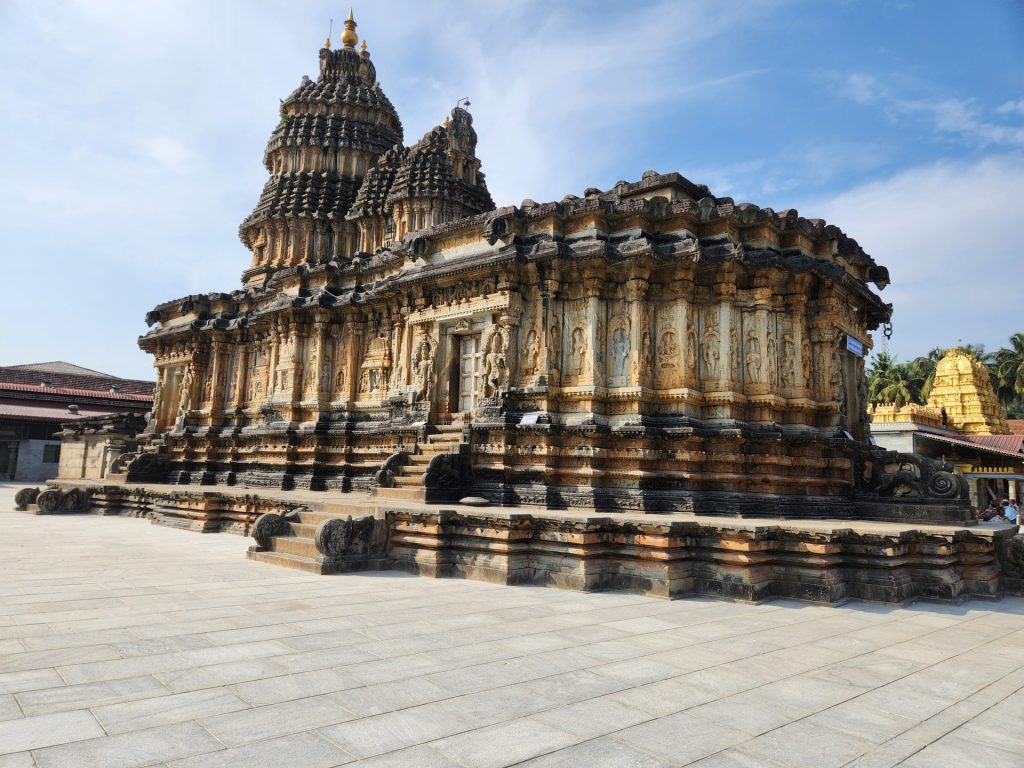
Serene Sringeri Temple
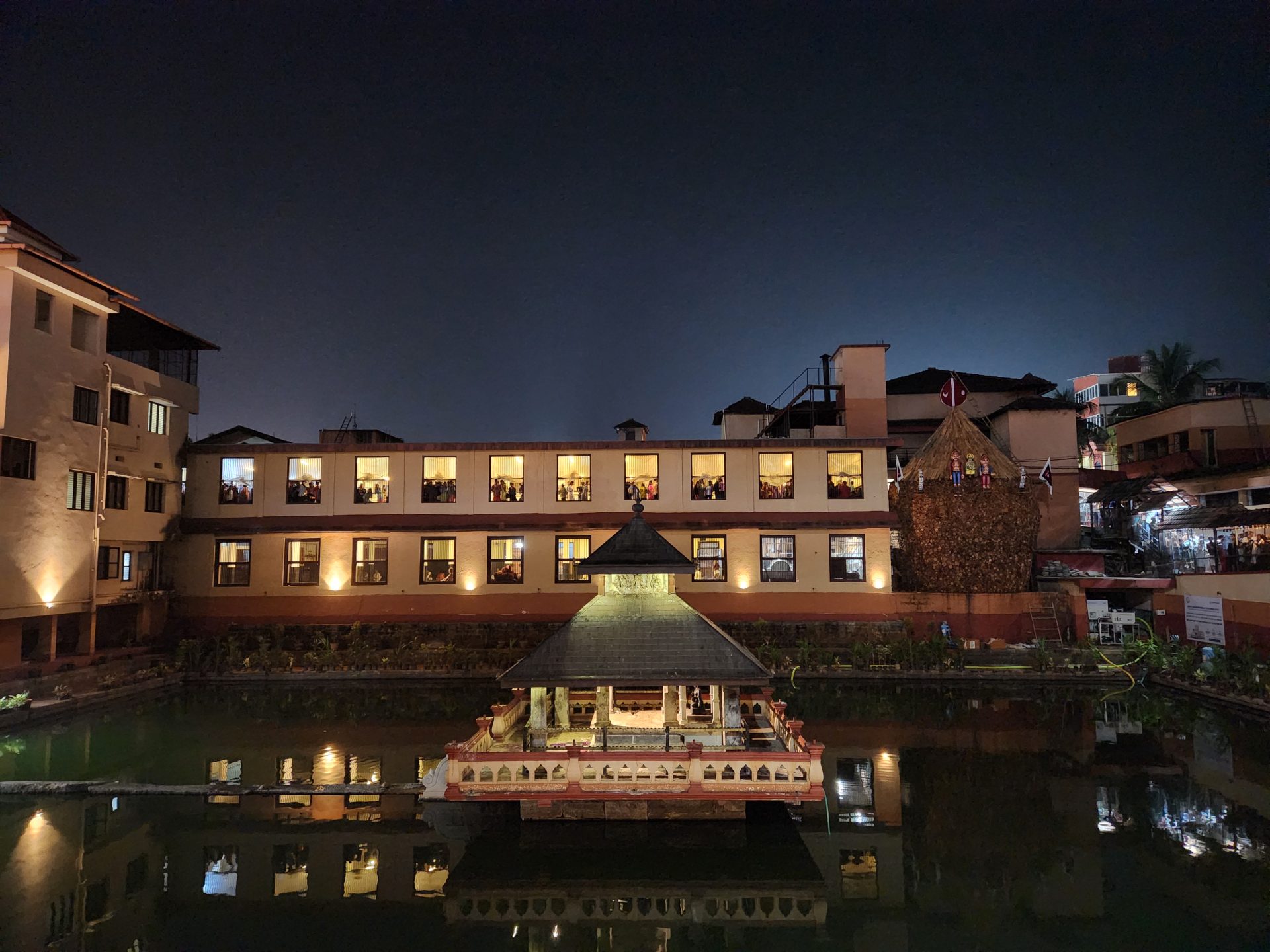
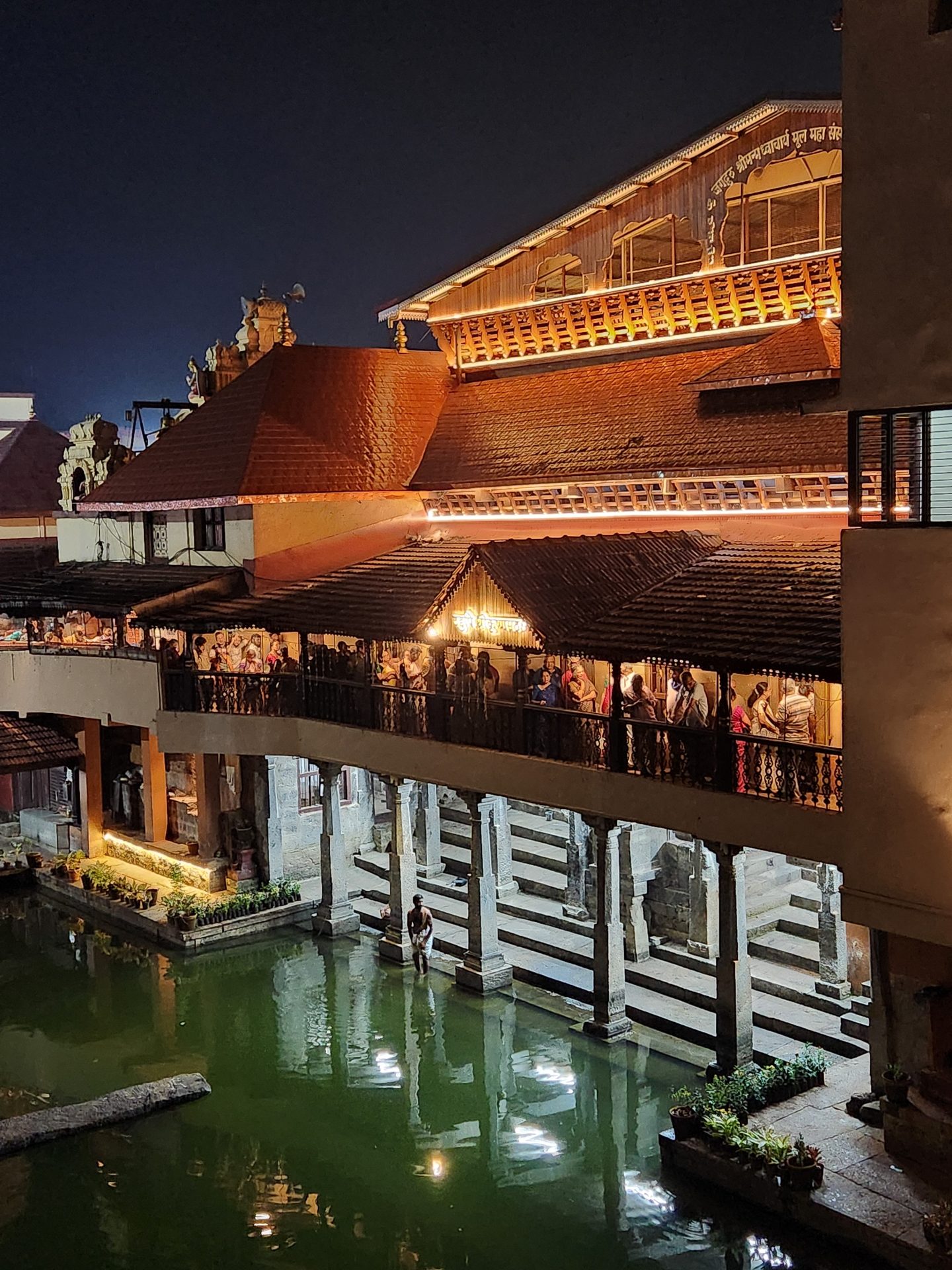
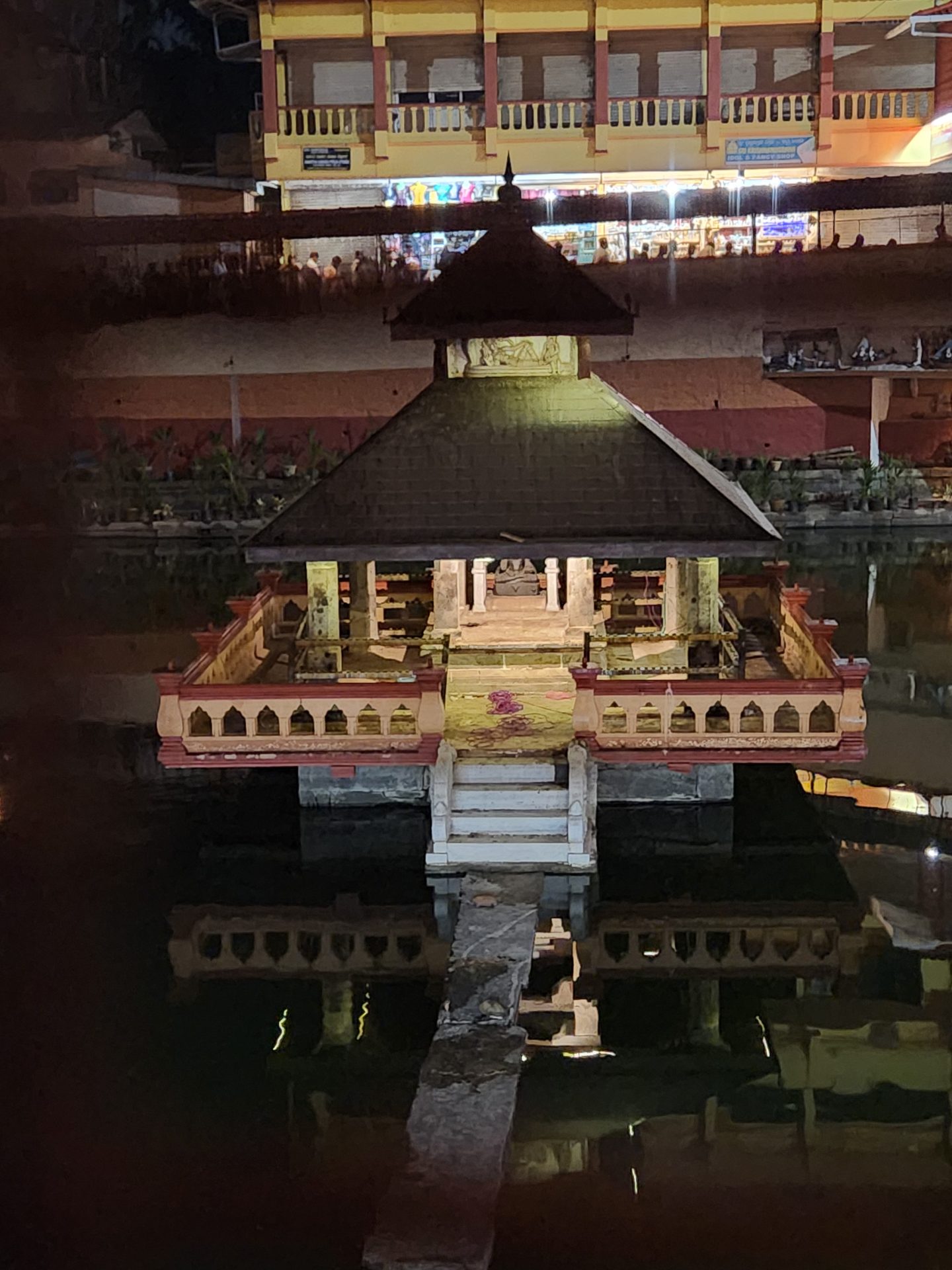
Udupi Krishna Temple by night
The Kapu Beach Lighthouse
Tea Garden near Kudremukh
Made a rough cut plan for around a week throwing in a lot of beaches, café hopping, hilly terrains, backwater cruises into mangrove forests thrown into the itinerary so that their interest was kept alive and while I kept juggling with the itinerary thanks to Chatgpt and the multiple sources from the net, squeezed in a few important temples.
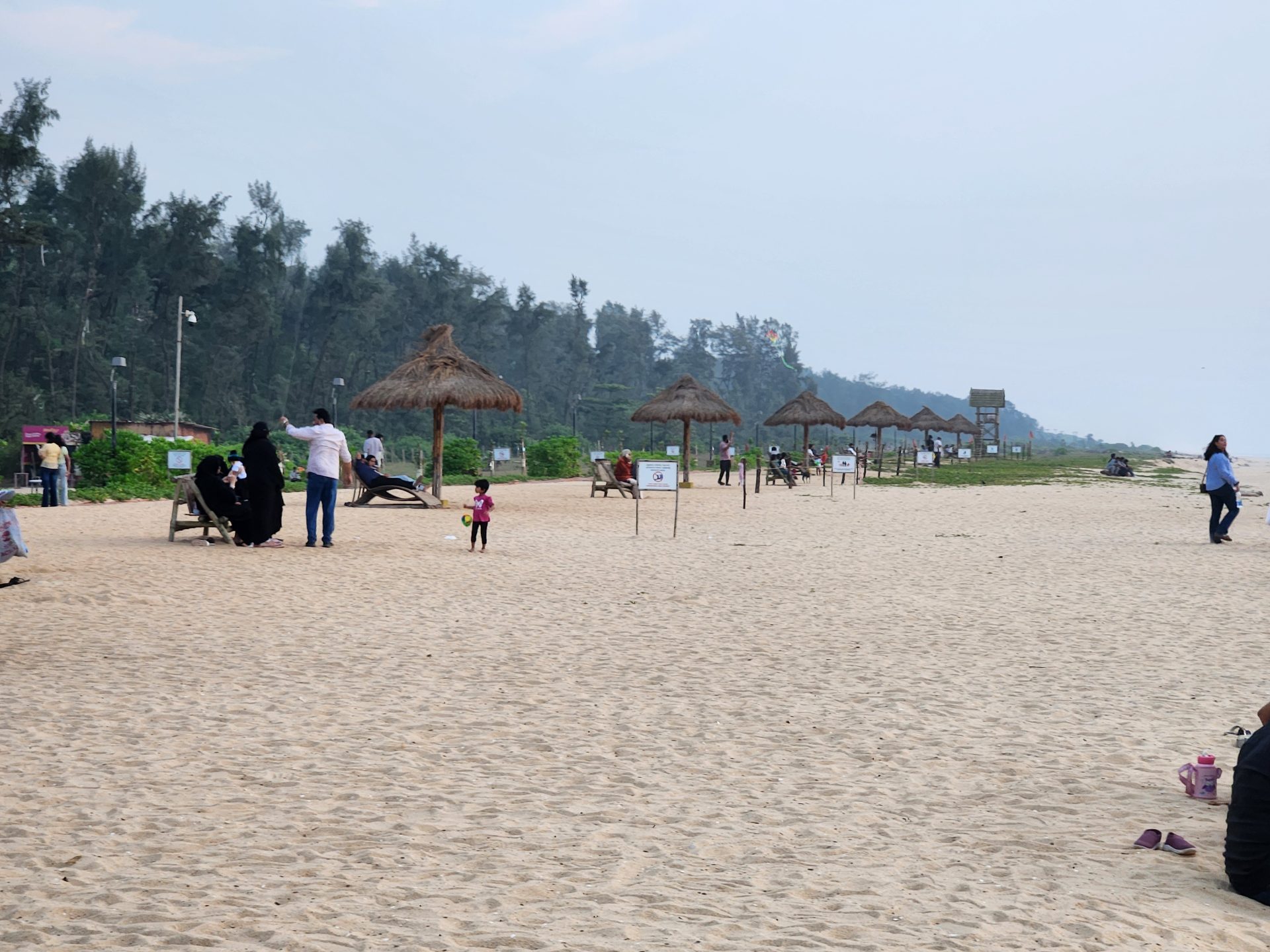
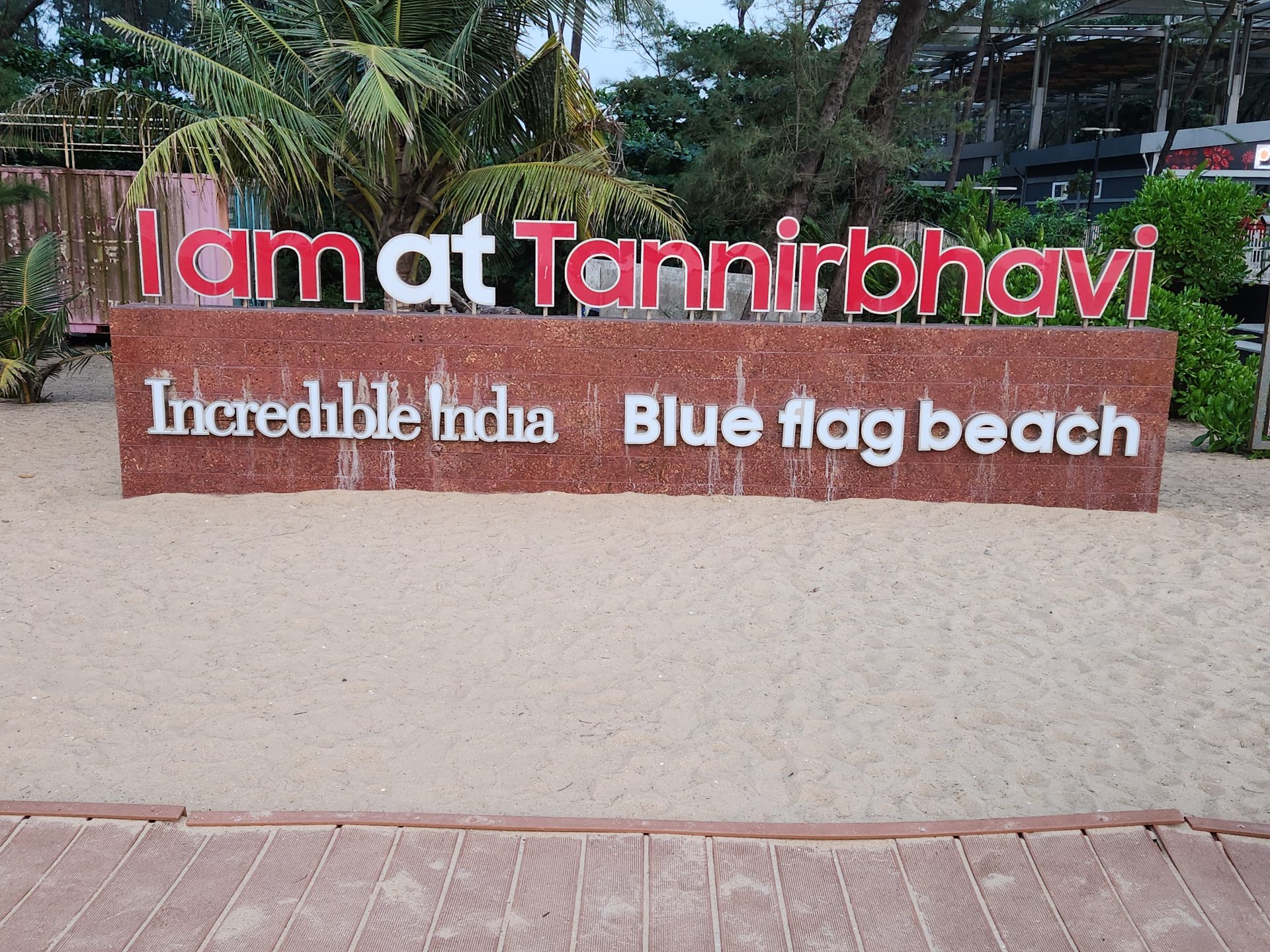
The Tannirbhavi Beach
Sunset at Agumbe View Point
Knew a little bit about the city of Mangalore and Manipal from my earlier official visits in 2013 and while I took a colleague’s help and the cab agency in fine tuning the itinerary, made a 8 day plan. The months of October to March are the best time to visit this coastal belt. The weather does remain warm but the mornings and nights are especially pleasant.
Some bit of Trivia on Mangalore
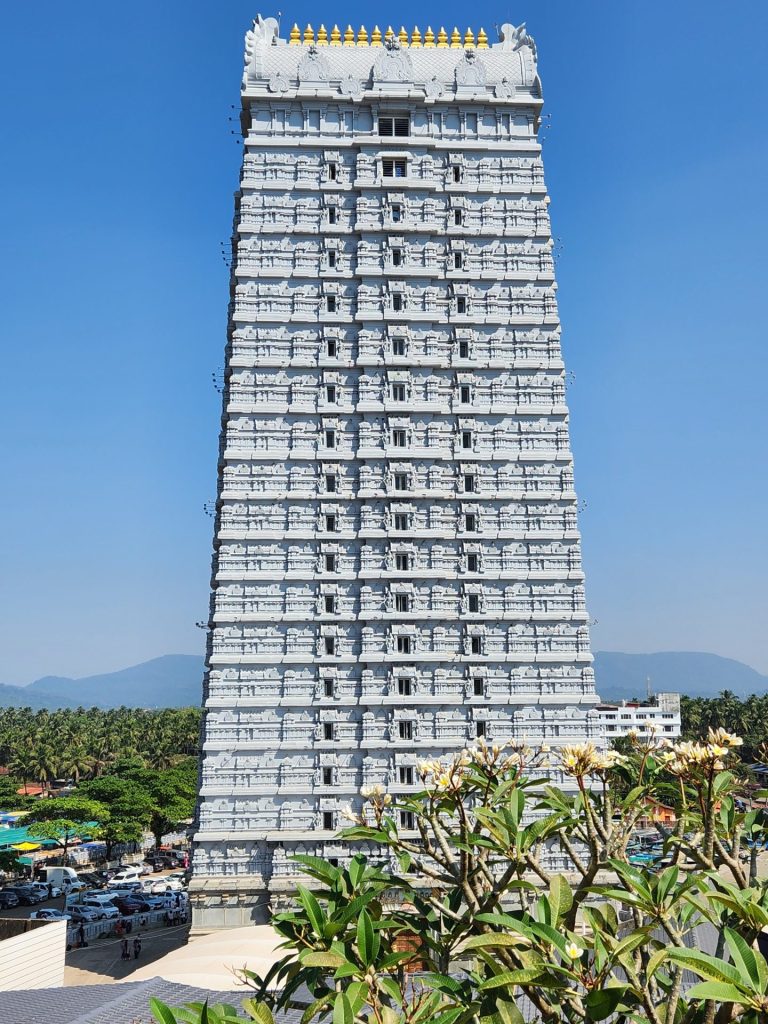
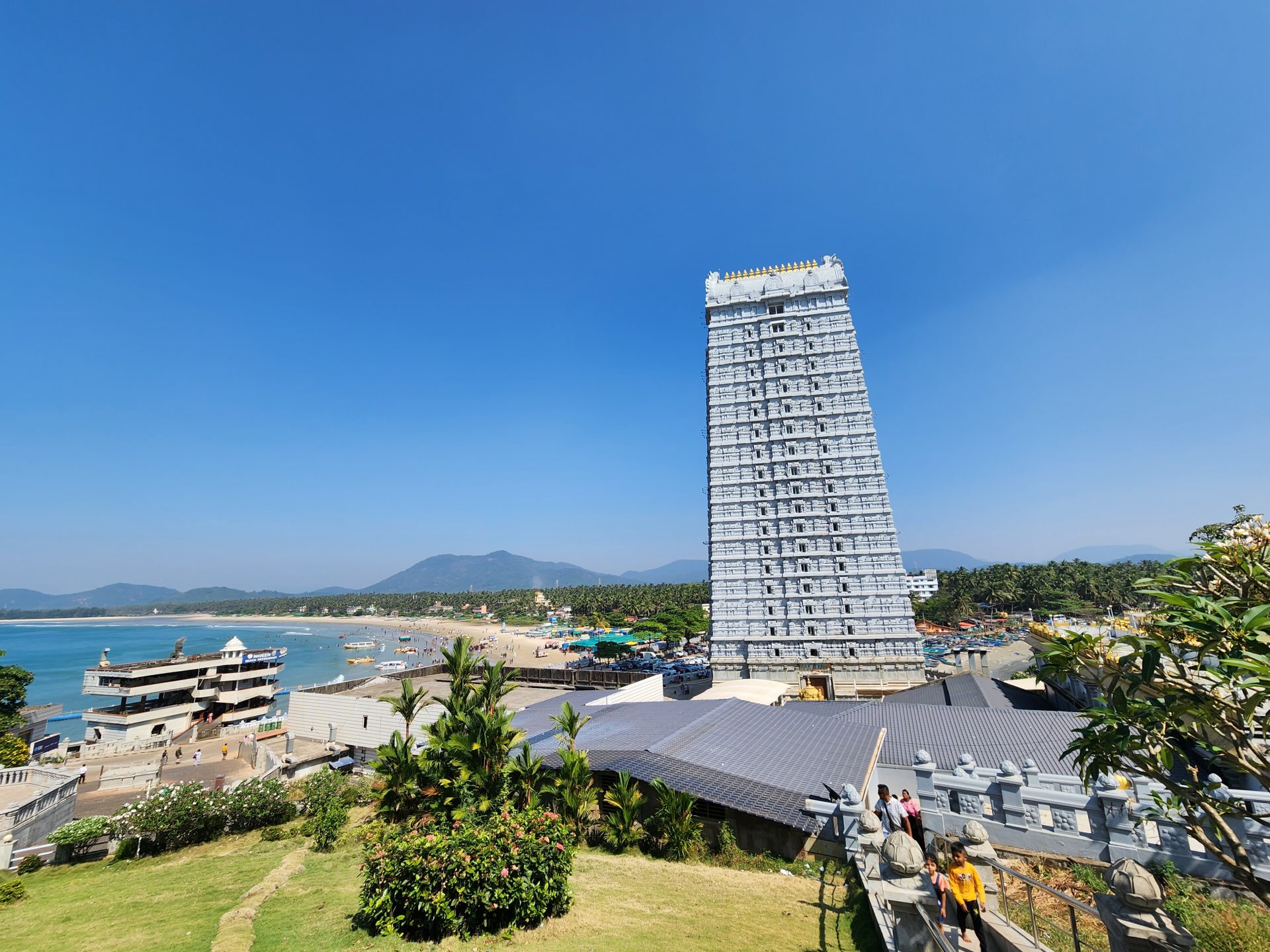
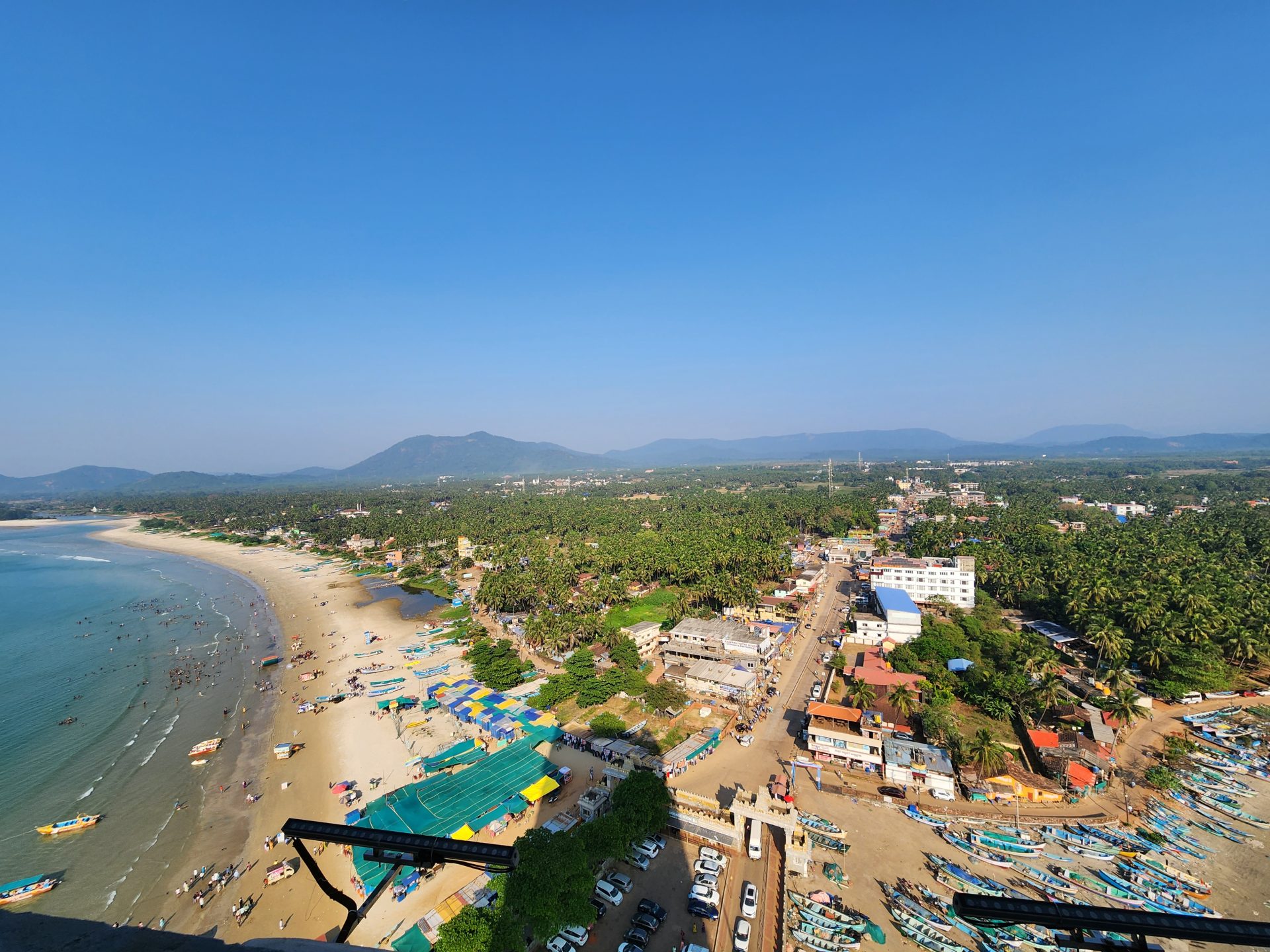
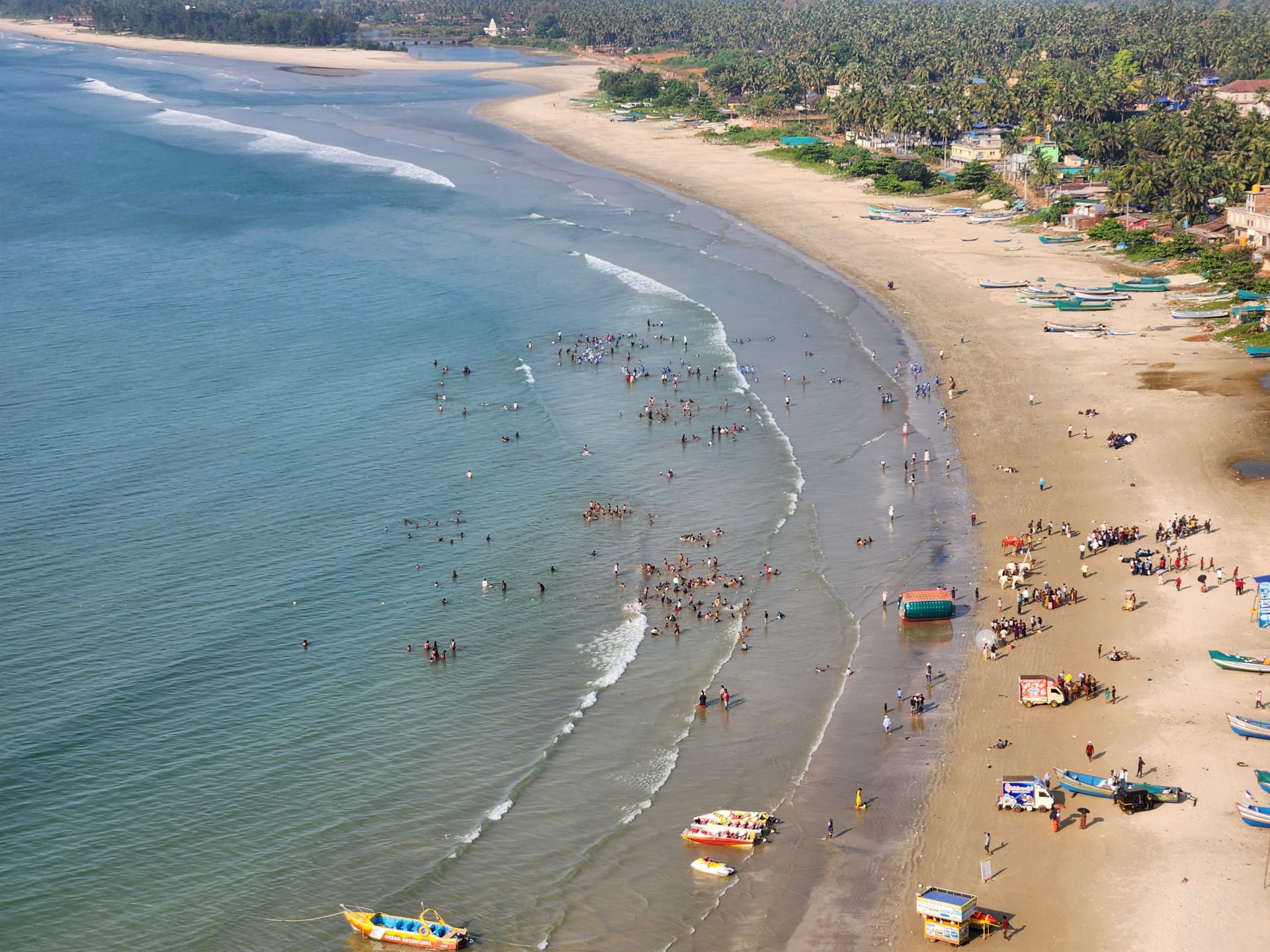
The tall Gopuram of Murudeshwar
Right from as early as the 3rd Century, the city of Mangalore has been home to multi-linguistic communities. The homeland of the Tulu speaking people had the Maurya empire claim ascendancy over it till the Kadamba Dynasty took over and ruld over it till the 6th century. The Alupas then ruled the ancient port city of Mangalore, known as Mangalapura then from the middle of the 7th Century to the late 14th /15th Century and during this time, they acted as feudal rulers under larger empires like the Chalukyas, Hoysalas and Vijaynagara.
The city served as a key trade hub for Arabs, Persians, Europeans, dealing in spices, coffee, cashews. The Portuguese occupied Mangalore from 1520s and developed trade interests with the Vijayanagara dynasty and post that the disintegration of the Vijayanagara empire, the Keladi kings took over.
Honnavar Backwaters
The town was completely burnt down by the Arabs in retaliation to the Portuguese dominance and subsequently, Hyder Ali, the King of Mysuru took over and ruled for four years before losing possession to the the East India Company of the British.
His son Tipu Sultan wrested control in 1783 and renamed the city as Jalalabad only to finally lose it during the 4th Anglo Mysuru war.
The Britishers continued their rule but did nothing to bring in any kind of industrialization. The local capital kept getting deployed on land and money lending, leading to the development of the banking system.
The European missionaries who came in the early 19th century developed educational institutions, set up printing presses, textile mills and a factory which made the Mangalore Tiles.
Dec 5th 2025
How does one reach Mangalore
We took the early evening Mangalore express train which left Chennai Central sharp by 16.20 PM. Got ourselves some food packed from A2B in the station premises since we were not sure what we would get enroute.
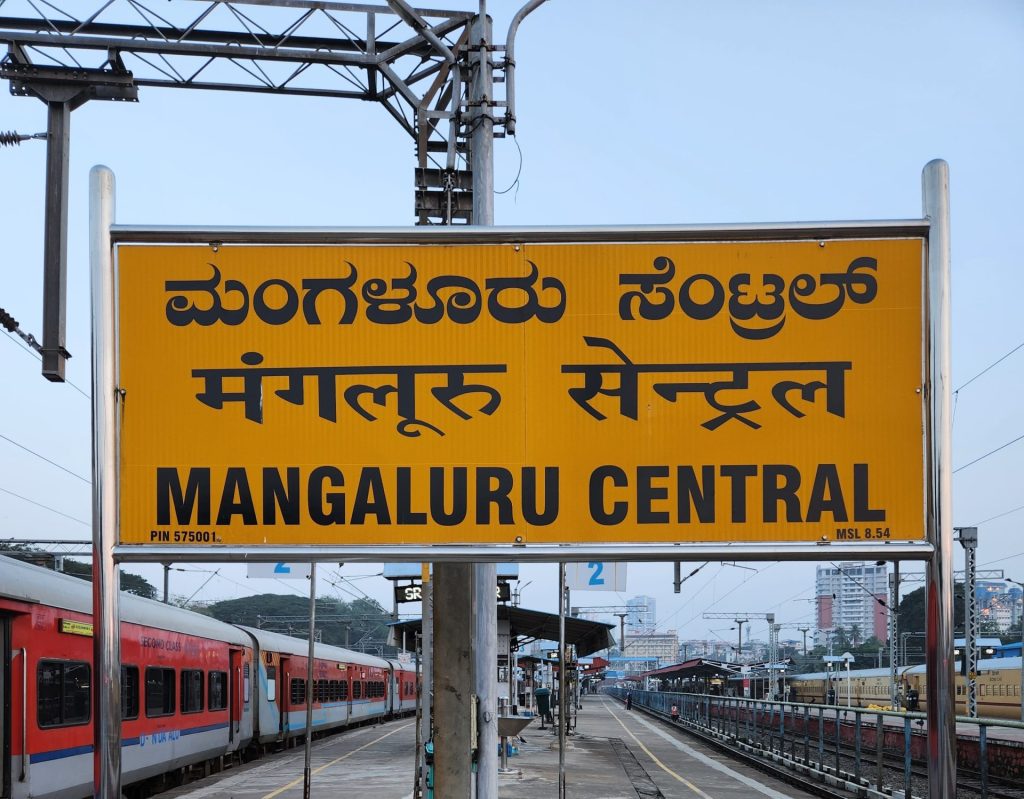
Settled in with a book and a laptop in hand and post a few rounds of coffee and tea and an early dinner, an uneventful journey culminated at Mangalore sharp at 7.00 AM the next day and to our surprise, 15 minutes early.
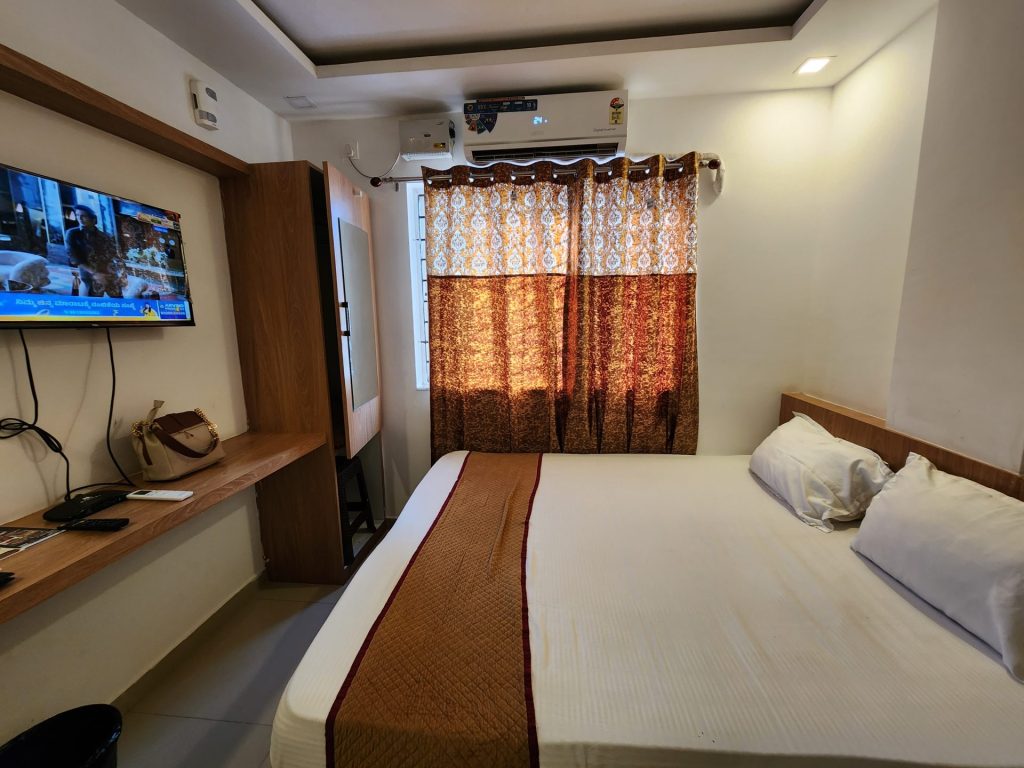
Given that our initial plan was to reach Mangalore only on 7th and with a last minute inclusion of preponing the trip by a day to accommodate Karkala, most hotels recommended by friends and colleagues like Woodlands, Poonja International, Deepa Comforts were sold off for the weekend and managed a last minute booking at Classic Comfort Lodge.
A non descript hotel in Bunder and around 1.5 kms from the station, the place took us by surprise. Pretty clean rooms, clean linen and a good working AC was all that we needed for the night and this hotel did remove all our initial apprehensions.
Day 1 : Maṅgalūru, Nāvu Bandiddēve
Hotel Classic Comfort Lodge, Mangalore
Dec 6th 2025
We had plans of doing the local temples in the morning and a couple of beaches if time permitted in the 2nd half and after breakfast at a nearby restaurant, we headed first for the Kadri Manjunath temple.
The Kadri Manjunath Temple
Said to have been built during the 10th or 11th century, this temple was redone in the 14th century as a complete stone structure and has Hindu and Buddhist histories since Buddhism was practised here till the 10th century.
There is a 5 feet tall bronze statue of Lokeshwar (identified as Brahma) which has a 968 CE inscription engraved on the pedestal which mentioned that King Kundavarma of the Alupa Dynasty installed this idol in Kadarika Vihara and also mentions Mangaluru as Mangalapura.
The image of the idol has 3 faces, 6 arms and 2 of the arms hold flowers while the crown depicts a meditating Buddha.
A couple of undated bronze images of similar craftsmanshipof Avalokiteshwar (known as Narayana) and Buddha (known as Vedavysya)can also be seen in the temple. Legend has it that Parashurama who was living in Sahyadri killed the cruel Kshathriyas and donated the land to the Kashyaps.
While praying to Lord Shiva for a place for living, he was assured that if he performed a penance at Kadali Kshethra, Lord Shiva would reincarnate himself as Manunatha for the world’s betterment. Based on Lord Shiva’s instructions, Parashurama threw his axe into the sea and created a place where he could do his penance. Lord Shiva appeared to him as Manjunatha and stayed at Kadri for the world’s betterment along with Goddess Parvathi.
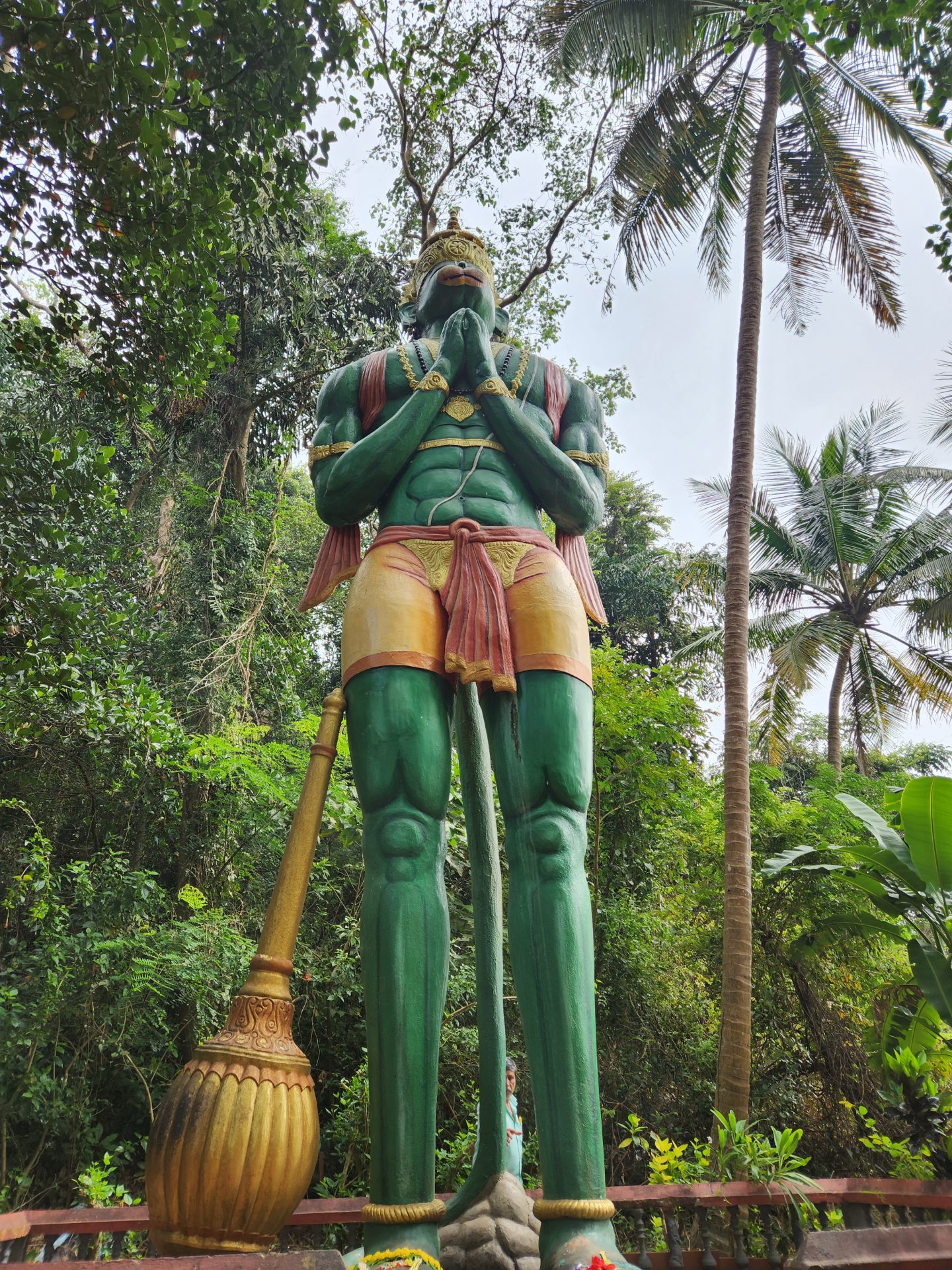
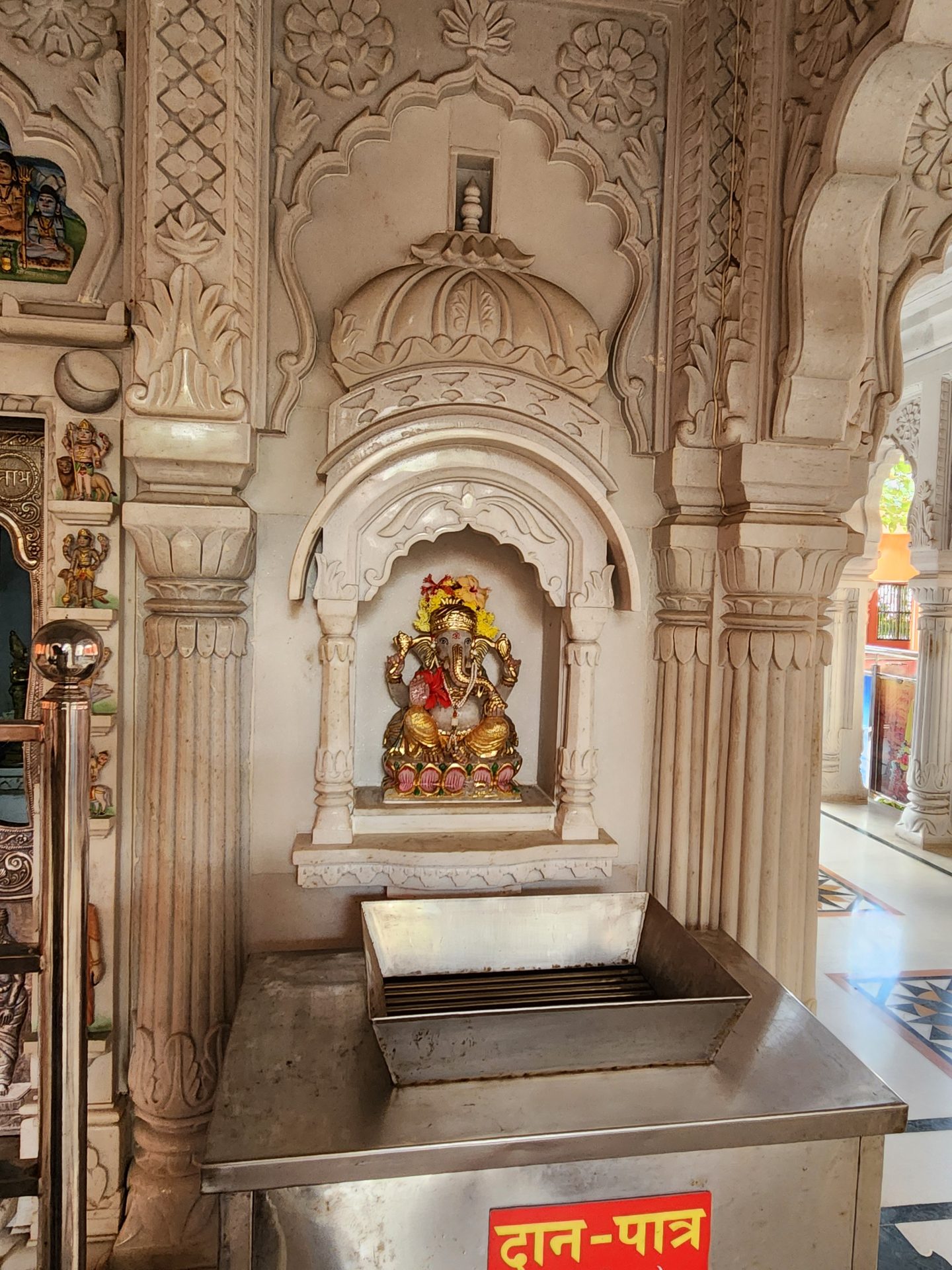
The initial climb brings onto a tall statue of Hanuman. A further flight of steps and a pretty long climb at that leads one to the Kadri Shree Yogeshwarar Mutt where one gets to see a temple for Lord Ganesh and Shaneeswarar.
The Mahatobhaara Sri Mangaladevi Temple
After having spent around an hour at the temple till about 11.30 AM, we headed for the Mahatobhaara Sri Mangaladevi Temple, located around 5 kms away. Located in Bolara, this temple built in Kerala style architecture is dedicated to the Hindu goddess Shakti in the form of Mangaladevi from which the city of Mangalore derives its name. Believed to have been built during the 9th century by the most noted king of the Alupa Dynasty
Kundavarman, another legend attributes the building of the temple to Parashurama, one of the 10 avatars of Lord Vishnu. The presiding deity Mangaladevi is seen in a seated posture (known as Dharapatra) in the central shrine, accessible through a flight of 5 steps. The gateway tower of the temple has 2 storeys with the upper storey having wooden trails covering the hall where the drums are beat during festivals and also known as the Kottupura.
The Kudroli
Gokarnatheswara Temple
We moved on next to the century old Kudroli Gokarnatha Kshetra also known as the Gokarnatheswara temple, located around 3.6 kms away.
Built in 1912 by Adhyaksha HoigeBazar Coragappa, this temple was consecrated by Narayana Guri and is dedicated to Gokaranatha, a form of Lord Shiva.
The temple was originally meant for worship for the Billava community who were prohibited from entering other temples. Surrounding the main temple are shrines for Annapoorneshwari, Mahaganapthi, Subramanya, Shaneeswara, Anandabhairava and Hanuman.
The gopurams or the towers are constructed in the Tamil Nadu style and are adorned with murals, depicting scenes from the epics and mythology. Navarathri and Shivarathi are celebrated with lot of fervour in this temple and this place forms a major source of attraction during the Managaluru Dusshera celebrations.
The temple earned the name of Kudroli or Kudrevalli since the land it was built on was earlier used by Tippu Sultan to graze his horses. The temple tank has statues of Lord Shiva in different postures on all sides.
It was around 1.30 noon by the time we exited the temple and we could feel the rumbling in our stomachs given the amount of walking we had to do around, especially at the Kadri Manjunath temple since it was built atop a small hill. We headed for Paakashala and had a nice lunch comprising of Veg Handi Biryani, Paneer Mutter and rotis, some cream of greens soup and finally washed the food down with some cold coffee, tea and fresh lime.
The Ferry Ride from Sulthan Bathery
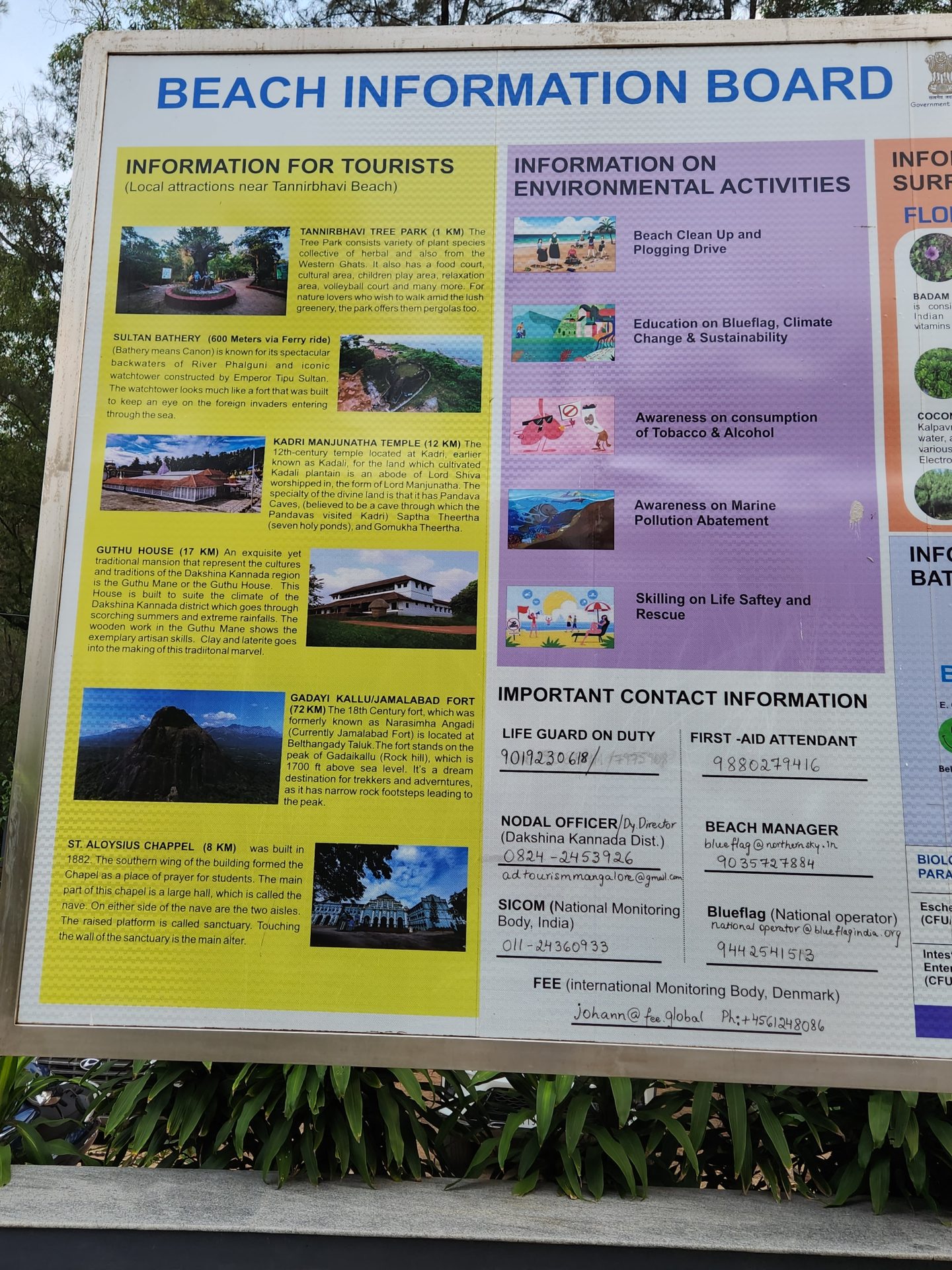
We reached our hotel by around 2.30 in the afternoon and caught up with some rest before starting for the beaches at around 4.30 PM. Our hotel folks advised us to go to Sulthan Bathery, located around 4 kms away in Boloor and take the ferry to Tannirbhavi beach. Suthan Bathery was built in the 18th Century as a Watch Tower by Tipu Sultan and to keep a watch on the British Navy but is in dilapidated condition.
A short ferry ride across the Gurupura river brought us to this beautiful beach. Return tickets are Rs.20/- per head.
The boats ply from 8 AM in the morning till 7.30 PM in the evening.
We reached the beach well ahead of the Sunset time and spent some time looking at the beautiful views around.
The Tannirbhavi Beach
Accredited as a Blue Flag beach, this white and soft sand beach is clean and pretty well maintained. The entry tickets to the beach are at Rs.20/- per head.
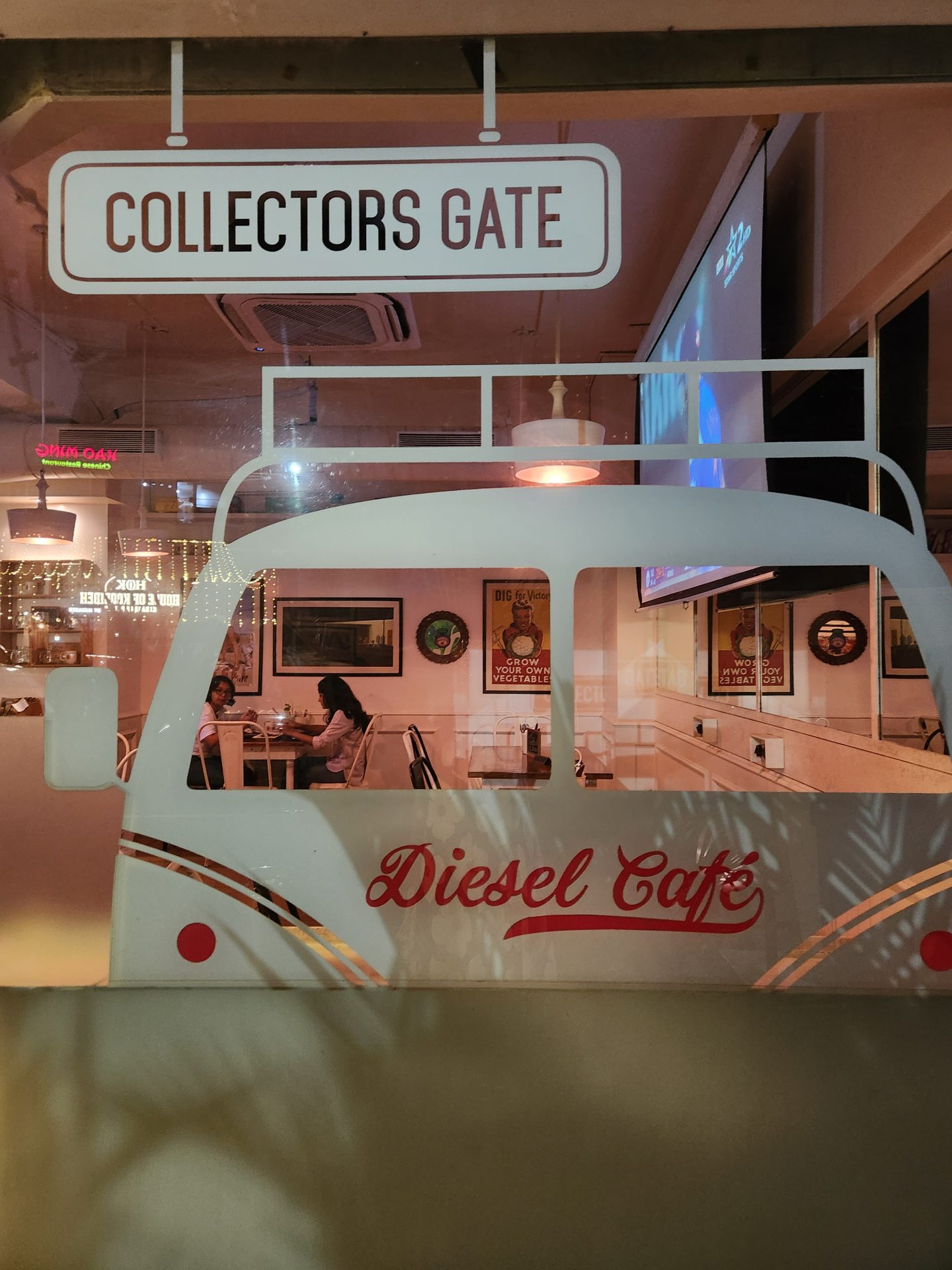
We left the beach at around 6.30 in the evening and took the road route back to the city. We stopped by at Diesel Café for a light dinner and headed back for the hotel. Kept our bags packed and ready since we had planned an early start by around 7.30 AM the next morning from Mangalore to Udupi. A chocolate mud cake, some French Fries, a brownie all washed down with some Cappucino and Masala tea.
Dec 7th 2025
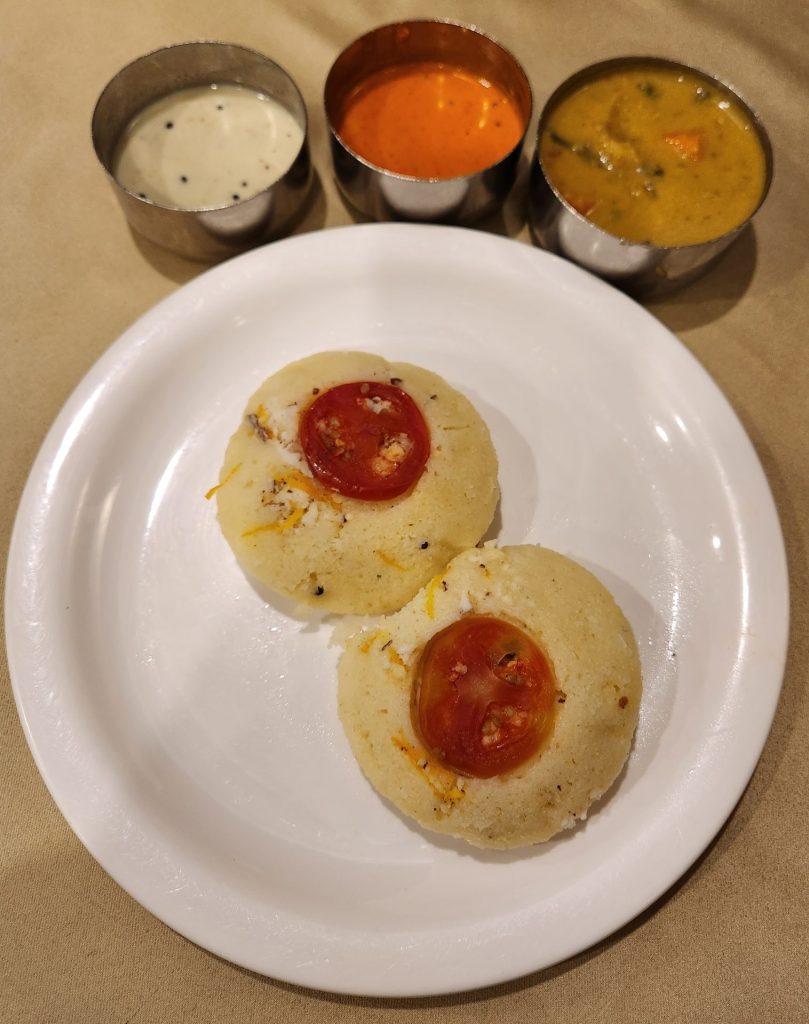
Breakfast @ Woodlands
We had a cab booked for the next 6 days to take us to various places planned around Coastal Karnataka and our driver Rajnikant arrived at our hotel sharp at 7.30 AM. After checking out of our hotel, we headed for Woodlands in Balmatta for breakfast. Given its popularity, we were lucky to have landed early since by the time we completed our breakfast, crowds had started building up.
Day 2 : Udupi Town
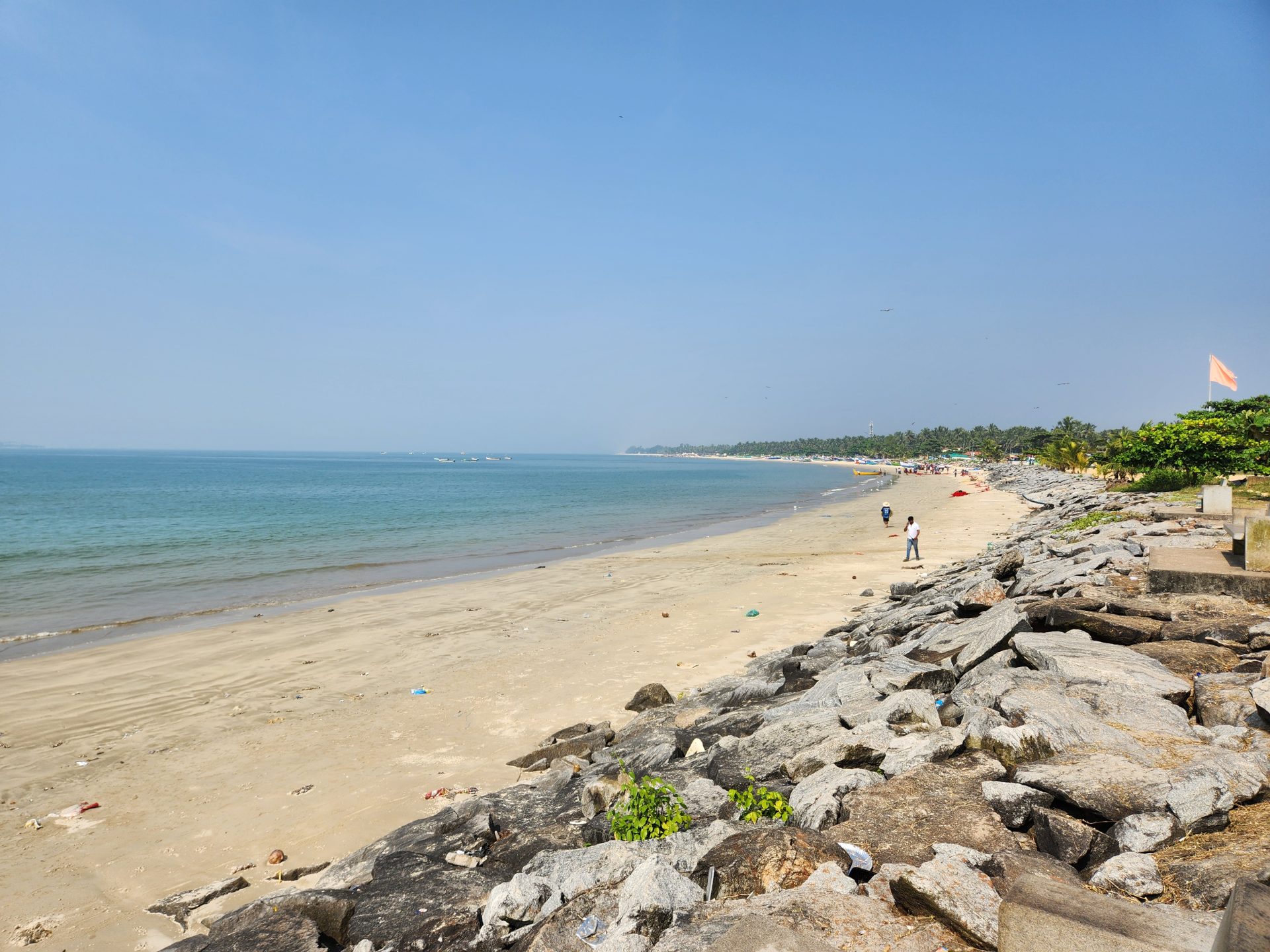
Our first halt enroute Udupi was to be the Kapu or the Kaup beach, 44 Kms away. The roads were a pleasure to be riding on and we reached Kapu beach by around 9.30 AM. The beach was literally deserted and our intent was to stop by to see the beach and lighthouse and move on. There were water sports activities available but we were not too keen on it.
Was in no mood to get wet right at the start of the day. The Lighthouse stands tall at 27 metres and was built in 1901 by the Britishers atop a small hill. Its understood that the Lighthouse offers excellent views of the beach and the sunset right from the top but is open only from 4 PM to 6 PM in the evening. We had to anyways give the lighthouse climb a skip and we moved on at around 10 AM for Udupi.
A Ferry Ride to St. Mary's Island
We had booked ourselves in Villa Malpe located very close to the Malpe beach and since our check-in time was around 3 PM in the afternoon, we decided to visit St Mary’s Island before reaching the Villa.
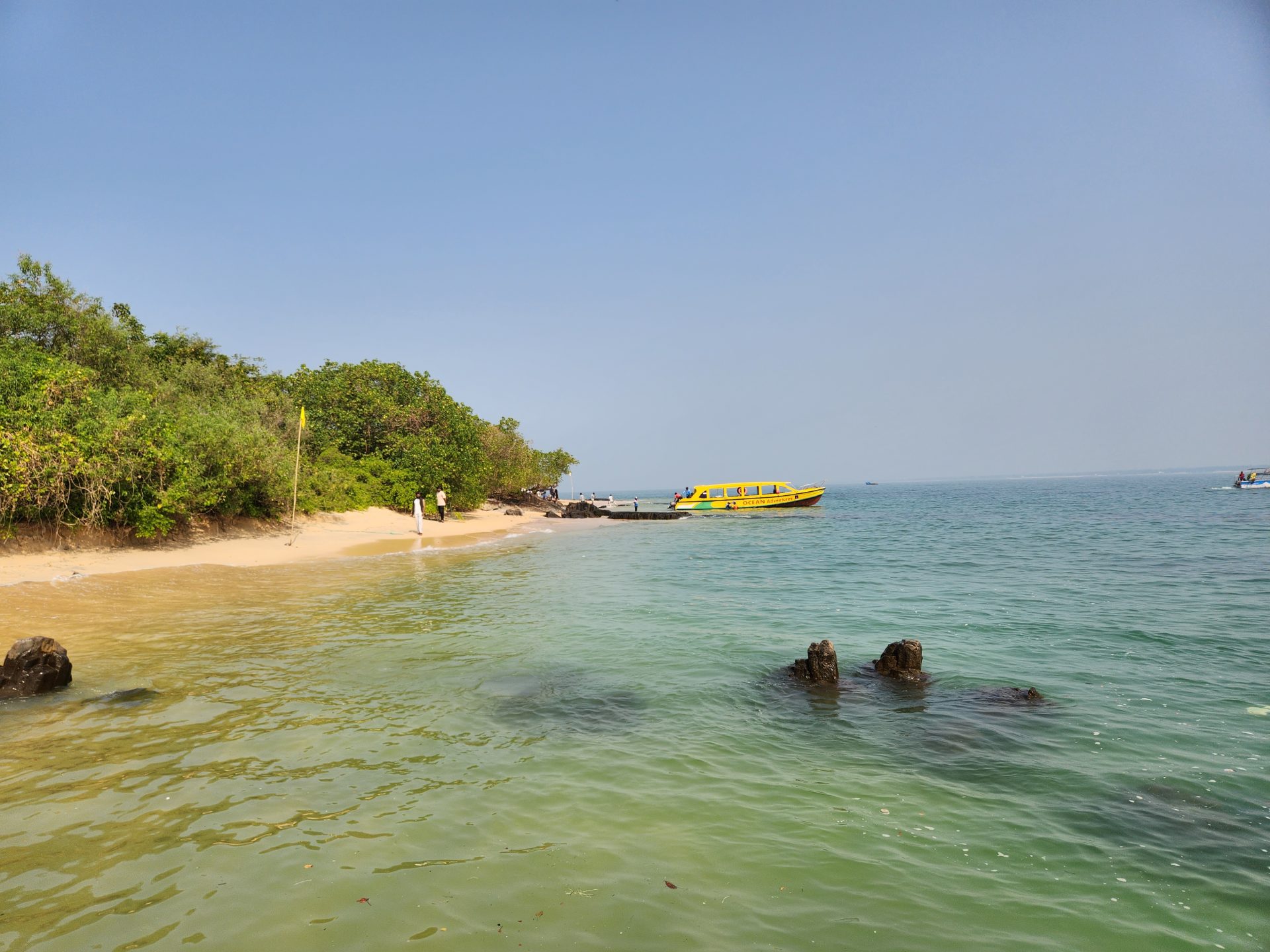
We reached the Ferry point at around 10.45 AM. A half an hour boat ride is what it too for us to reach the island. Tickets for the to and fro journey were Rs.350/- per head and Rs.250/- for the camera.
Life jackets strapped, we started the journey around 11.15 AM. Loud foot tapping music started as soon as the boat set forth and there was a boisterous group of middle aged couples who could not resist breaking into a dance.
This went on till the boat anchored a few metres before the island after which we were moved to a smaller boat so that we could reach closer to the island.
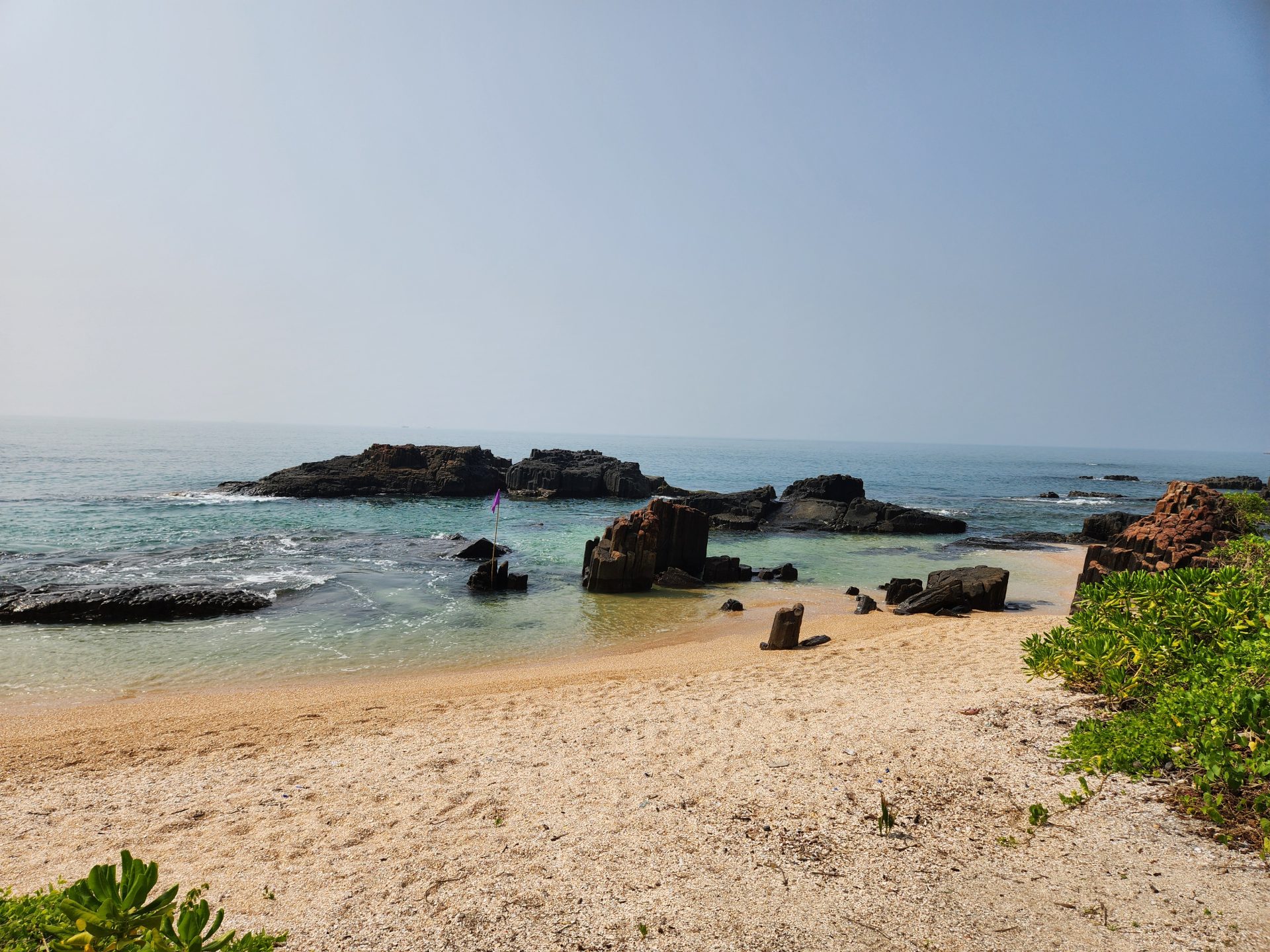
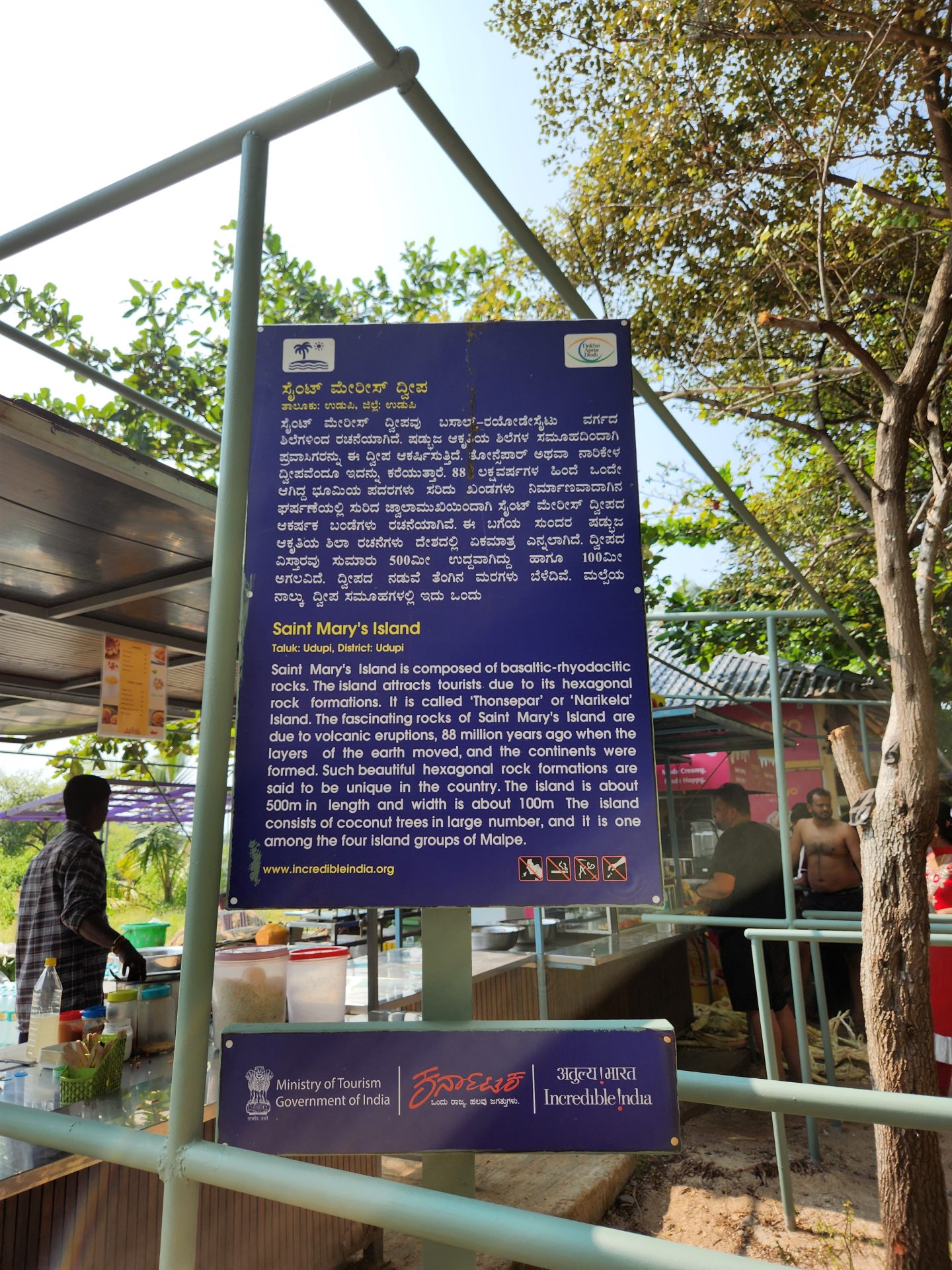
The island is a unique geological site, famous for its Hexagonal Columnar Basalt rock formations formed millions of years back when a volcanic activity separated Madagascar from India.
Also known as Rhyolitic Lava formations, the site is protected by the Geological Survey of India and are part of four small islands.
These islands are also known as the Coconut Island, North Island, Darya Bahadurgarh Island, and South Island. The beaches are made up of lot of shells.
The heat was a killer but the cool waters offered some solace and after spending almost an hour on the island, walking around, we made our way back to the ferry point.
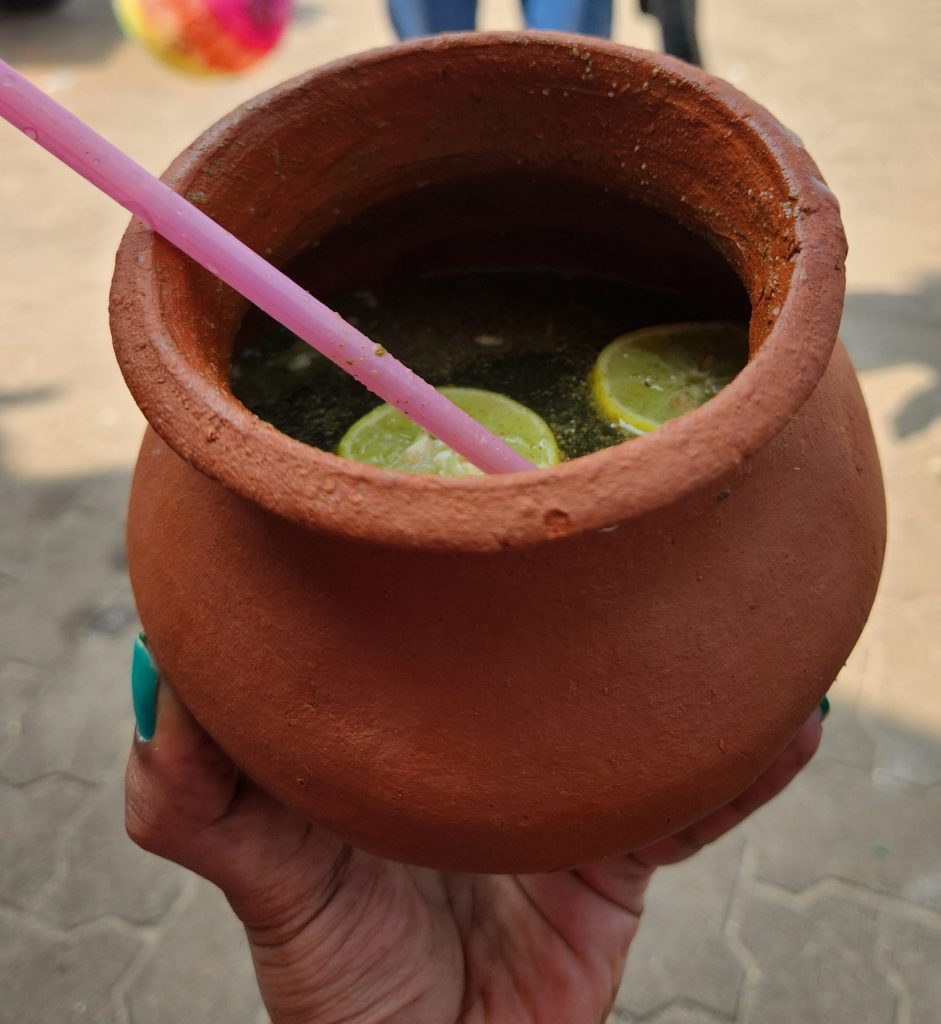
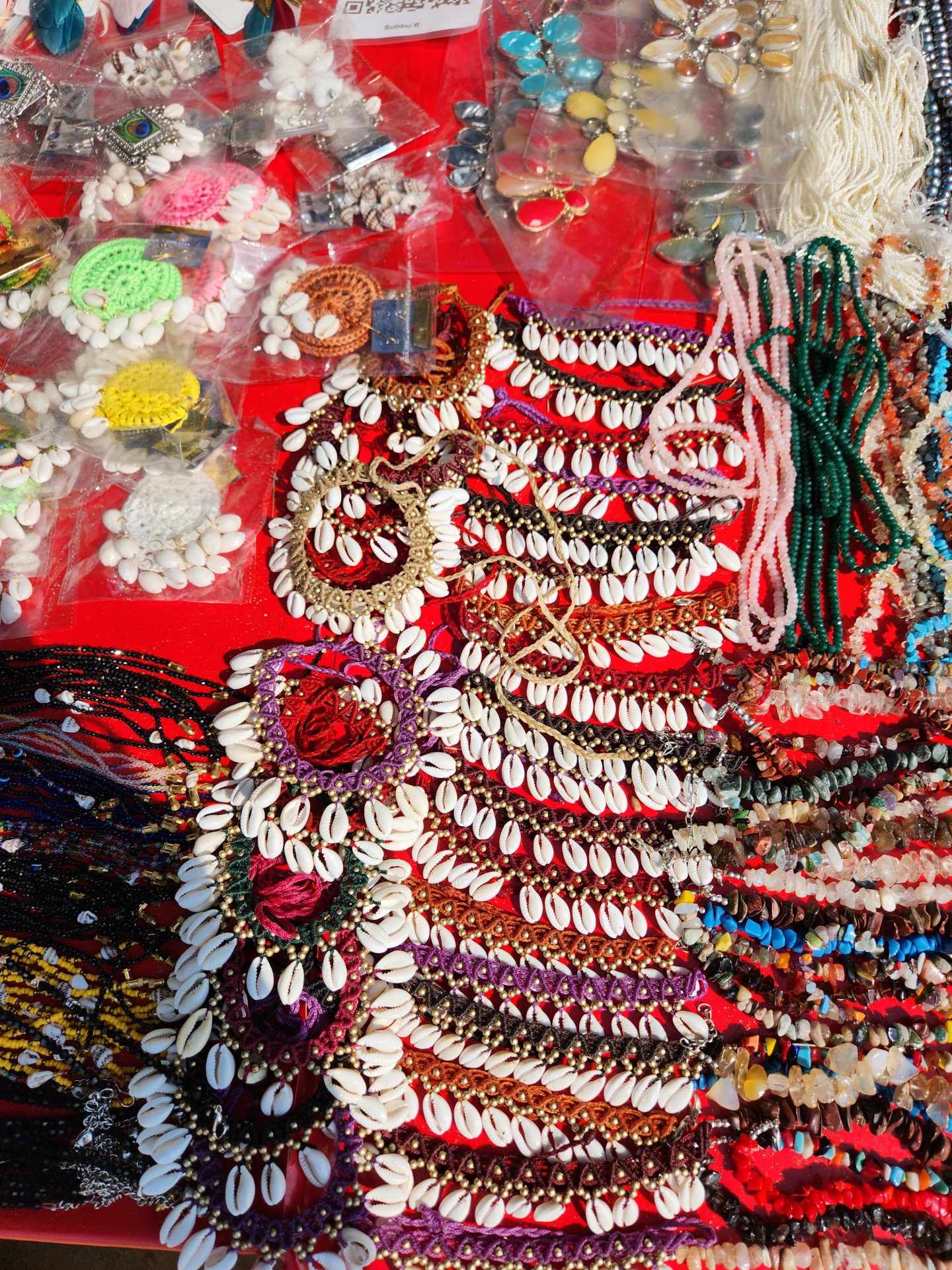
We were back to the mainland by around 1 PM and while the ladies got busy shopping for handicrafts, dresses and fridge magnets, I went around the small park and Sea Walkway. The coolants served in the Matkas (Earthern Pots) were awesome and especially the Masala Lime Soda and Tempered Buttermilk garnished with Chillies and Ginger.
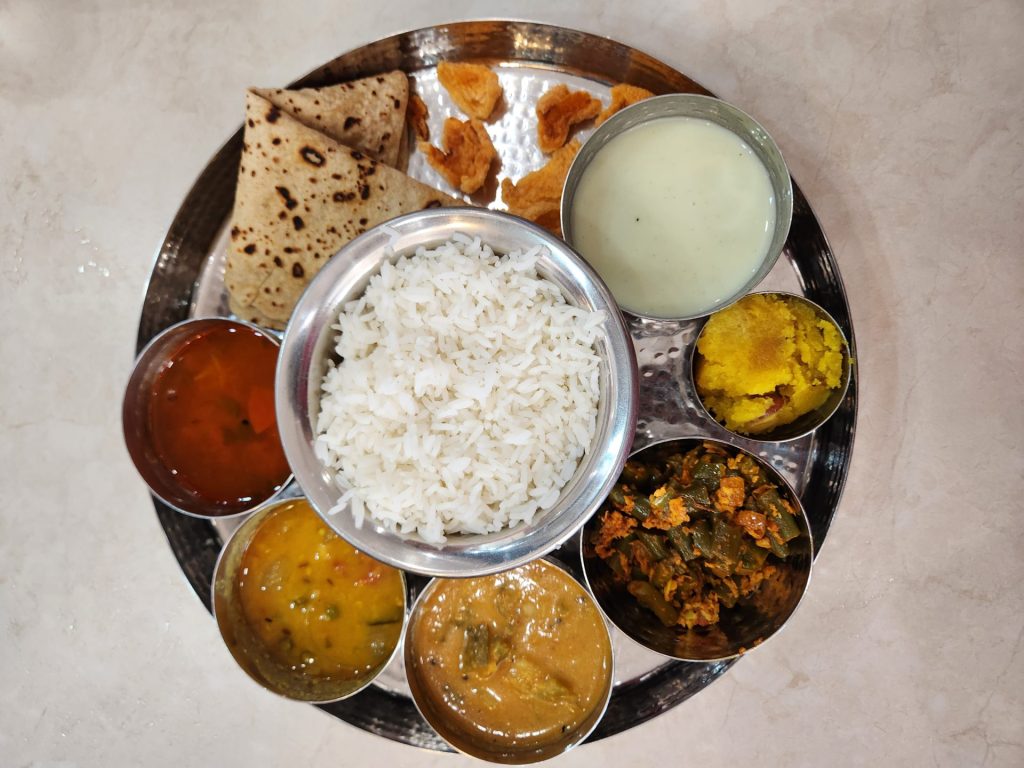
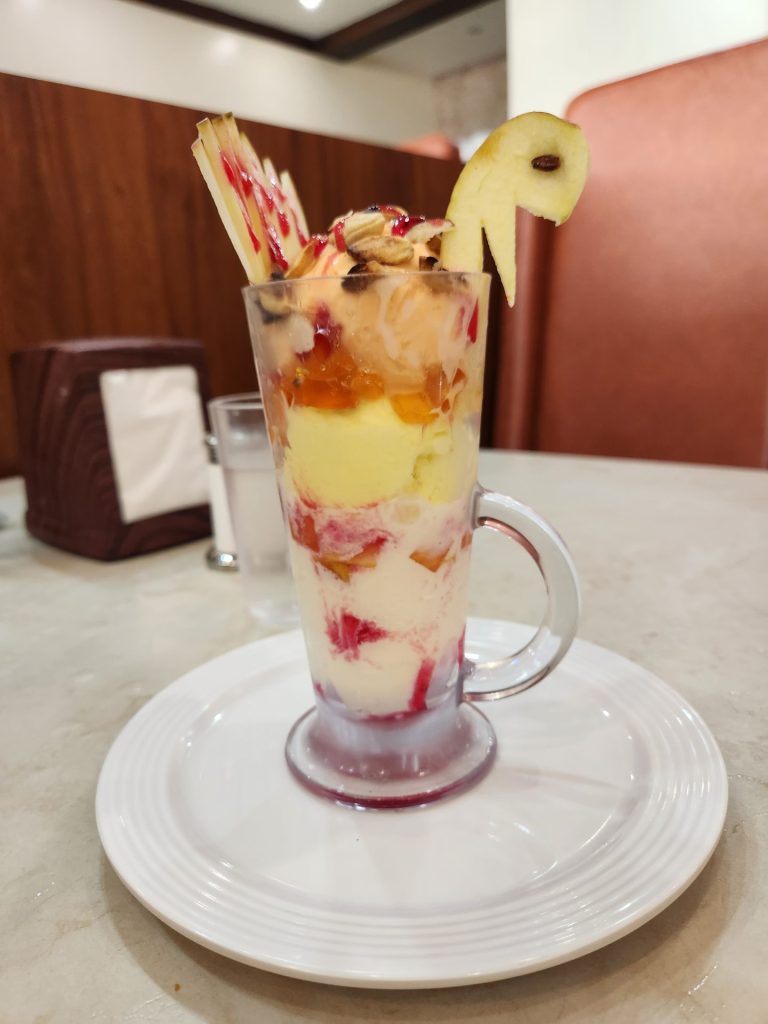
At around 2, we set out for lunch towards Udupi town and in around 3 to 4 kms, we found a pretty nice Udupi restaurant, Krishna Swaad. South Indian Thalis in Karnataka style were ordered along with some Gadbad ice-cream. Now that the name Gadbad meaning chaos or confusion could not be patented, most restaurants across Karnataka have this line item popping in in their menu.
The contents looked more akin to the Falooda which we get in Chennai but more of the dissection later on when we hit its origins in Mangalore.
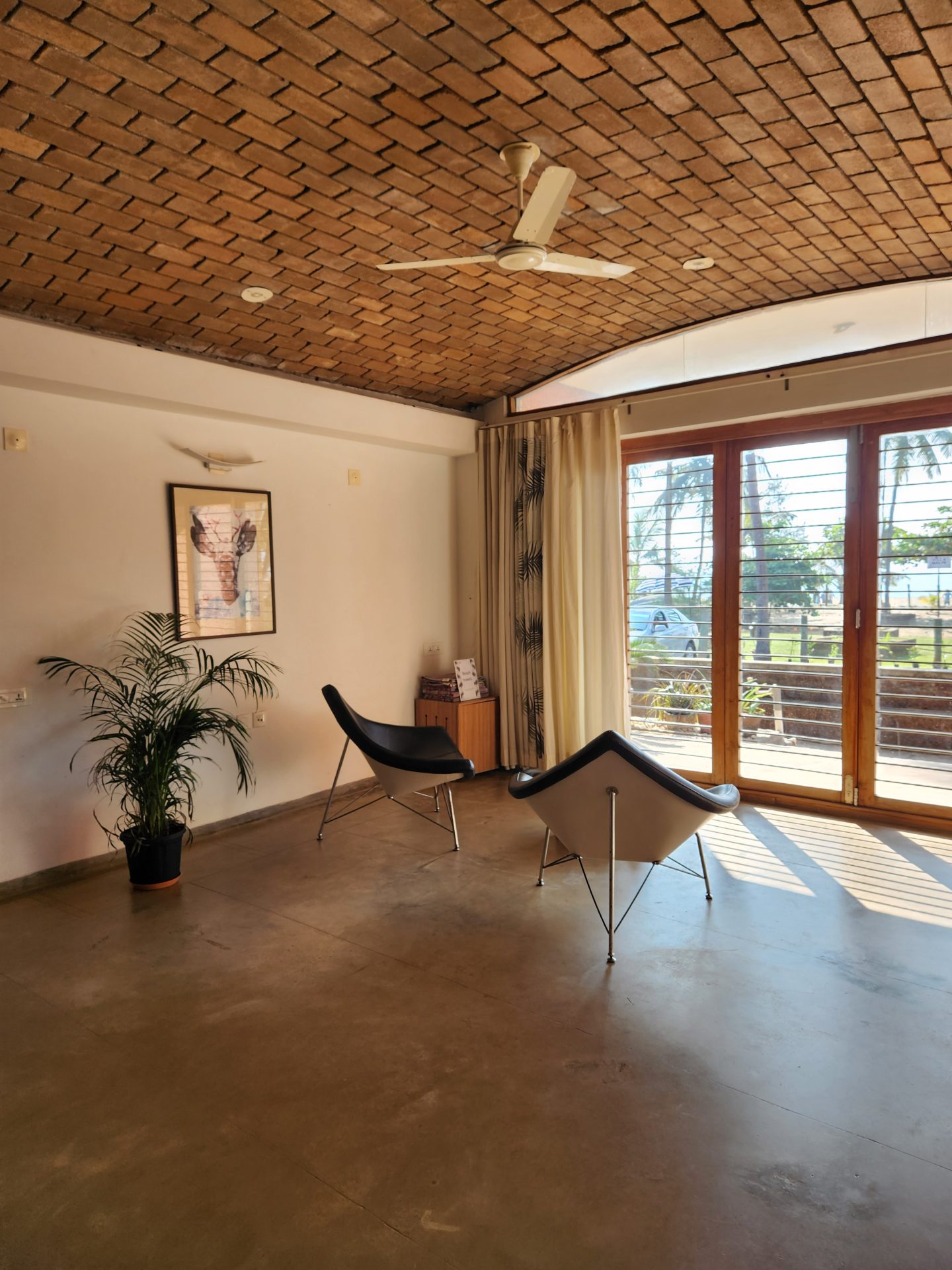
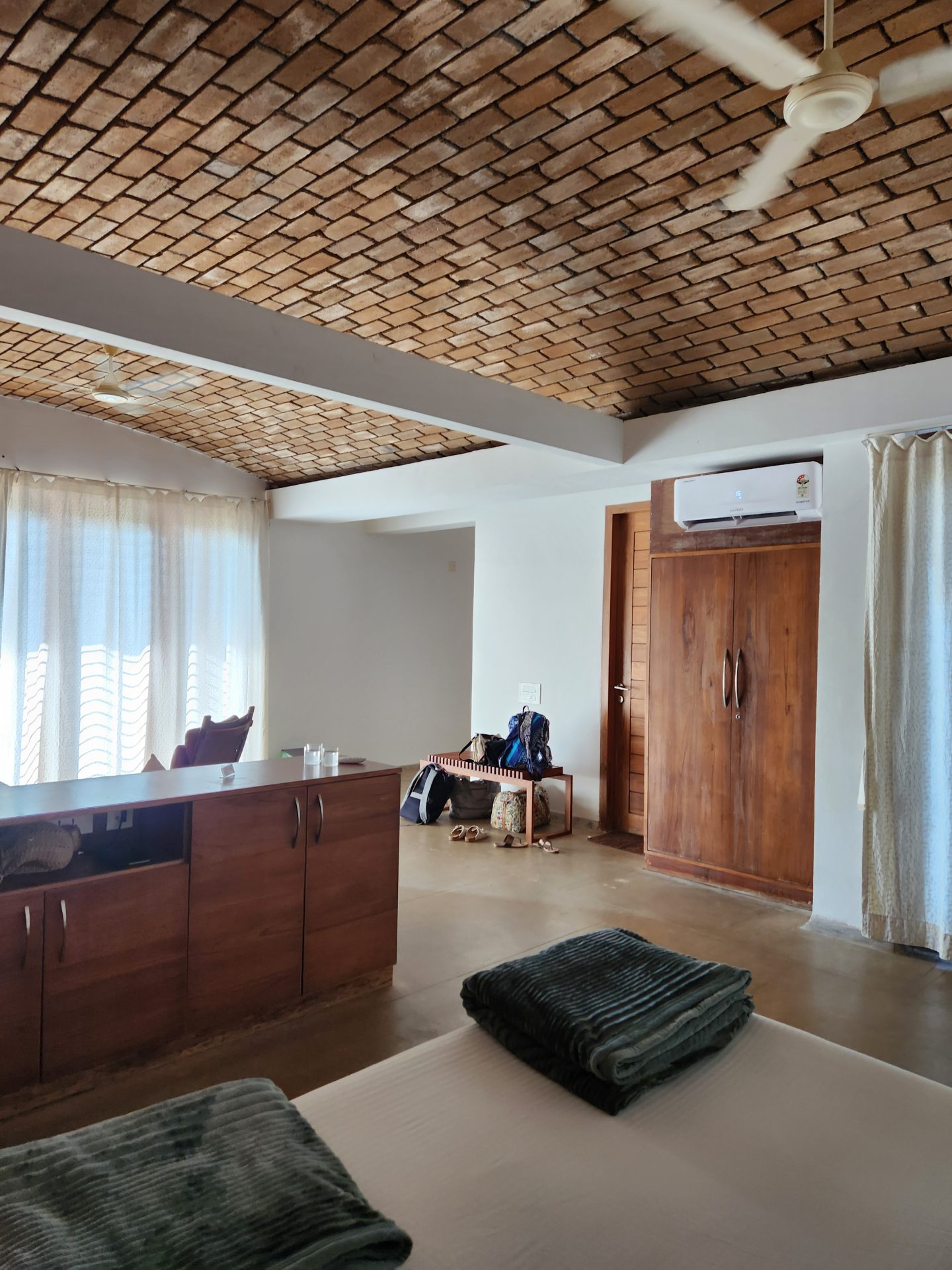
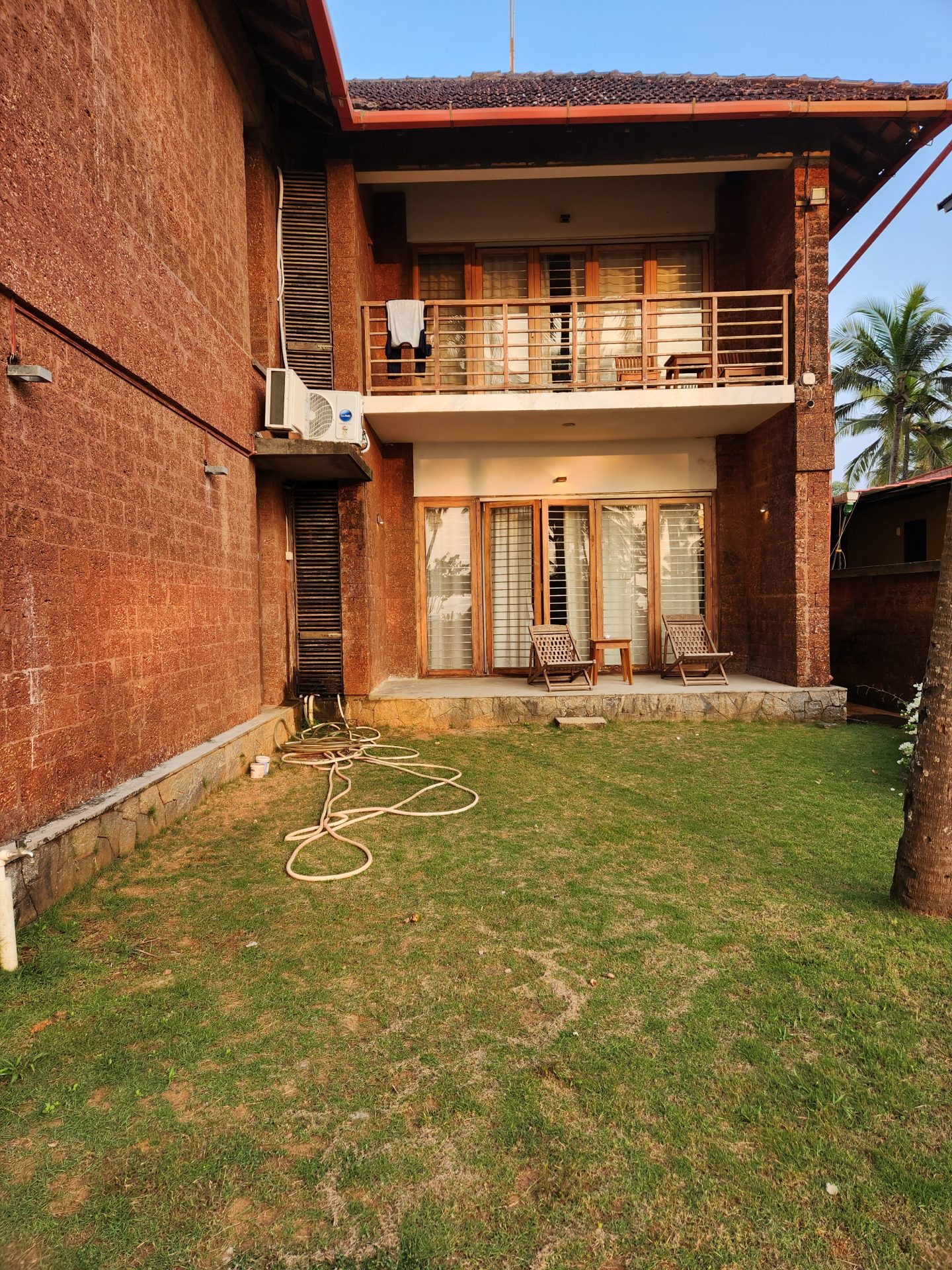
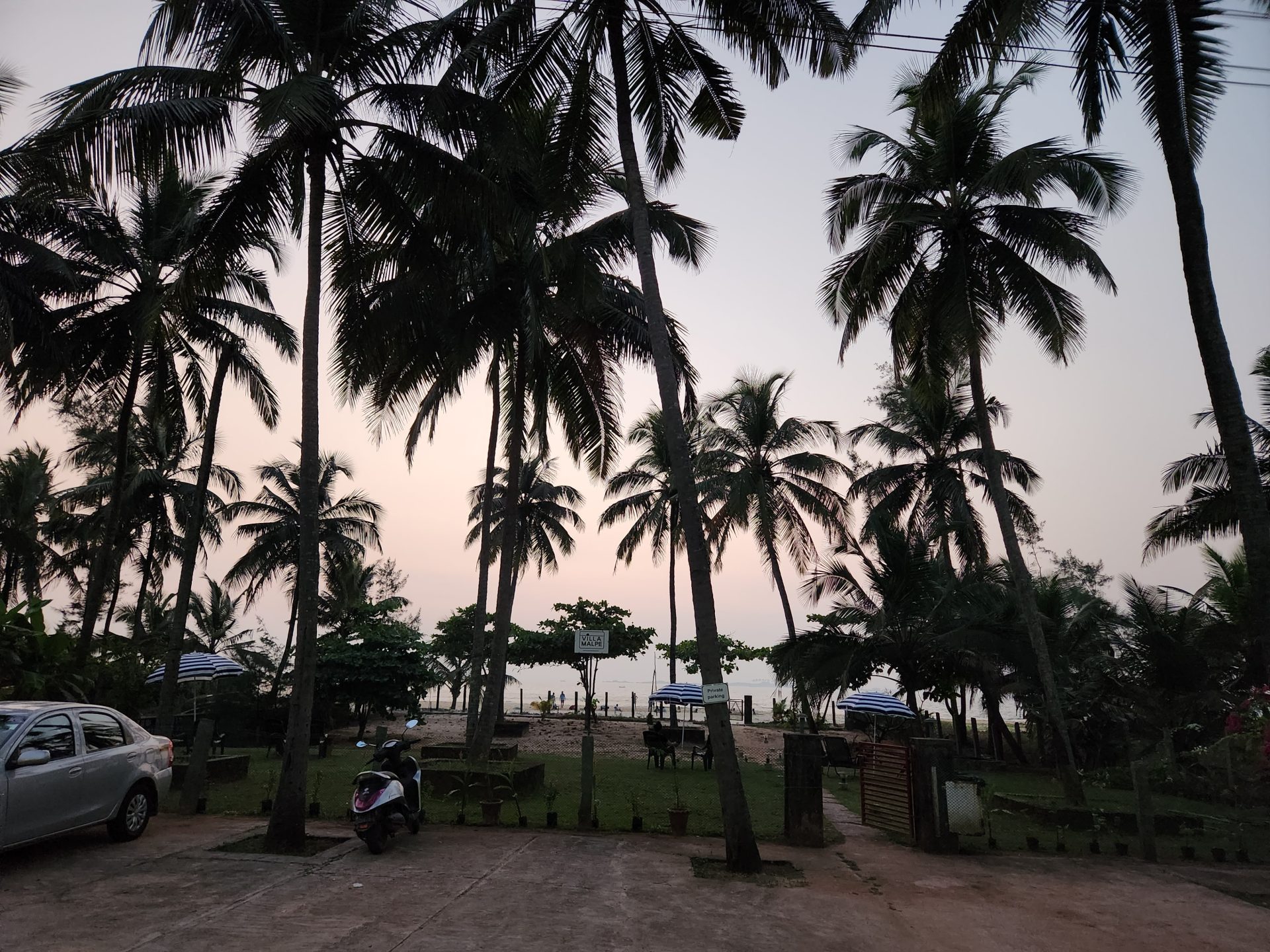
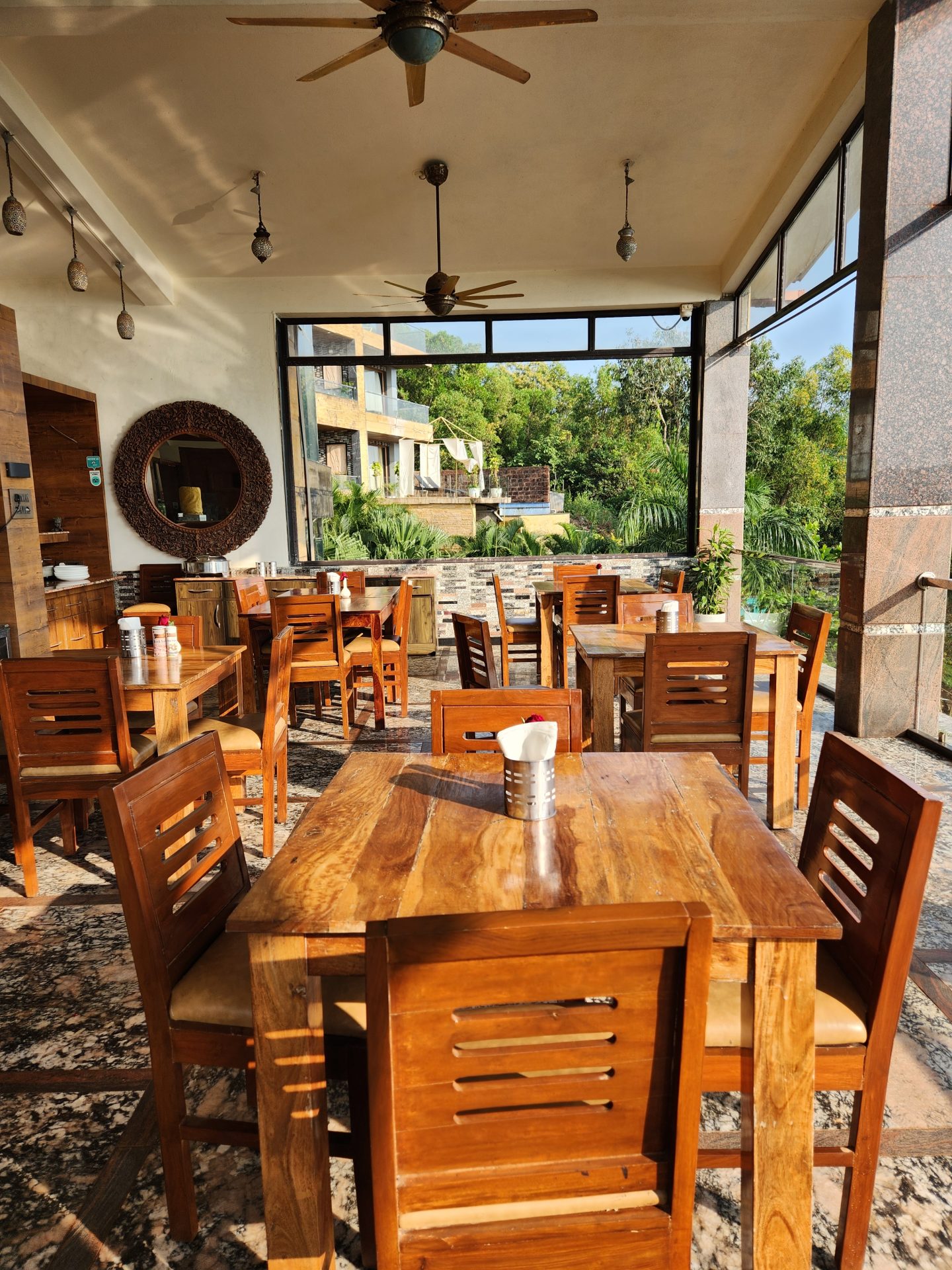
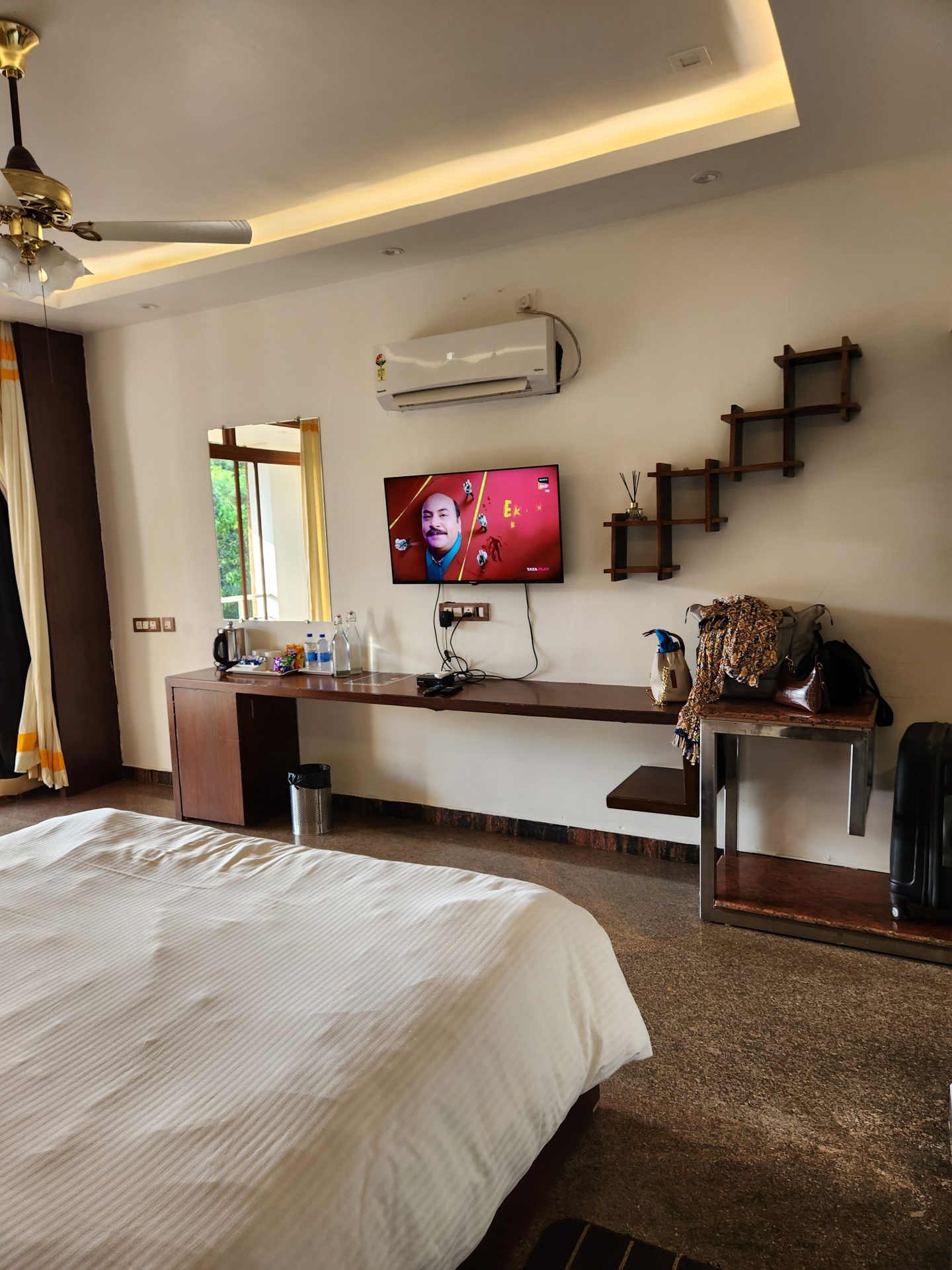
Lunch done we drove on for around 4 kms to reach the Villa Malpe overlooking the Malpe beach. This boutique resort was more of a bed and breakfast homestay with 4 well appointed air conditioned rooms and with very nice interiors.
The perfect place to relax and put your feet up though the only aberration was the lack of food since the cook was on leave.
So much so for homestays but the comfort, peace and tranquil surroundings more than made up for this and in any case, the Zomatos and Swiggys of the world were available at our disposal.
Since we were a bit away from the town of Udupi and at a beach villa, we decided to order our dinner the same way.
Hotel Villa Malpe Udupi
The Malpe Beach
The evening was spent lazing around the Malpe beach and soaking in the sights of the orange hued red fiery ball slowing shutting shop and bringing in darkness. Dinner was from Malpe Lunch Home through Zomato.
Dec 8th 2025
The next day was our checkout and drive to Horanadu and since the start was early, we had to give the breakfast at the resort and which was scheduled to start only by 8.30 AM, a miss. An hour’s drive brought us to Sanoor in the outskirts of Karkala where we stopped by for some breakfast at Sagar Ratna.
Day 3 : Horanadu, Sringeri and Ageumbe
An hour’s drive brought us to Sanoor in the outskirts of Karkala where we stopped by for some breakfast at Sagar Ratna.
The Drive through Kudremukh National Park
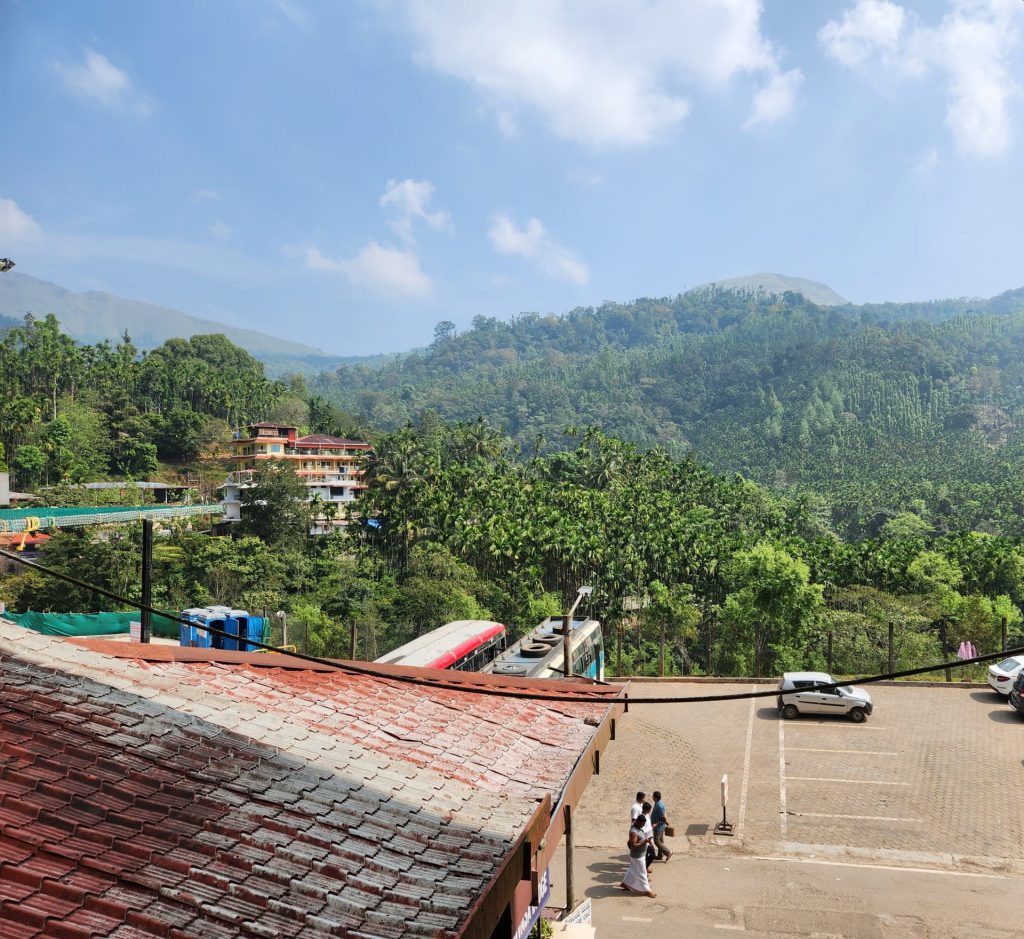
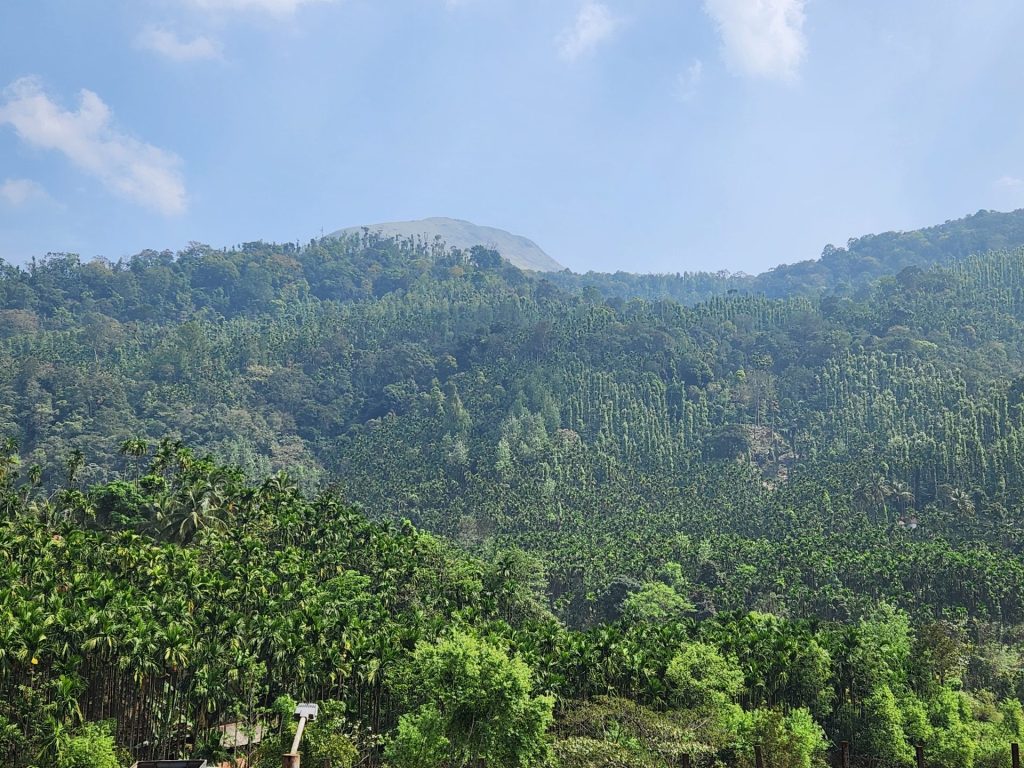
A sumptuous breakfast done, we started our drive through the Kudremukh National Park towards Horanadu, located around 80 kms away. Lush green dense forests, near zero inhabitation and not so good roads confronted us as we commenced our drive after obtaining the requisite passes from the Checkpost.
We stopped by at a waterfall and some tea gardens enroute for some quick pictures and after crossing the ghost town of Kudremukh, we reached Horanadu around 11.45 AM.
The Annapoorneshwari Temple at Horandu
Located on the banks of the river Bhadra and near dense forests and valleys in Chikmagalur District, lies this ancient temple of Goddess Annapoorneshwari also known as Sri Kshethra Horanadu.
It is believed that Sage Agastya first established the shrine. Considered to be a Hindu goddess of food and nourishment, this deity was renamed as Adishaktyatmaka Shree Annapoorneshwari and was created entirely in gold. Anyone or everyone who visits the temple is offered shelter and food within the temple premises.
As per an old mythology, during the course of an argument between Lord Shiva and Goddess Parvati, Shiva declared everything in the world to be an illusion including food. In complete disagreement with him, Parvati decided to disappear thereby bringing nature to a standstill.
This resulted in no change in climates while plants also stopped growing thereby creating a famine kind of situation. Feeling pity on this, Goddess Parvati reappeared and distributed food to everybody and after this incident, came to be known as Goddess Annapoorna.
This temple is believed to have been built 400 years ago by the family of Dharmakartharu whose descendants continue to serve and preserve the temple. The main festival celebrated here is Akshaya Trithi and it is understood that Sri Annapoorneshwari was born on this day.
A flight of stairs leads one to the main temple complex where the mandapam is built on the left hand side of the main temple entrance. The sanctum is surrounded by Adi Sesha. We had our lunch at the temple complex itself and then left for Sringeri by around 1 PM.
We had chosen the shorter route through the ghats. We were not sure if we had taken the right decision in terms of a savings of around 20 kms by choosing to drive through a single way narrow bad road for some sometime which seemed endless and very bumpy until we finally hit a kind of main road which was completely through dense forests.
Lonely stretches almost throughout but the condition of the roads were much better and we finally entered the temple town of Sringeri by around 2.30 PM.
The Sharadamba Temple at Sringeri
The temple remains closed between 2 to 4 PM and we had no choice but to wait.
We spent sometime walking over from one end to the other on a Hanging Bridge over the Tunga river. Post some coffee at a restaurant nearby we entered the temple complex by around 3.15 PM so that we were able to explore the outer parts of the temple before the main temple opened at 16.00 hours.
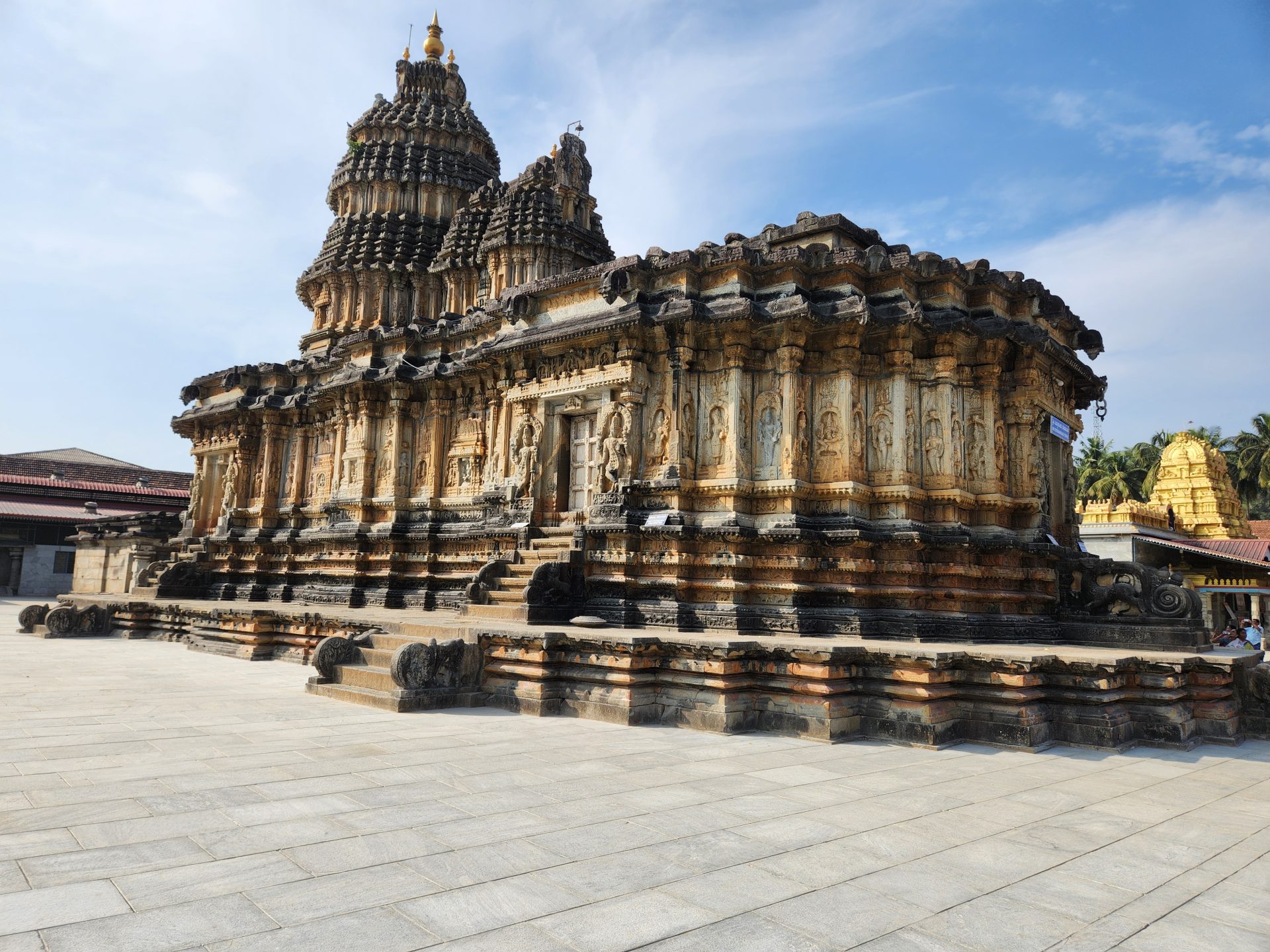
From the bridge, one gets to see architecturally unique Vidyashankara temple, dedicated to Lord Shiva. Sringeri is a significant Hindu Pilgrimage Center and is renowned for its Vedic Learning, Sanskrit education, Spiritual heritage and the natural beauty all around.
The Sringeri Sharada Peetham, one of the 4 Cardinal Monastic institutions has been established here by Adi Shankaracharya to propagate Advaita Vedanta philosophy, the other 3 being in Puri in Odhisa, Dwaraka in Gujarat Jyotir Math (Badrinath/Joshimath)in Uttarakhand.
The Gopuram from the entrance
The View from Inside
The Sharadamba temple is dedicated to the Goddess of Knowledge Saraswati. Sringeri’s name comes after Sage Rishyashringa and legends attribute the peaceful nature of the town to a snake protecting a frog from the sun.
Its believed that the earliest version of the Shiva temple was built in the 14th century while the temple which houses Goddess Saraswathi, in the 15th century. The Vidyashankara temple is a fusion of the Hoysala and Vijayangara style of architectures and has an apsdal shape.
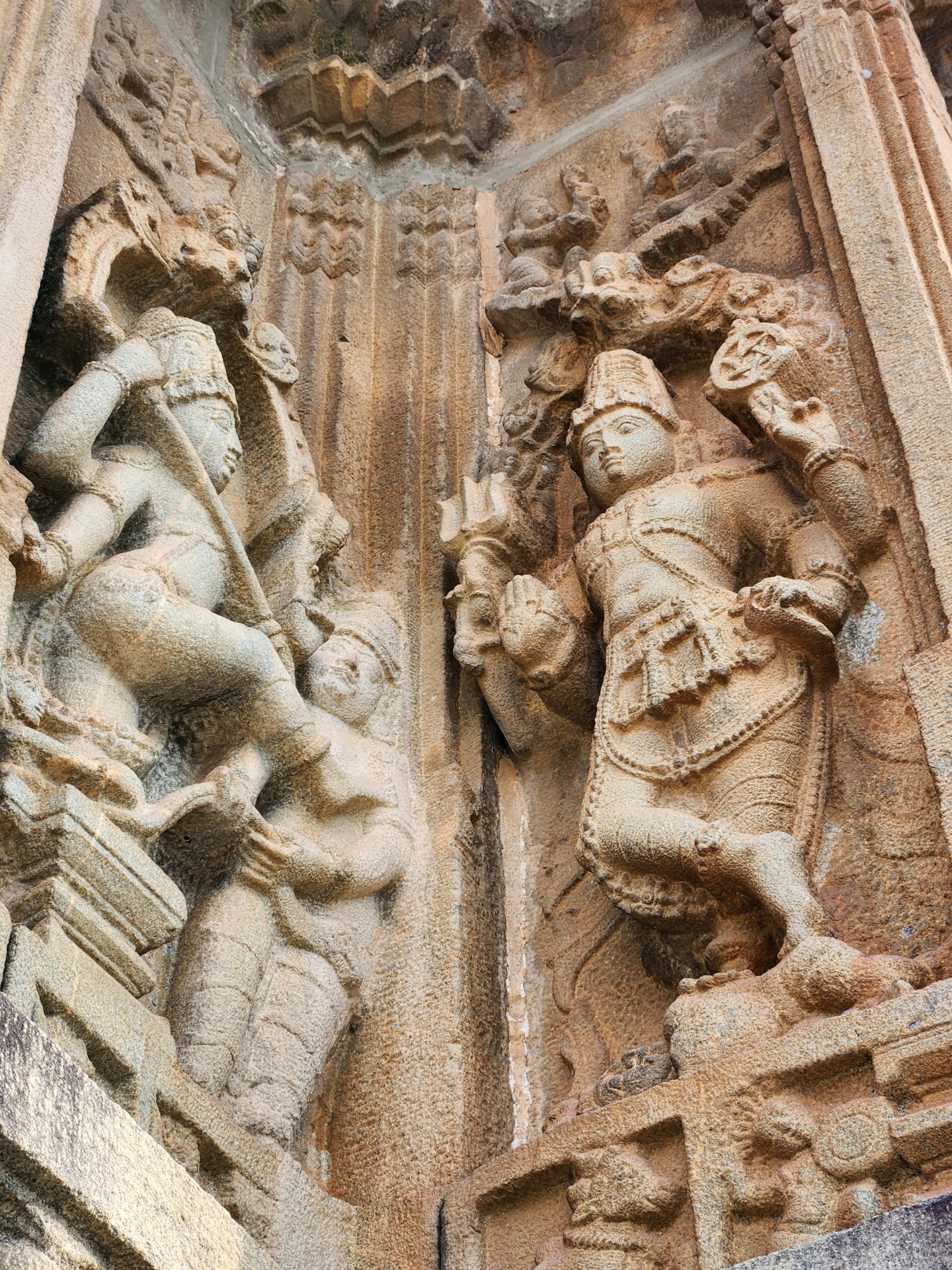
While the Gateway tower and outer walls use an almost circular plan, the inner chambers and sanctum are built square. Built on a high plinth like most Hoysala temples, the basement is adorned with ballustrades and sculpted animals with elephant-lion hybrids flanking the steps.
As per the monastery tradition, it is stated that Adi Shankaracharya installed a sandalwood image of Saraswati as Sharadamba in a simple shrine which was later replaced by the 11th Acharya of Sringeri Sri Bharathi Thirtha by a statue in gold.
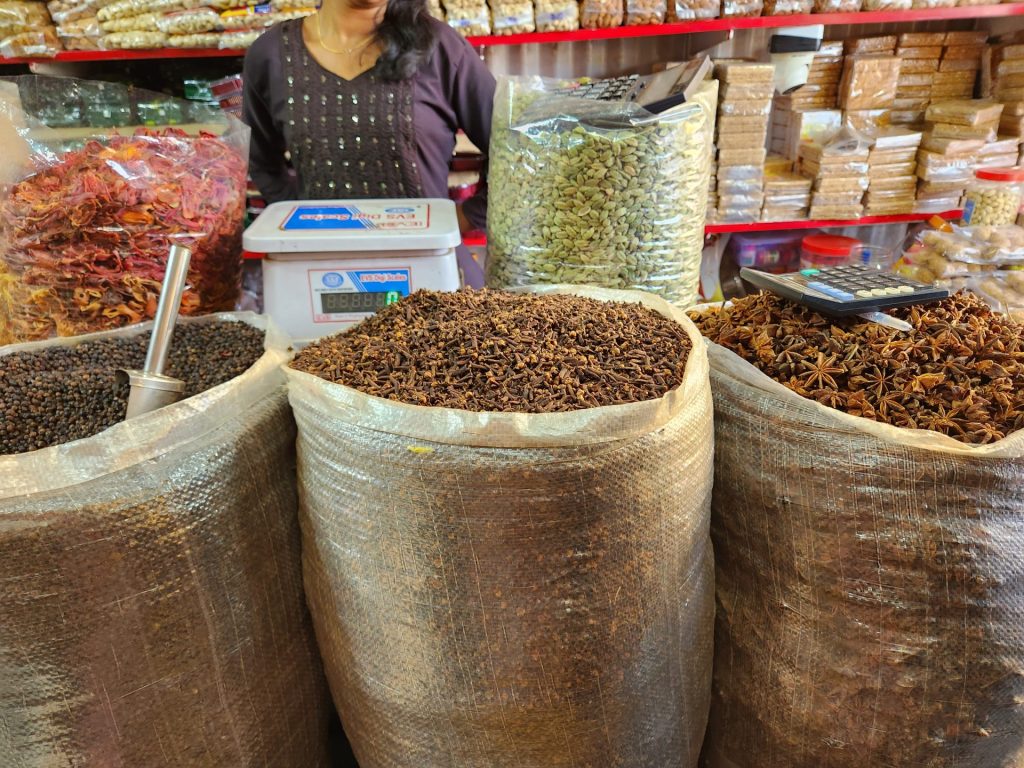
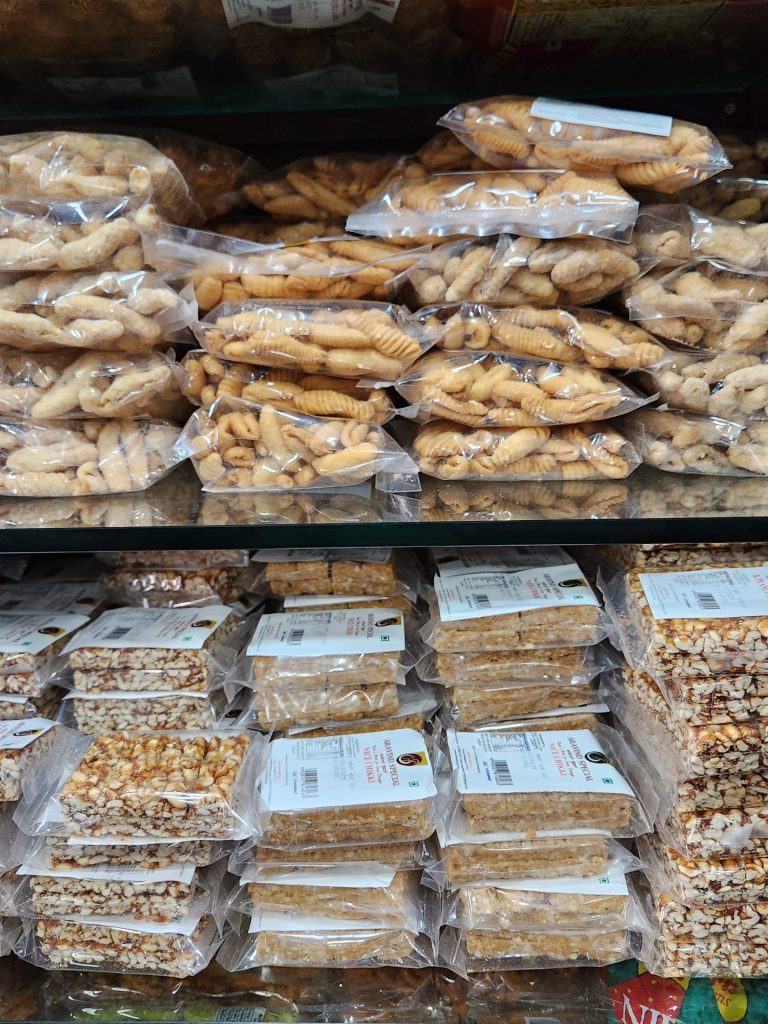
Some Spicy shopping before leaving
Some Spicy shopping before leaving
The Agumbe Ghats
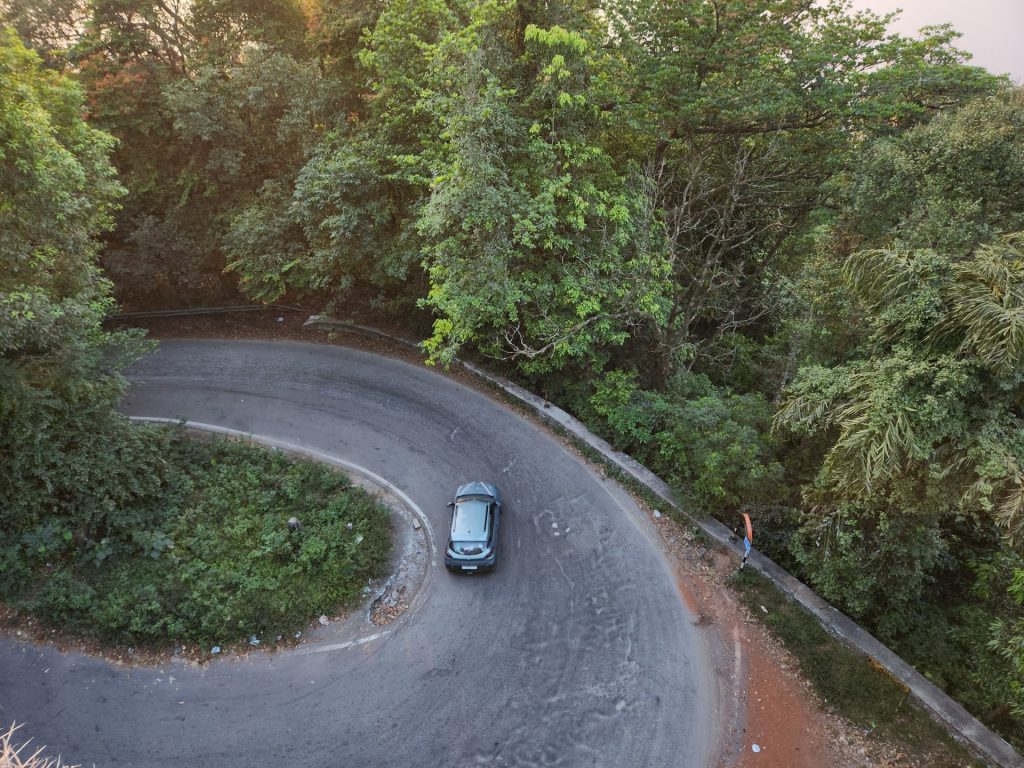
We left Sringeri at around 4.30 PM for Udupi and had chosen to drive through the Agumbe ghat road. The 80 kms drive was through coffee plantations, lush green dense forests for quite some distance. Lots of greenery and picturesque views and around 18 steeps hairpin bends on the descent made it for a pretty adventurous ride.
Agumbe is known to the Cobra Capital of the country, given that there are 71 species of snakes including the King Cobra which are abound here.
Agumbe is also referred to “Cherrapunji of South India” for its heavy rainfall and is famous for its stunning rainforests, biodiversity (Indian Giant Squirrels, Hornbills), scenic waterfalls (Barkana, Onake Abbi), and spectacular sunsets over the Arabian Sea.
We stopped by at the Sunset View Point which was just before the onset of the hair pin bends and commenced our journey at around 5.45 in the evening.
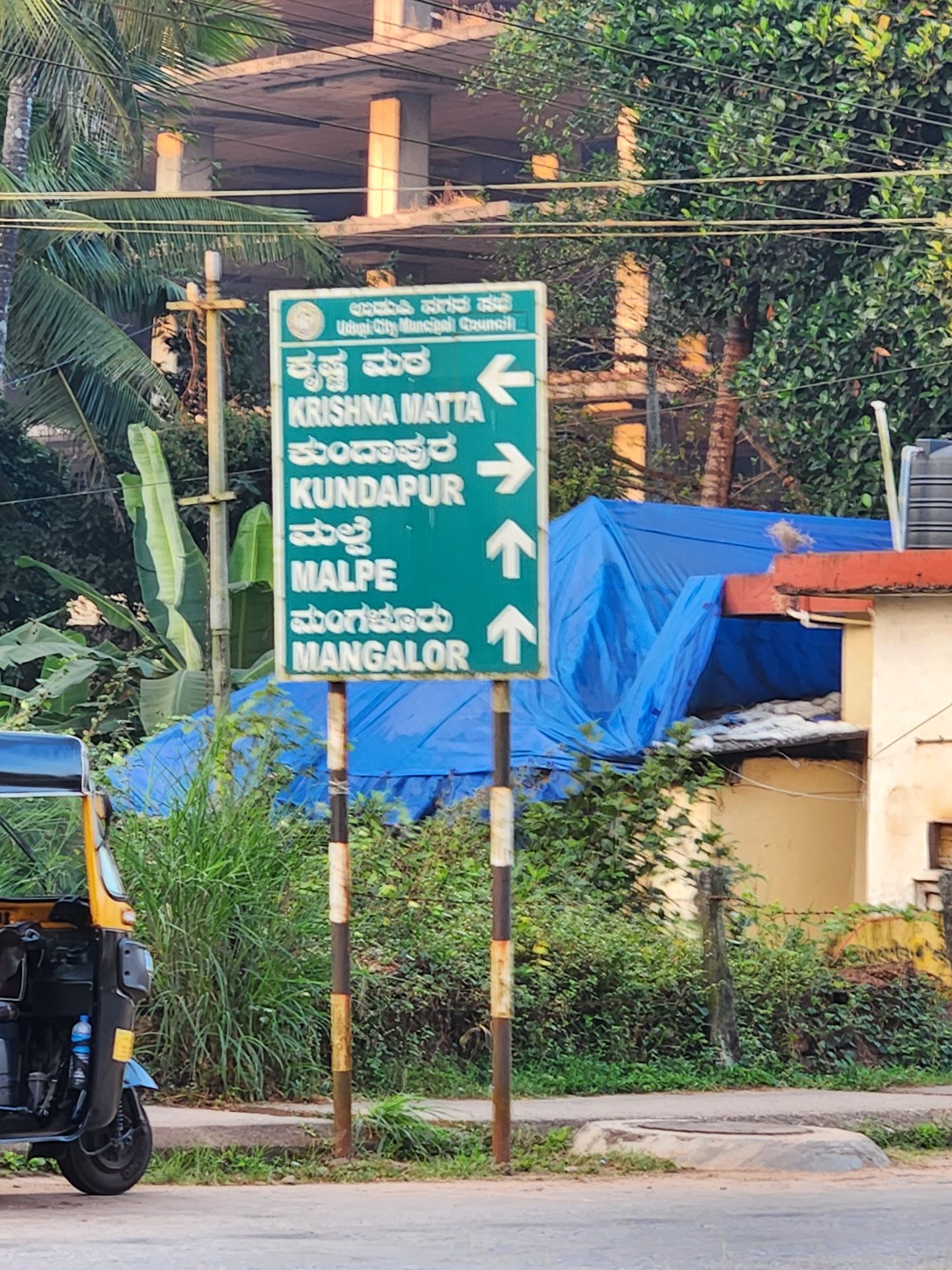
We had another 50 odd kms to cover and we entered the temple town of Udupi via Manipal and headed straight for the Krishna Temple by around 7.15 PM. The plan was to do a visit the temple that night and again the next day.
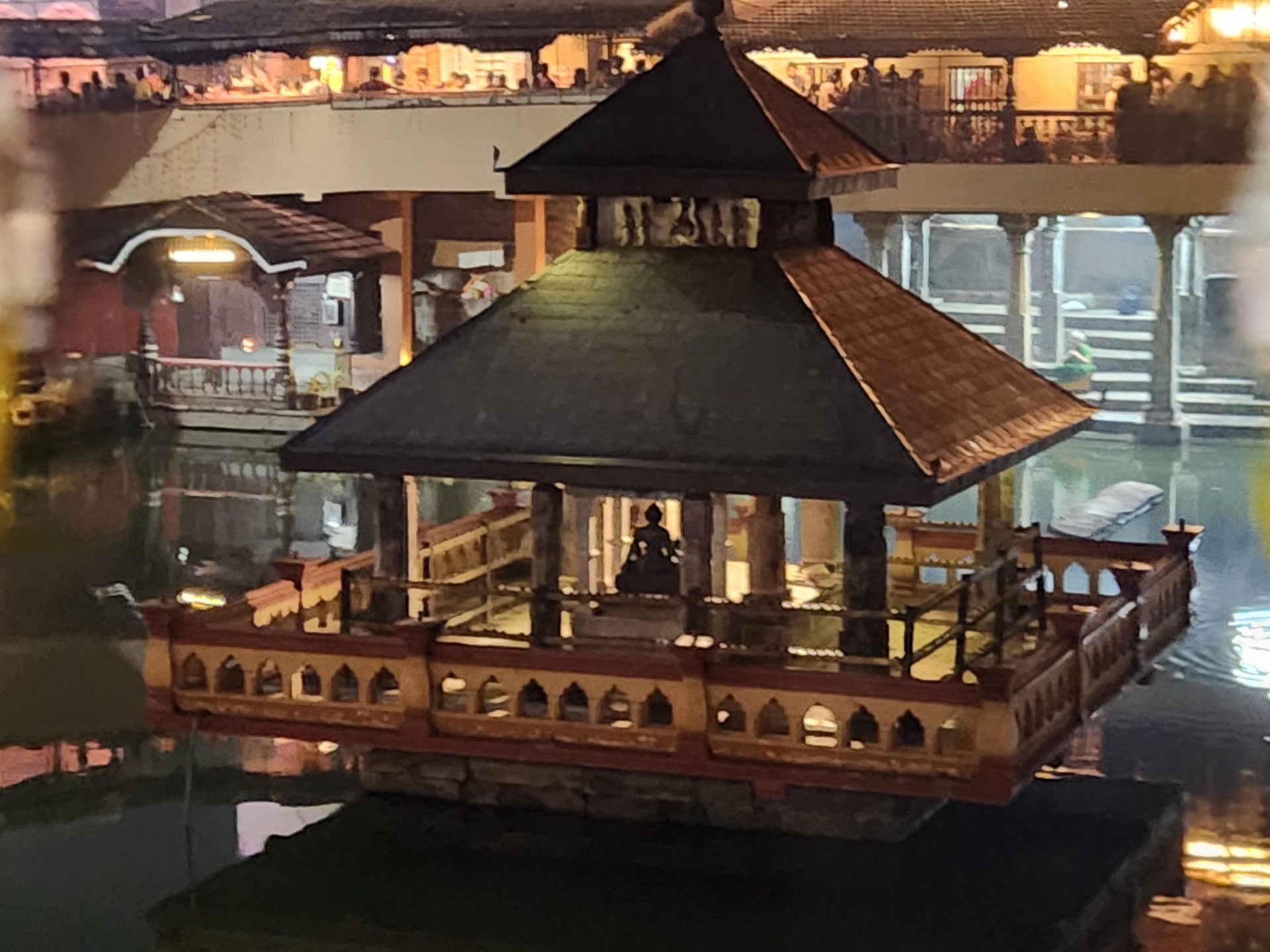
The Udupi Sree Krishna Temple by night
The Shri Krishna temple is a well known historic temple dedicated to Krishna and Dvaitha matha. Founded by the Vaishnavite Saint Madhavacharya in the 13th centur, the vigraha of Krishna was found in a large ball of Gopichandana. The darshan of Krishna is done through the silver plated 9 hole inner window, known as the Navagraha Kindi while the Outer window is known as the Kanakana Kindi. This is decorated by an Arch named after the saint Kanakadasa who was born as Veera Nayak and was an army chieftain of the Kuruba community in the Vijayanagara Kingdom.
After losing a battle, he became a dasa and devoted himself to singing devotional songs praising Krishna. During the time he came to Udupi as a pilgrim, the chief priest did not allow him inside the temple as he was a non brahmin and instead arranged a roadside hut for him where he continued singing and playing the Tanpura. It is said that the Krishna idol turned westward to face him, so impressed by his devotion. An earthquake on one particular night created a crack in the shrine wall, allowing Kanakadasa to see the idol and the chief priest on learning about this, widened the crack into a window than sealing it.
From the television on display
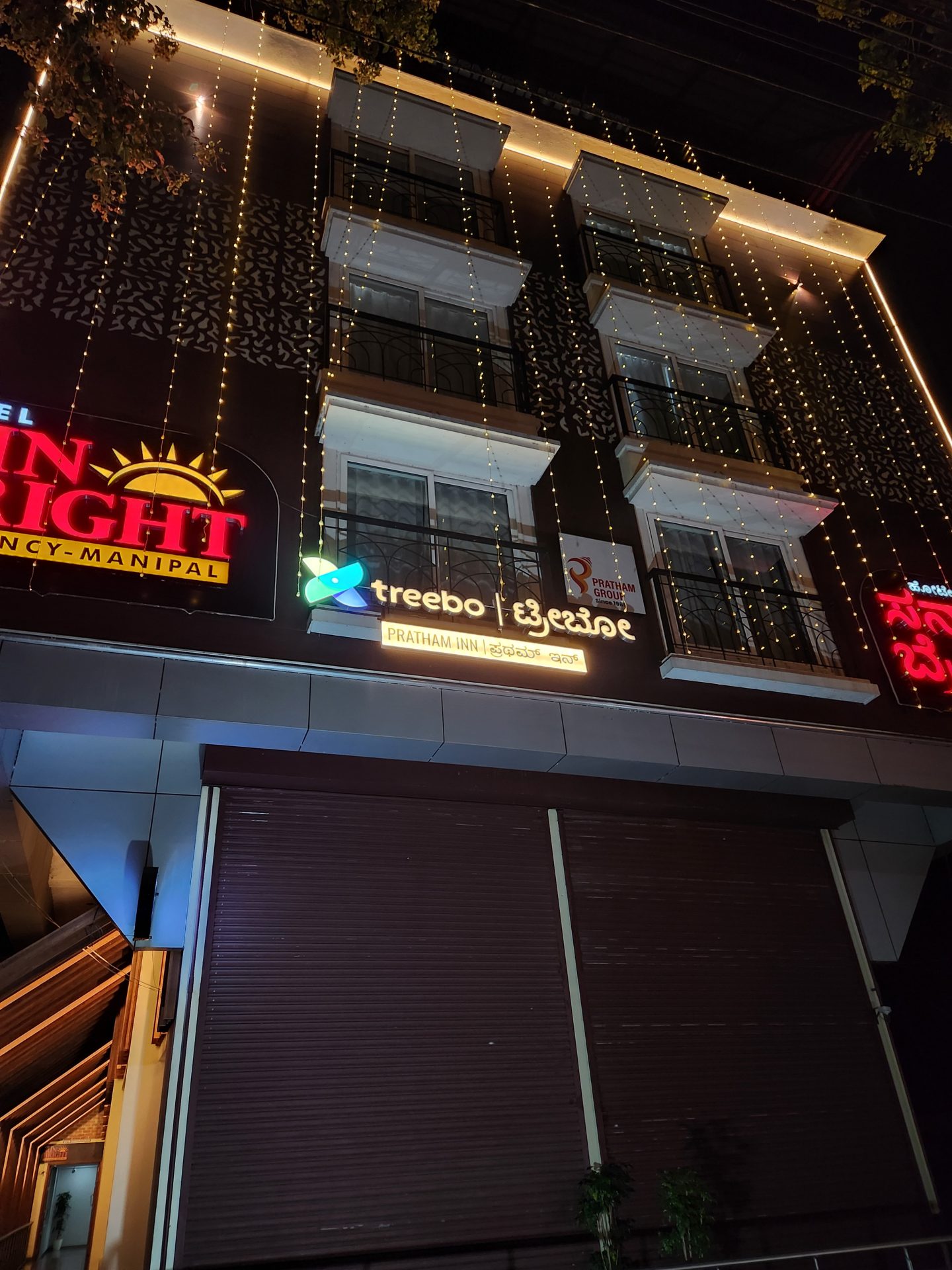
We left the temple premises at around 9 in the night and checked into Hotel Treebo Pratham Inn, 4 kms from the temple and on the road leading to Manipal. The plan was to stay within the city so that it gave us an opportunity to visit the Krishna temple the next day morning. Dinner was ordered through Zomato from a restaurant called New Shanti Sagar, post checking out a few random reviews. And the food was excellent. By the time the dinner got over and we crashed, it was almost 11.30. Fortunately, we had planned a 9.30 AM start the next day to Kollur and we had sufficient time to catch up with some sleep.
Hotel Treebo Preetham Inn @ Manipal/Udupi
Dec 9th 2025
The ladies took a rick to the temple while I went for a morning run upto the temple and came back. The weather was pretty nippy and the inclines on the road made it tough for running but managed a good 1 hour run walk. Finished a quick breakfast at the hotel and got ready for the day’s long drive ahead.
The Udupi Sree Krishna Temple by day
The ladies had finished their breakfast by the time I was at the lobby to carry out the checkout formalities. We started our drive towards Kollur by around 9.30 AM
Day 4 : Kollur and Gokarna
The 70 Kms odd drive brought us to Kollur town by around 11 AM. The temple is in the foothills of the Kodachdari Hills and on the banks of the Souparnika river.
A key pilgrimage site in Karnataka, the Kollur Shree Khsthram housing the Mookambika temple has been built in the Kerala-Dravidian architecture style and represents the Divine Mother as Goddess Saraswathi, Lakshmi and Parvati or Mahakali in a rare Tridevi as Shakti or Devi Mookambika.
The goddess got this name after killing the demon Mookasura, also known as Kaumasura.
This is centred around Swayambhu Linga (self manifested) Linga and a golden chain separates Sakthi on the left hand side and Trimurti (manifestation of Shiva, Vishnu and Brahma) on the right hand side.
A four handed Panchaloha idol of the Goddess Mookambika seated in a Padmasana position can be seen with 2 hands holding a Discuss and a Conch while the other 2 hands depict the Abhaya and Abeestha mudras. The temple also has idols for Ganapathy, Shiva, Vishnu, Hanuman, Subramanya, Virabhadra and the Snake gods.
The temple is generally very crowded on Tuesdays and Fridays and lots of people from the neighboring states also come in.
Special darshan tickets costing Rs.500/- are available and in case you do not have too much of time on your hands, this is an easier way to get inside.
Its believed that Adi Sankaracharya had set up the statue of Devi. The source of the Shakti has been described through ancient scriptures found here and dates back to 148 AD.
We left Kollur around 12 Noon for Gokarna, located around 135 Kms away and around 1 PM we pulled into Udupi Deluxe, a nice restaurant in the town of Bhatkal.
South Indian Karnataka style thalis, some Dal Khichdi, Palak Soup and Strawberry Soda formed part of our repast and at around 1.45 PM, we commenced our journey to Gokarna.
We left Kollur around 12 Noon for Gokarna, located around 135 Kms away and around 1 PM we pulled into Udupi Deluxe, a nice restaurant in the town of Bhatkal.
We had read about the Vishnu Theertha in Kumta enroute Gokarna through Instagram and decided to check it out. After an hour’s drive and a deviation into the town for around 3 Kms, to our disappointment, the gates were locked and looked like nobody seemed to have visited the temple in recent times. Maybe a dated Insta story but there was not a single soul around who could tell us if the temple gates would open or not.
We finally left by around 3 PM and reached the town of Gokarna by around 3.30 PM. A bit of searching around since the Google maps was making us go in circles and we finally hit the Kudle Beach Resorts by around 4 PM.
The Kudle Beach View Resorts & Spa @ Gokarna
A beautiful resort built atop a cliff and overlooking the Kudle beach, we finished the check in formalities and were shown into our room in around 15 minutes. The travel had taken its toll on the ladies and we decided to stay put in the rooms for the day and plan the visit to the beaches and temples in Gokarna the next day, since we were anyways scheduled to stay here for 2 nights.
Got out of the room around 5.30 PM in the evening to stroll around the resort and capture the sunset across the beach from the resort. Spent around 45 minutes idling around and came back to the room around 6.30 PM. Folks were still asleep and got out to the balcony and spent some time catching up with my mails. Around 8 we ordered dinner at the resort’s restaurant Seashell and crashed early.
We had decided to give the Beach Trek a skip and the plan was to do the Om beach in the morning and Kudle beach in the evening along with a visit to the town to see the Gokarna temples and beach.
Dec 10th 2025
The Om Beach @ Gokarna
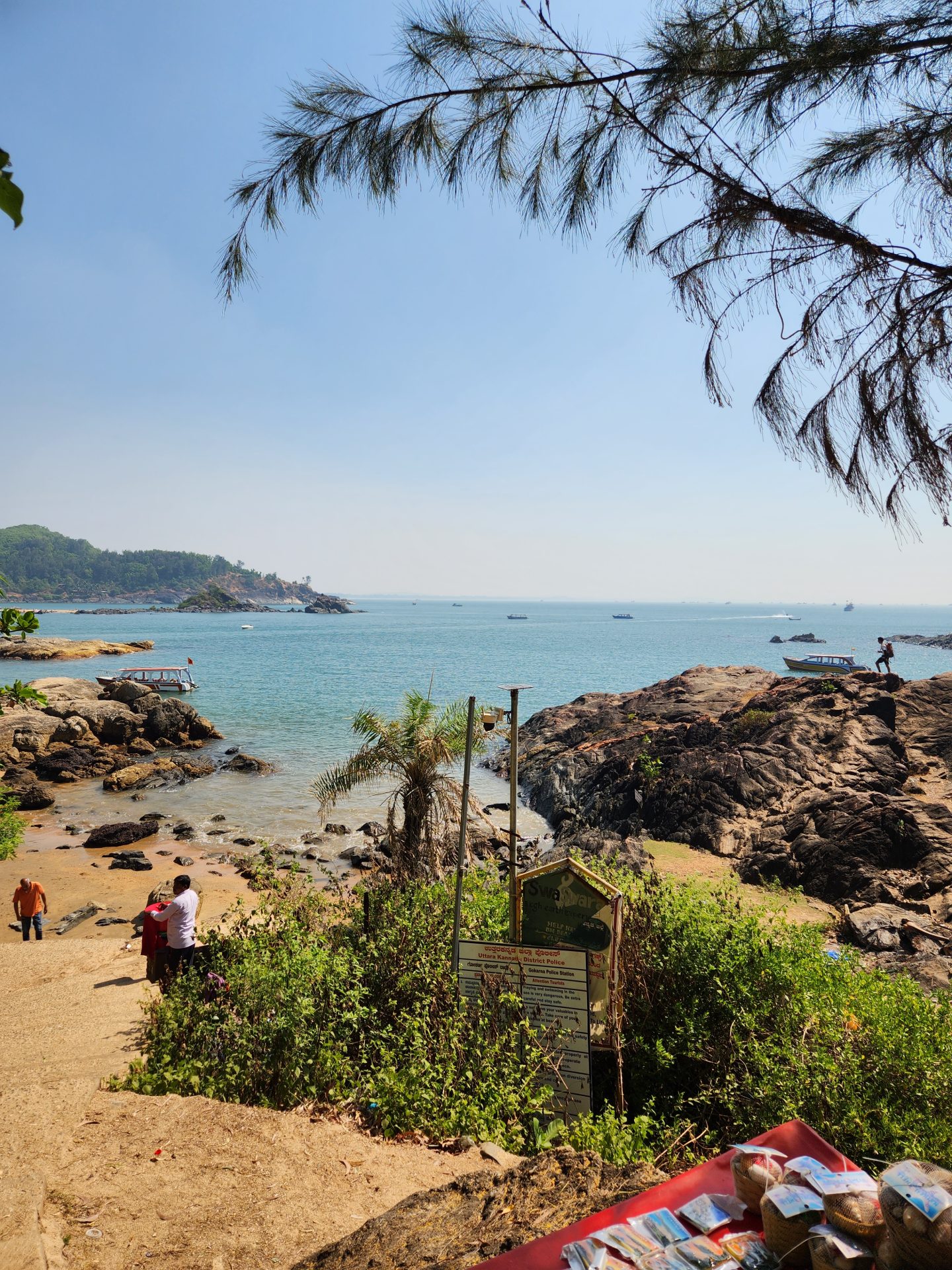
After a hearty breakfast at the resort at around 10.00 AM we started for the Om beach, located around 3 Kms away. We reached the beach after a pretty steep descent over a flight of stairs.
The views were pretty amazing as we kept descending. Standing right atop before the final descent, one could see the shape of the beach in the form of an Inverted ॐ.
Café Namaste was there right at the entrance to the beach and there were a few shops selling trinkets and magnets which immediately caught the attention of the ladies.
While they kept themselves busy between tender coconut water and shopping I decided to check out the boat ride to see the various other beaches.
The ladies refused to join me and it was me all alone in the company of 6 other tourists who set sail towards mid sea to see the Lighthouse, the point where the river meets the sea and the other beaches. The boatman said that if we are lucky, we could get to see dolphins and asked us to wear the Life jackets before the ride commenced.
The first of the stops was at a point where the Adhanashni river meets the sea. The town of Gokarna lies between this river and the Gangavalli river.
One can clearly discern the change in colour of waters from blue to black. The boat stopped for a while mid sea to check for the dolphins but it was not our day I guess. We then passed by the Lighthouse atop a hillock, the Paradise Beach, the Half moon beach shaped like a crescent where one of the couple families disembarked and then the entire stretch of the Om beach till the place where we had boarded. A 45 minute ride came to an end around 11.30 and costed me Rs.500/-.
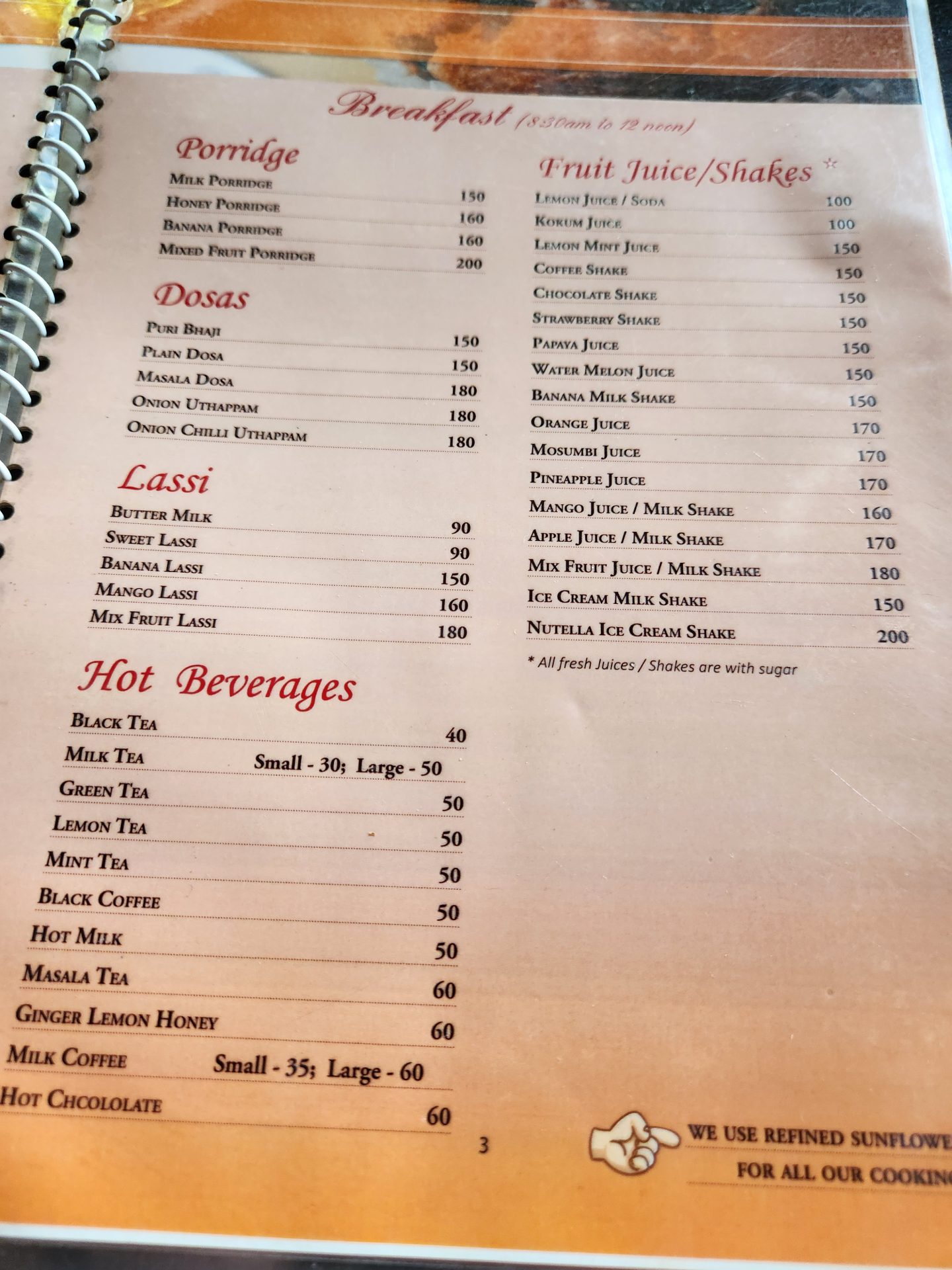
We spent some time in the waters and finally headed for the Namaste Café to get ourselves some cold coffee and shakes. We were back in the resort by around 2 PM and none of us were hungry. Decided to share some curd rice ordered at the resort and chilled out for a couple of hours before the evening trek towards Kudle beach which was there right below our resort.
The Kudle Beach @ Gokarna
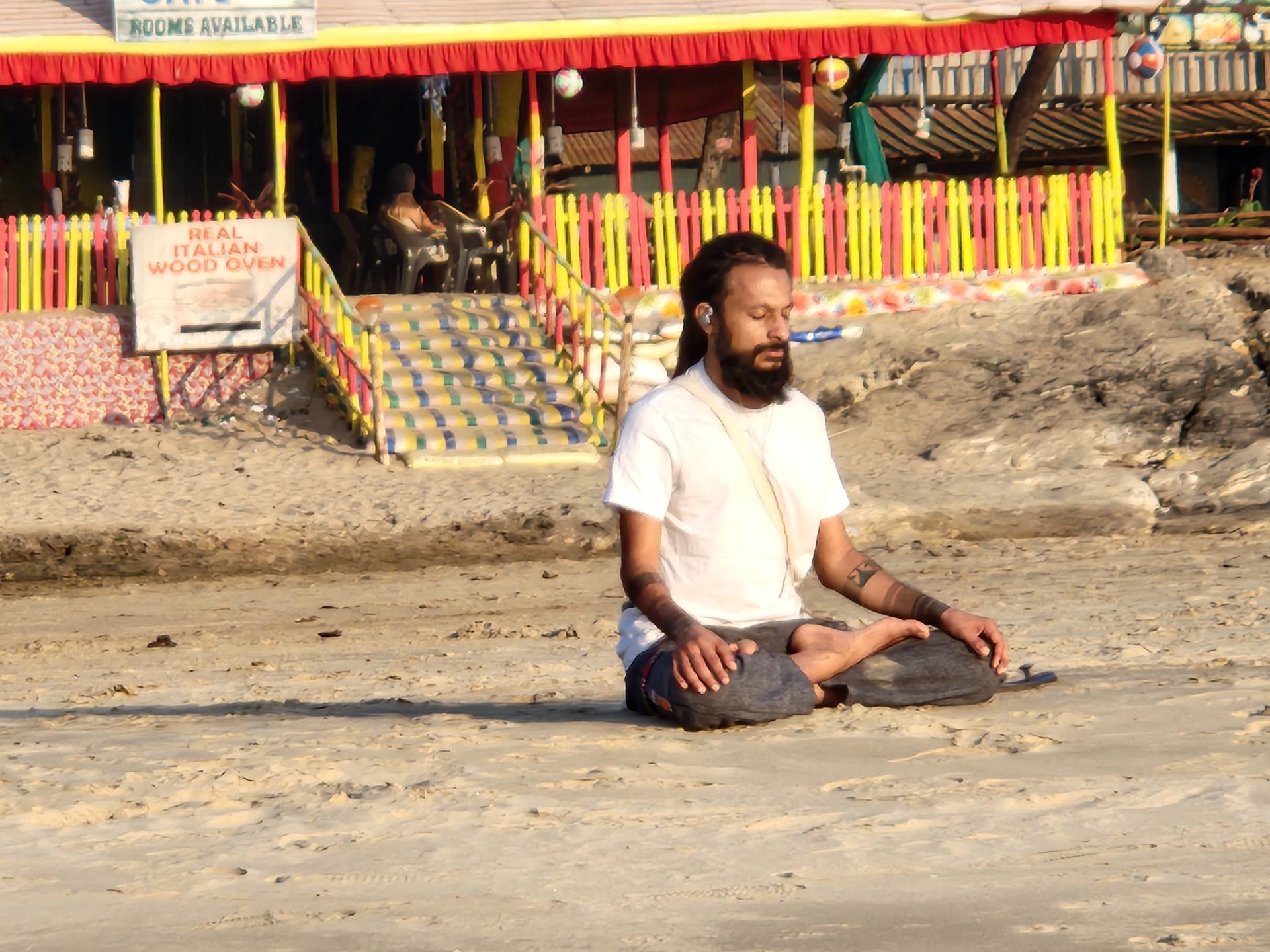
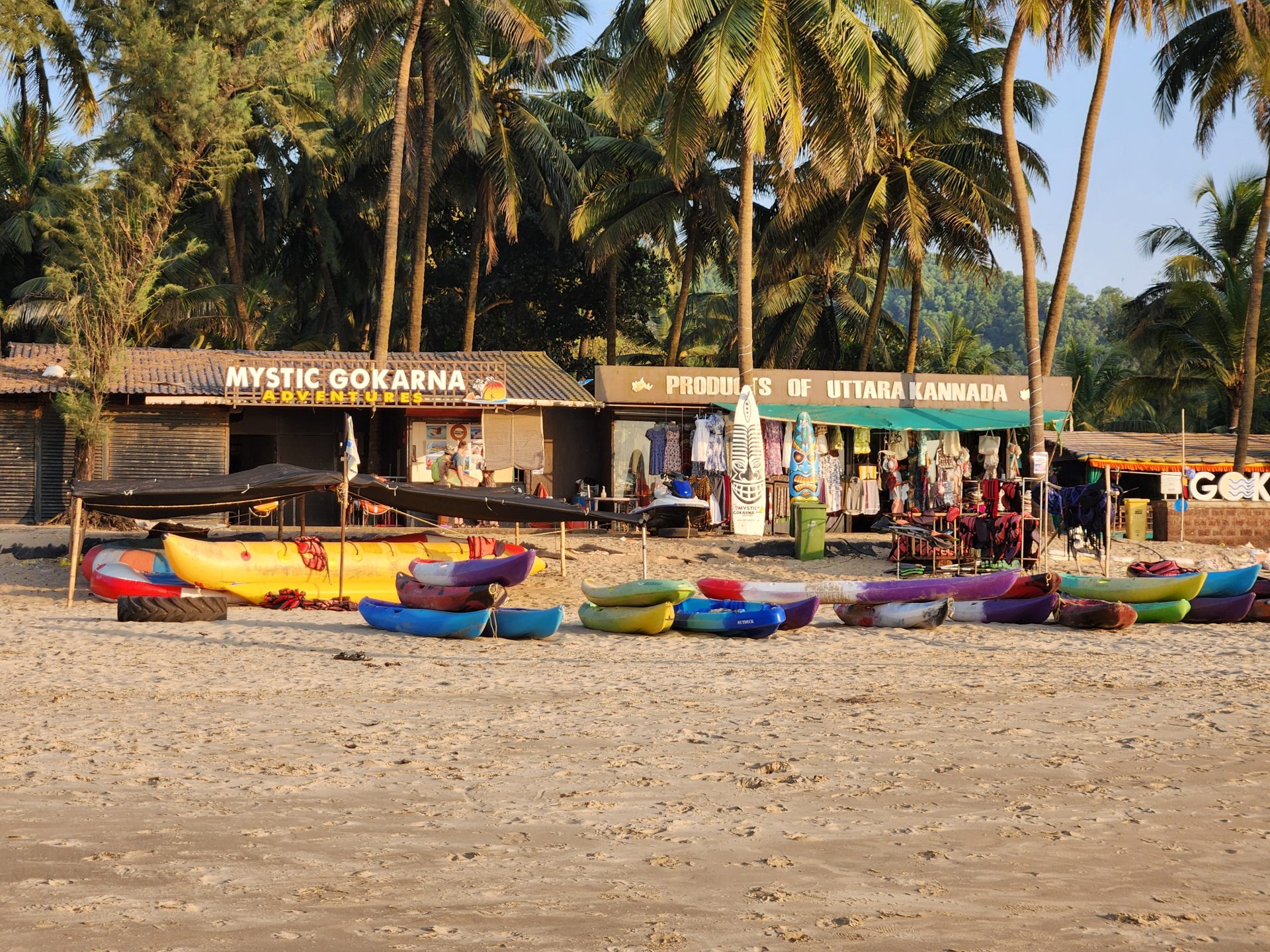
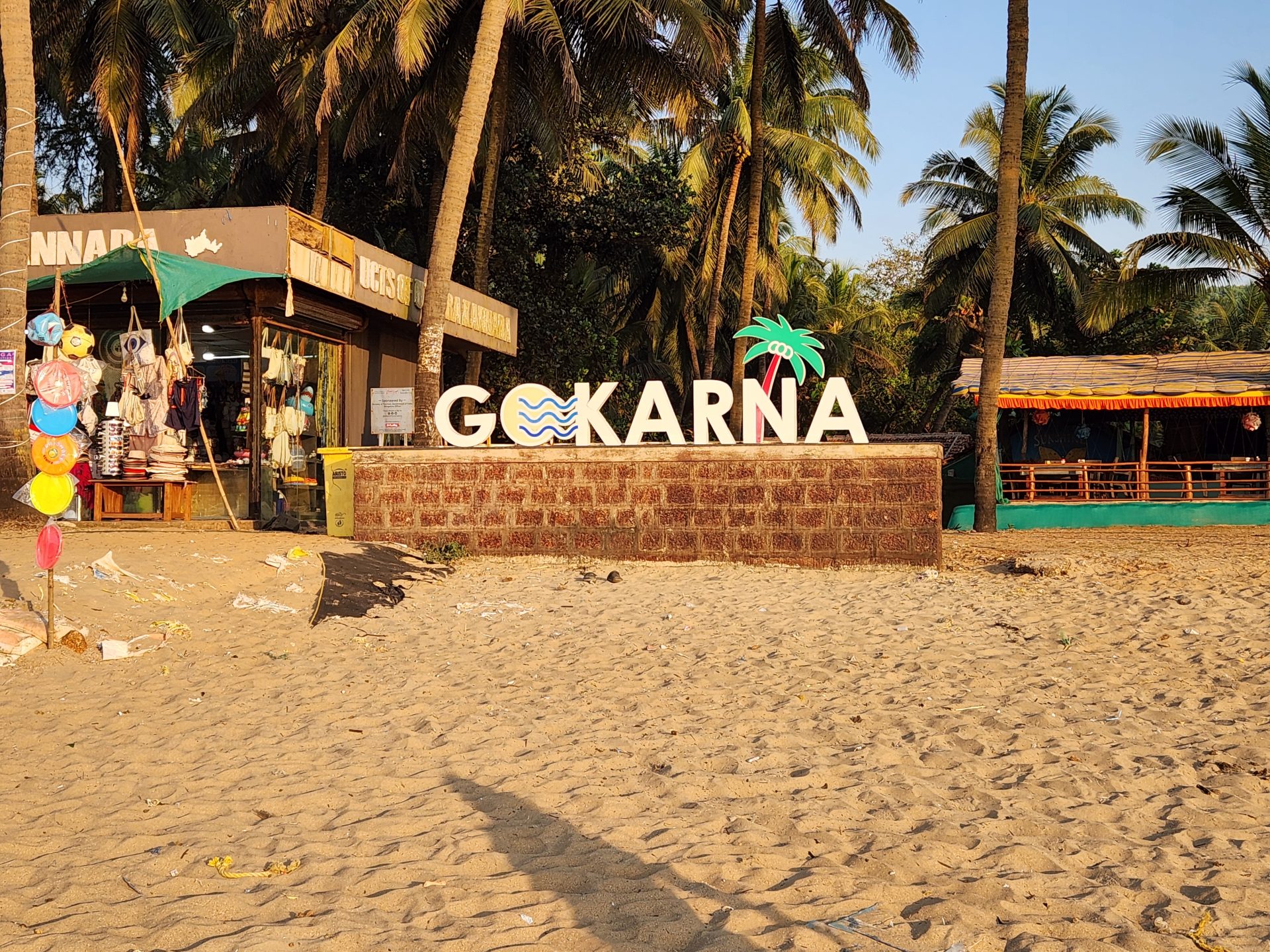
The Kudle beach was a 10 minute walk from our resort and around 4.30 in the evening we entered the beach area. A pretty clean beach save for one of those stray cattle which was loitering around. A few folks were meditating on the beach, a few indulging in Parasailing, Water Skiing and Banana boat rides.
We indulged in yet another round of shopping and walking on the pristine beach and finally reached our resort at around 5.45 PM. Our car driver was ready and we started off for the temples of Gokarna, knowing well that it would be dark by the time we reach the Gokarna beach.
The Gokarna Mahabaleshwar Temple
The first of the stops was at the 4th Century CE Gokarna Mahabaleshwar Temple. The temple holds lot of significance for the origin of the name Go-karna meaning the Cow’s ear.
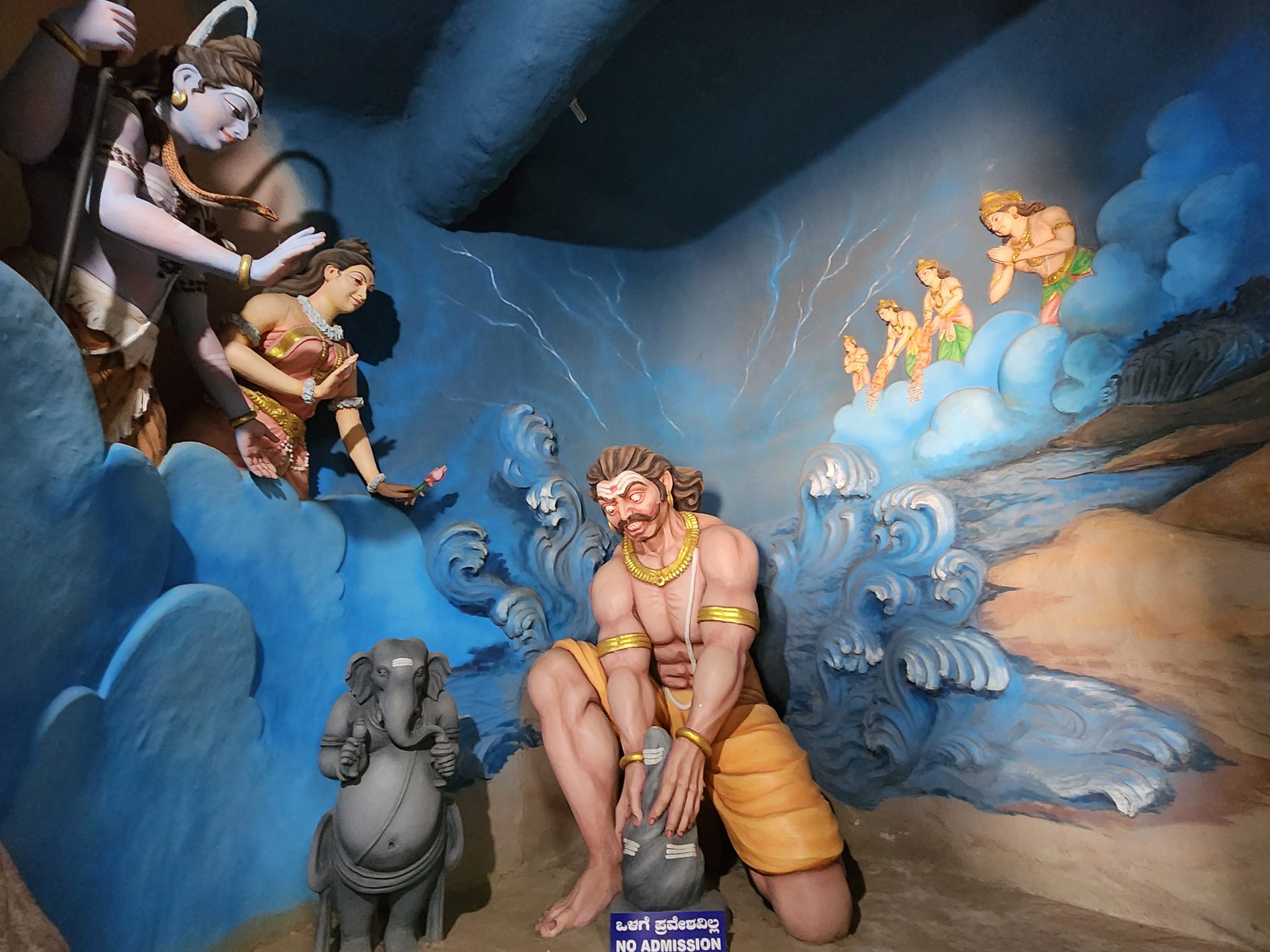
Legend has it that Lord Shiva appeared from the ear of a cow or where the Atmalinga (Shiva’s soul lingam) was placed by Lord Ganesha. Pleased with his penance at Mount Kailasha, Lord Shiva bestowed Ravana with the Atmalinga which would make him invincible but only on the pre-condition that the Linga would remain permanent wherever he placed it on the ground.
On his way to Lanka and while in Gokarna, the gods devised a plan to disallow the Atmalinga from reaching Lanka and Lord Vishnu using his Chakra blocked the sun.
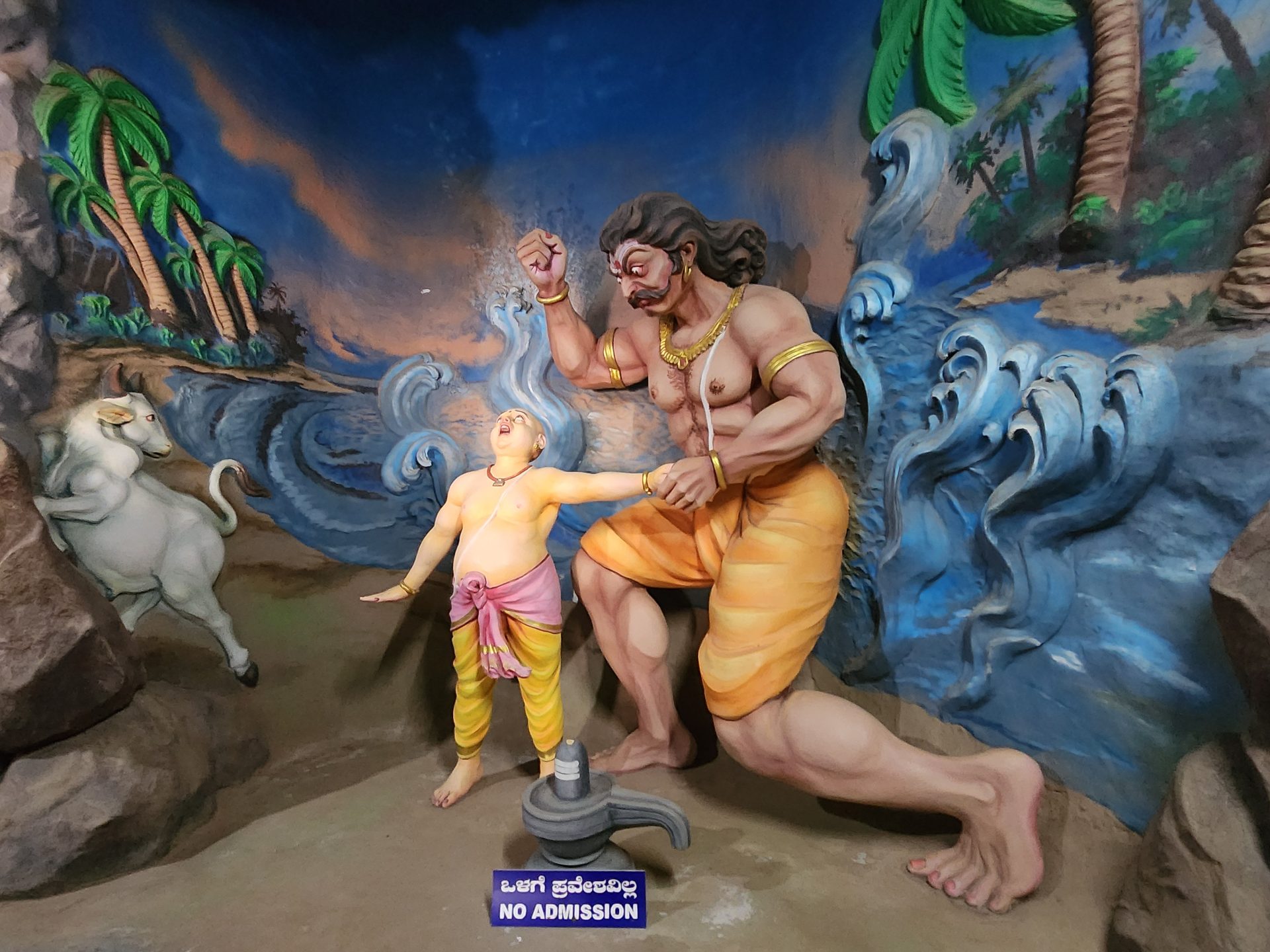
Thinking it was dark and time for his prayers Ravana agreed to give Lord Ganesha who was disguised himself as a brahmin boy to hold the Linga for him till he completed his prayers.
Lord Ganesh had one precondition that in case he is not able to hold on to the weight for long, he would call out Ravana’s name thrice.
Ravana was so deeply immersed in his prayers that he could not hear Ganesh’s cry who quietly then placed it on the ground and disappeared.
When Ravana tried to lift the Linga, he could not and in anger threw the offerings atop the lingam and which is where the temples of Murudeshwar, Dhareshwara, Gunavanteshwara and Shejjeshwara have been formed.
He named the Linga Mahabala, one with lot of power and that was how the name of the temple originated. This temple is also known as the Kashi of the South.
This temple is one among the 7 sacred places of salvation or Muktikshetras where many Hindus of Karnataka perform the death rites for their departed, the other 6 being Kollur, Udupi, Subrahmanya, Kumbasi, Koteshvara and Sankaranarayana.
The temple is believed to have been a large complex of shrines and much of it belonged to the Vijayanagara period. In this temple, devotees are allowed to touch the Atmalinga and offer prayers.
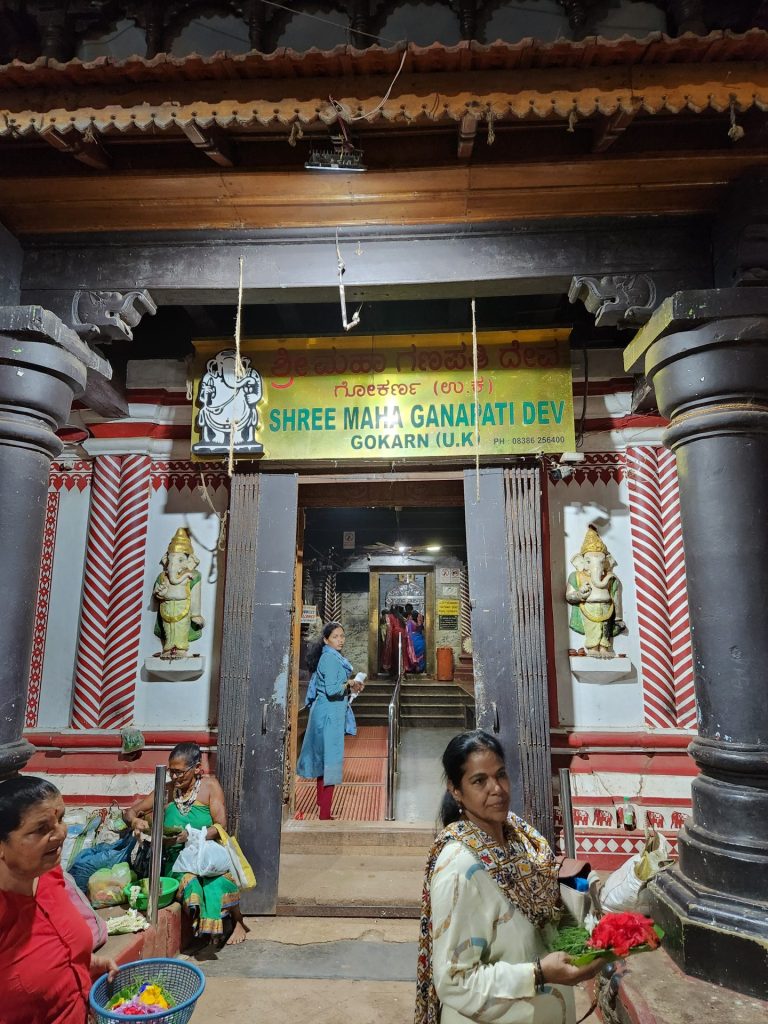
The Gokarna Maha Ganapati Dev Temple
Adjacent to the Mahabaleshwar temple and around 40 steps away lies the Shree Maha Ganapthi temple. The 1.3 metre tall black stone statue of Lord Ganesh has a hole near the head, believed to have been caused by a stone thrown in anger at him by Ravana when he dropped the Linga which he was supposed to hold on for him.
The statue is believed to be 1500 years old.
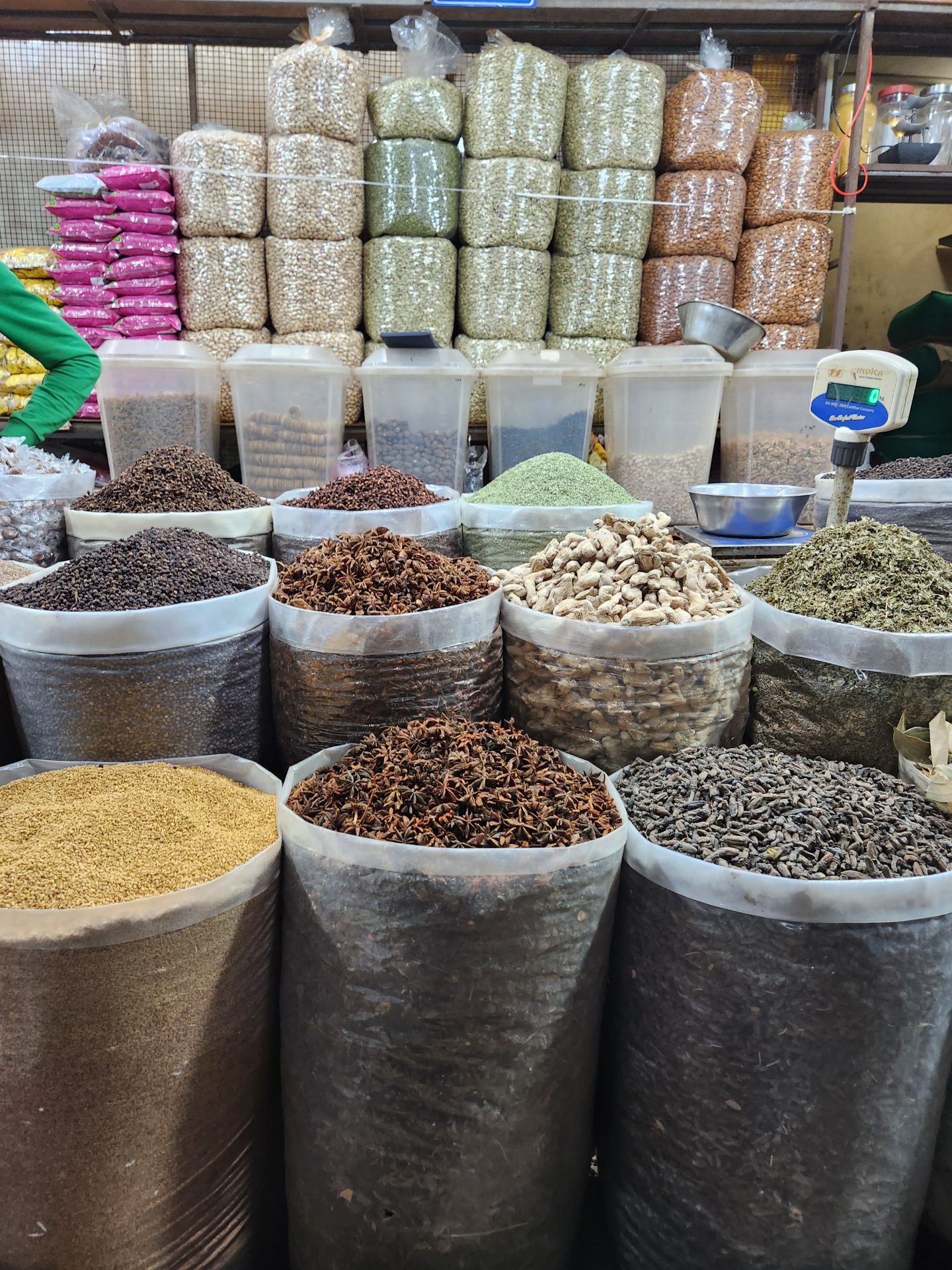
A little bit of shopping for spices and bags ensued in the Gokarna market and we then walked across to the Gokarna beach. It was dark but there were people moving around and we started for our resort by around 7.15 PM.
The Resort looked very picturesque and colorful at night and went around clicking some pictures.
Dinner was ordered at the resort itself and once our packing was done, we slept off as a packed schedule awaited us the next day.
Dec 11th 2025
The Shiva Caves @ Gokarna
After finishing off our breakfast at around 9 AM, we walked across to the Shiva Caves, also known as Ali Gerba or Gobharga Caves. The name Gobharga suggests womb of the cow connecting it to the larger Gokarna Legend where Lord Shiva emerged from Mother Earth at the confluence of the rivers. It was a 5 minute walk from our resort. A narrow opening took us to the interiors of the cave. Looked spooky but we decided to go in and explore it.
This is an ancient naturally formed cave on a mountainside. There is a natural Shiva Linga inside formed by dripping water. There are ancient carvings/inscriptions believed by mythology to be Lord Shiva’s abode and linked to the legend of the powerful Atmalinga brought by Ravana. A natural rock formation, believed to potentially be thousands of years old, with carvings dating back centuries
The Jatayu Theertha @ Gokarna
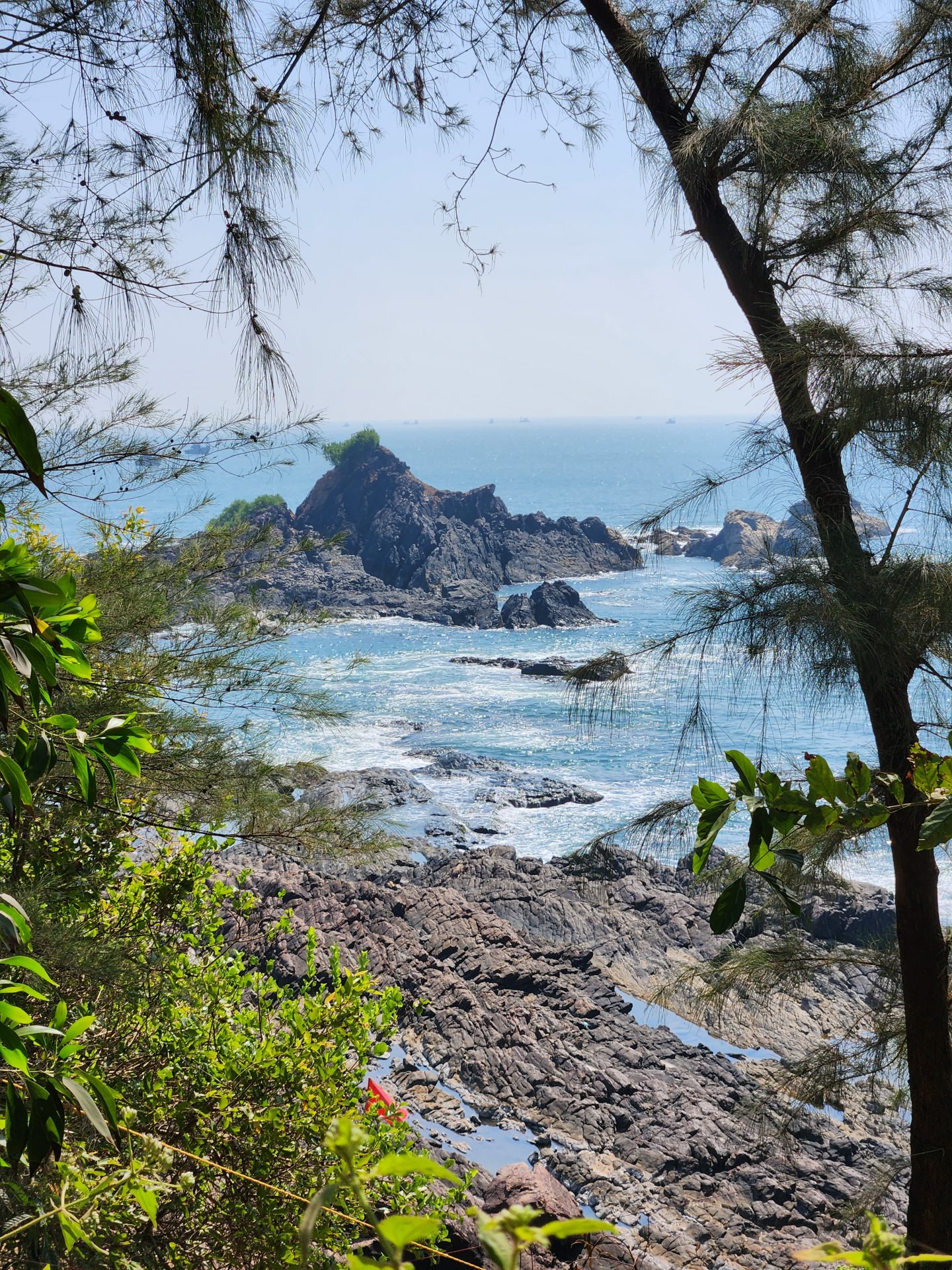
There was one more place near our resort to visit at a distance of 850 metres called the Jatayu Theertha which the ladies did not want to visit. Believed to be a spot where Jatayu fell while trying to save Ravana, the views from atop a cliff are amazing. The blue waters of the sea and the cliff formations look pretty picturesque. Was back at the hotel by around 10.00 A.M.
The Backwaters @ Honnavar
The plan for the day was to see quite a few places enroute on our way back to Managlore and we left our resort for Honnavar as the first stop.
Upon entry into the town of Honnavar, one needs to take a left turn onto Church Road and drive on for about a km to reach the point from where the backwater cruises start. As soon as we turned onto the road, a guy on a bike kept tailing us and then overtook us to keep looking back that we were following him.
All this happened in typical filmy style and we knew there was no escaping him. The guy Vivek emerged from the parking lot and showed us around the boat and the pictures from people who had done these boat rides into the mangrove forests.
Looked very tempting but given the heat, we finally decided to give this a skip since this would have taken up 45 minutes of our time in the hot sun and we would then have to wait at Murudeshwar temple for over an hour or two. We had done a similar backwater cruise in Poovar and that was slightly earlier in the morning and finally moved on.
The Shiva Temple @ Murudeshwar
At around 12.45 we pulled into the town of Murudeshwar.
The temple built atop the Kandiuka hill remains closed between 13.00 to 15.30 hours and we just about managed to enter the queue at the right moment before the gates were closed.
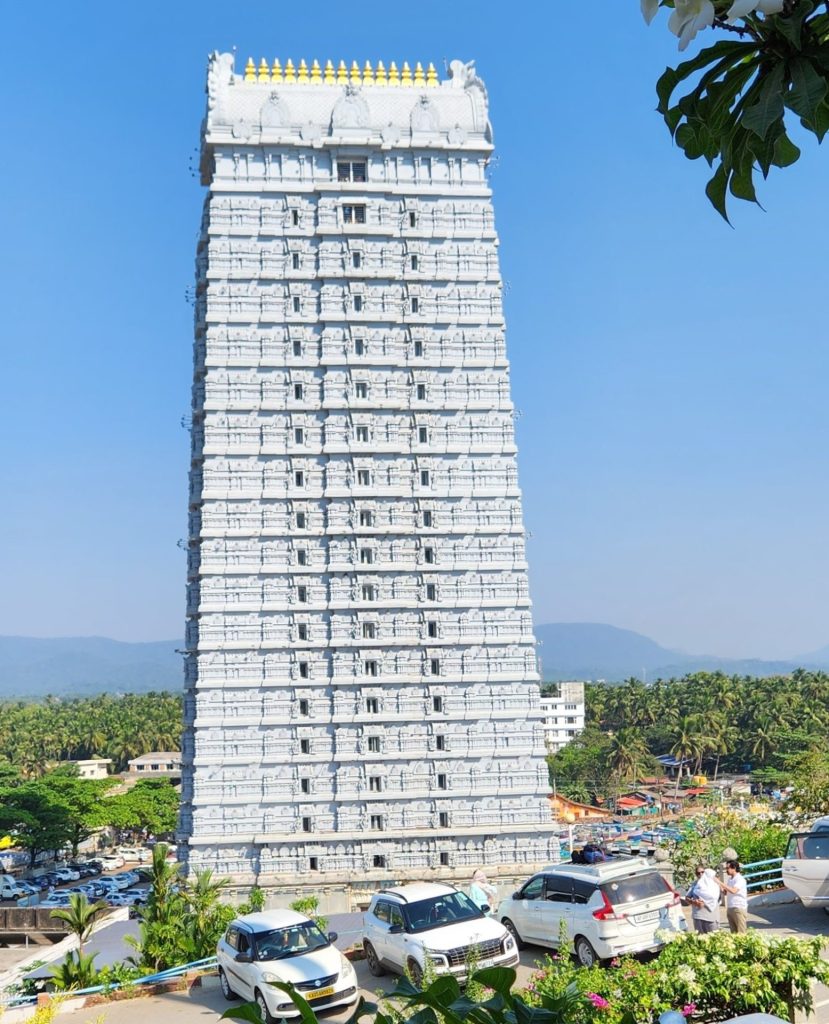
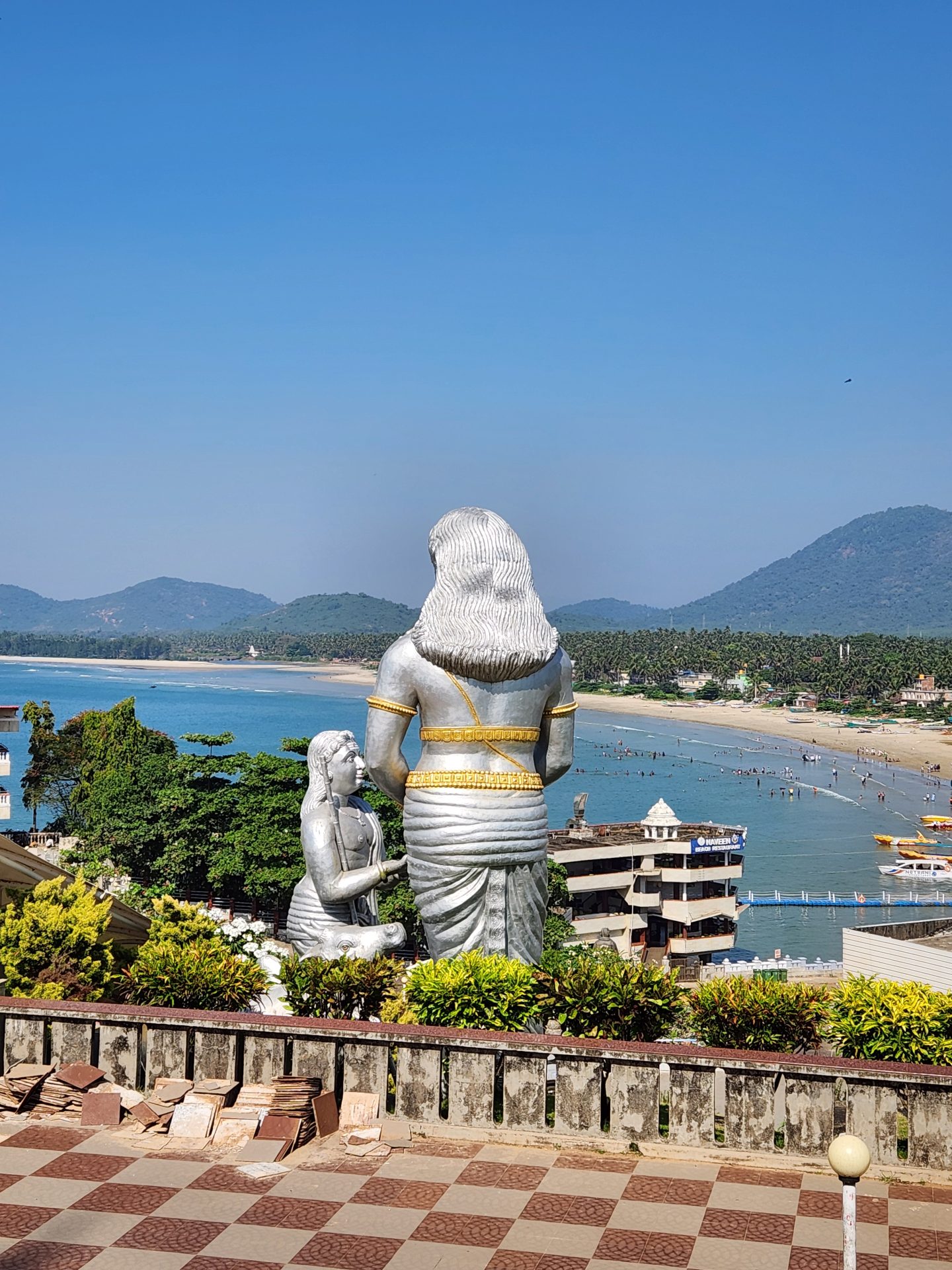
The Murudeshwar temple lies off the coast of the Laccadive sea and also has the world’s 3rd largest Shiva statue. The statue is 123 feet tall and took 2 years to build by Shivamogga’s Kashinath and several other sculptors and was funded by R.N.shetty, a businessman and philanthropist for around ₹50 million.
Right in front of the statue, there is a 20 storied Temple Tower which is India’s 2nd tallest.
It has an elevator which takes one right to the top for some stunning views from the top of the tower. One need to buy tickets for this at Rs.20/- per head.
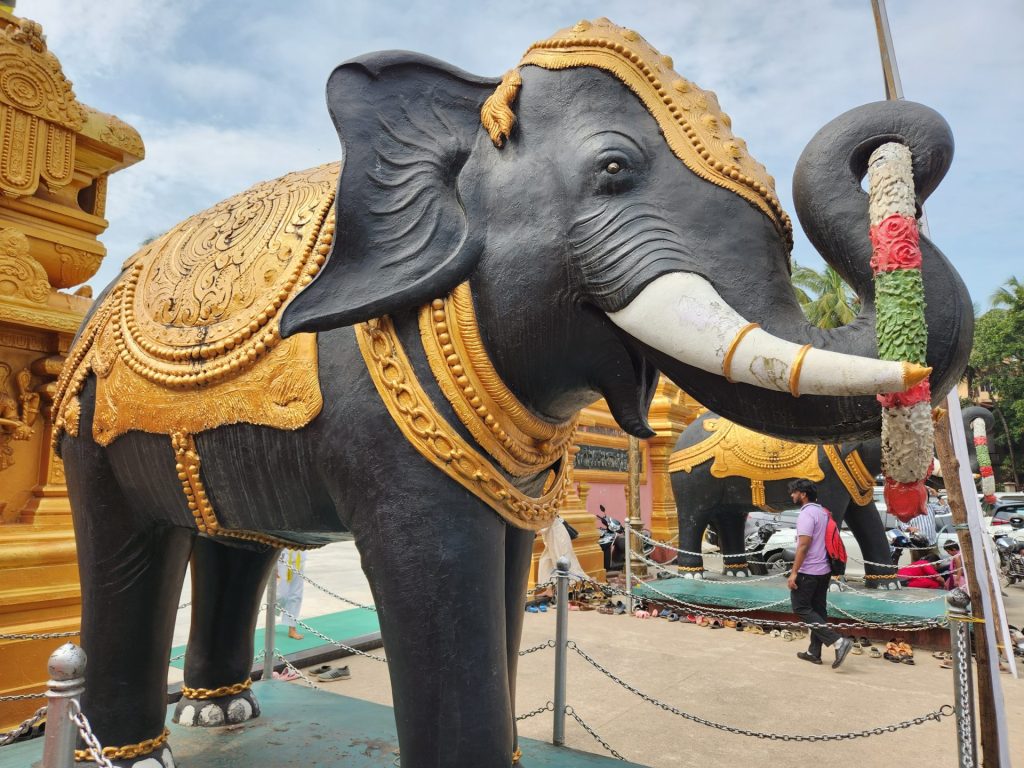
Built in 2008, the temple has a Rameshwara linga at the bottom of the hill which enables devotees to do the seva themselves while a Shaneeswar temple has been built next to the idol of Sri Akshayaguna. 2 Life size elephants built in concrete stand guard at the steps leading to the temple.
Adjacent to the giant Shiva statue is a park which has statues of the Sun Chariot and Arjun receiving the Geethopadesam from Lord Krishna.
Save for the sanctum sanctorum, the temple otherwise looks completely modernized. The main deity is Sri Mridesa Linga, also known as Murudeshwara. The Linga here is believed to be a piece of the original Atma Linga and is placed 2 feet below ground level. We were a bit unlucky not to see the statue in its full glow as there was some renovation work going on and a scaffolding was in place.
Right near the basement of the statue, there is a Bhukailasa Cave museum filled with statues and three dimensional models and scenes also known as Dioramas, depicting different stories of mythology.
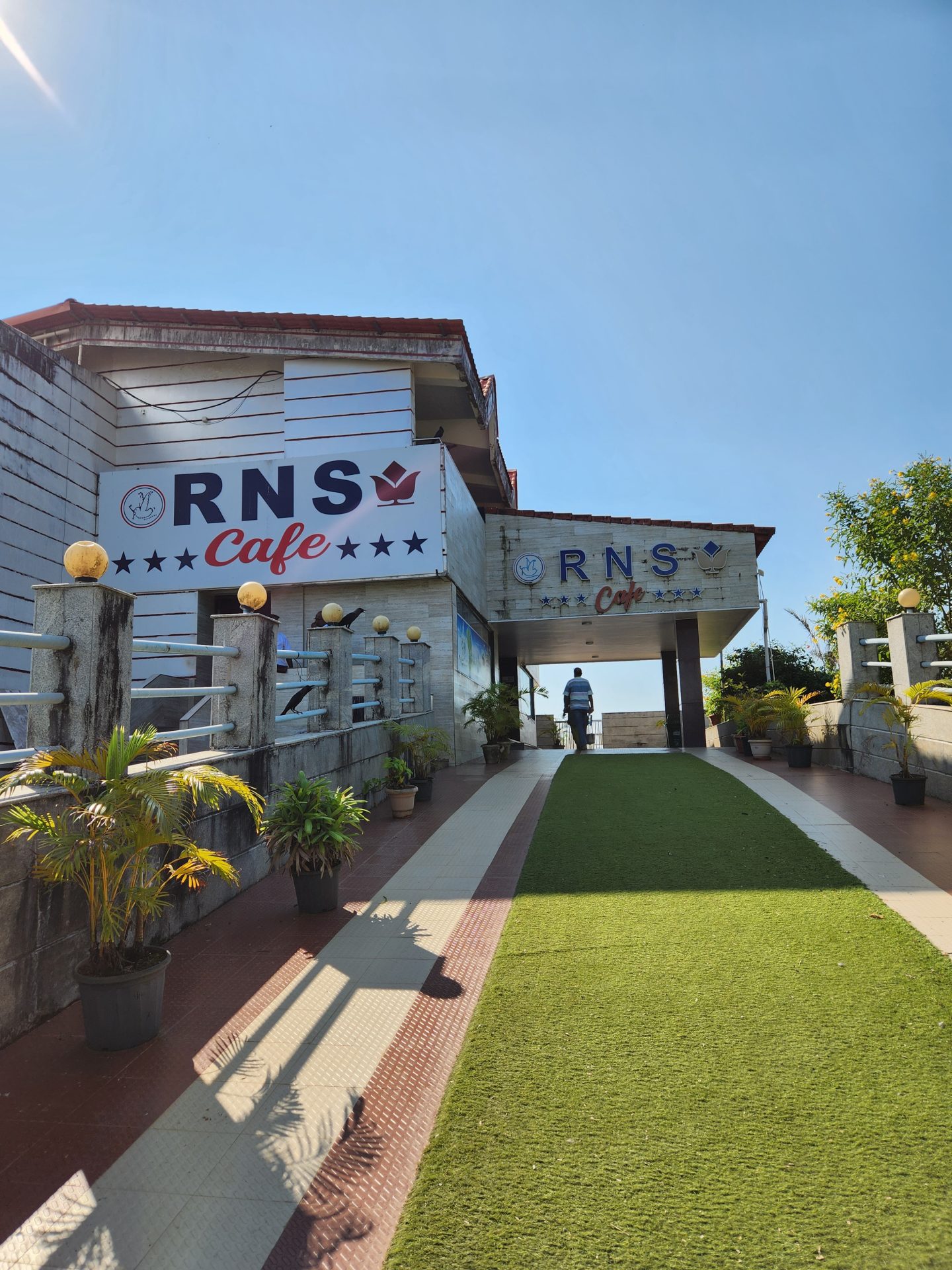
The Lift to take us to the top of the temple tower was closed and would start functioning at 3.30 and we had an hour at our disposal. We finished off our lunch at the nearby RNS Café.
Excellent food comprising of Veg Fried Rice and Noodles, some awesome strong Rasam with Plain rice and Ladies Finger Tawa Masala washed down with some Masala tea.
We entered the temple tower by around 3.30 PM and having bought the tickets for the lift for Rs.20/- per head, waited for our turn to be taken up. Excellent views from top and after spending around 15 to 20 minutes on top, we made our descent. Spent some time on the Murudeshwar beach after which we started our drive back to Mangalore around 4.15 PM.
The Maravante Beach
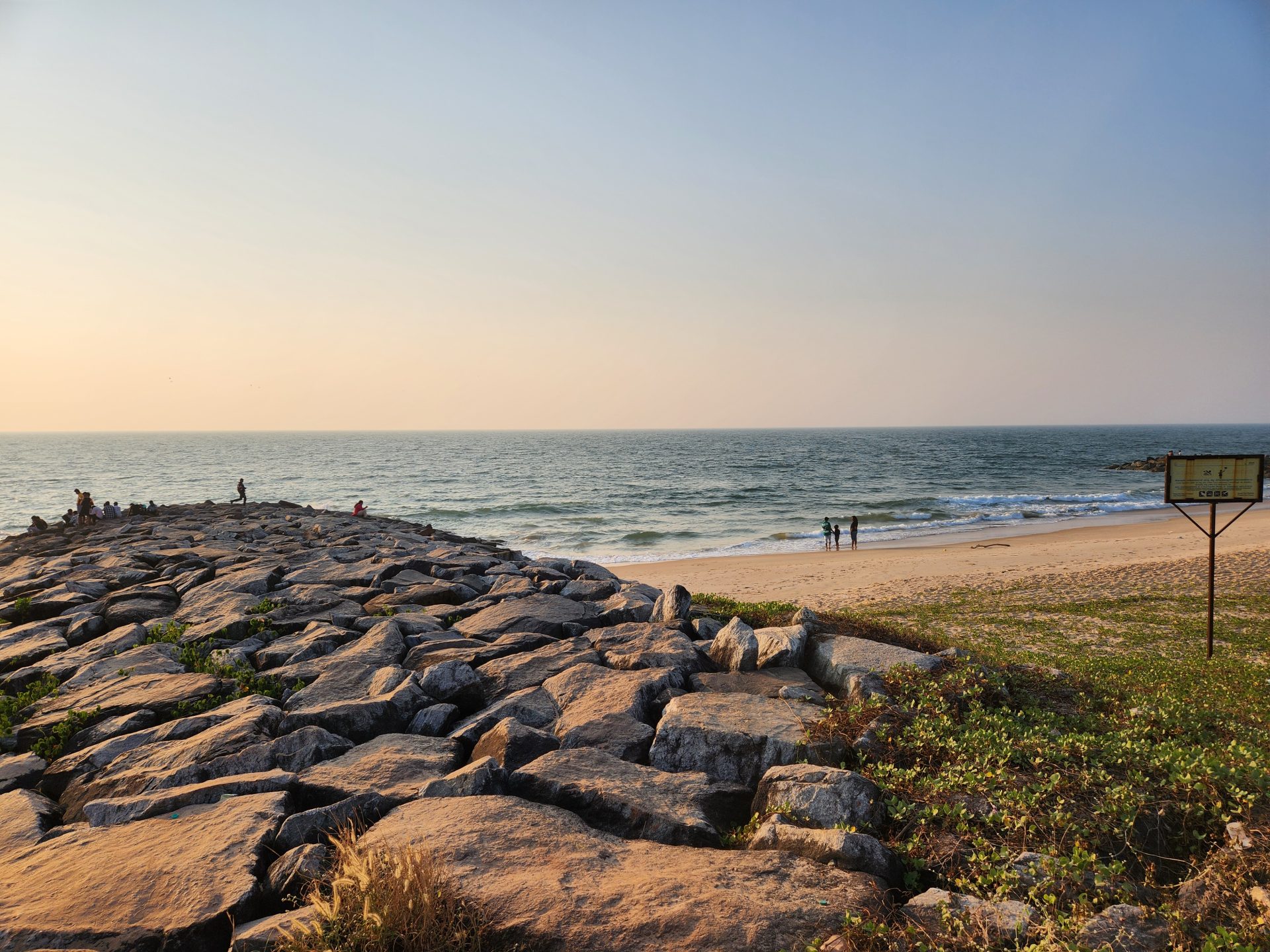
We reached the Maravante beach road at around 5.15 PM where the road has the Arabian Sea on one end and the Souparnika river following on the other side. A relatively clean but rocky beach, this place is also called the Trasi Beach.
Sunset would have taken another 30 minutes more and we did not have that much of time on our hands since we had the Anegudde Vinayak temple to also cover before reaching Mangalore.
The Anegudde Vinayak Temple
We drove on for around 25 kms and a small detour inside the town of Anegudde brought us to the Vinayak temple by around 5.40 PM. This place is also known as Kumbhashi, said to be derived from demon Kumbhasura.
The word Ane-gudde means Elephant and Hillock, and since this is one among the 7 Mukthi Sthalas and the abode of Lord Vinayak, the Elephant God, the place got its name. There were no crowds in the temple except the locals and in 15 minutes we were out of the temple.
We commenced our drive to Mangalore which was around 84 kms away by around 6 in the evening.
There was not much of traffic enroute until we crossed the coastal town of Surathkal, known for its Engineering College and beach and reached our hotel around 19.45 hours.
We had booked our stay at Hotel Metro Plaza, very close to the Railway station.
We bid adieu to Rajanikant, our driver who patiently showed us all the places we wanted to see and also suggested a few tweaks here and there so that the travel was comfortable with enough breaks.
Our 5 day package where we had the car at our complete disposal costed us Rs.20,000/-.
The cab owners Mahesh and Ritesh can be reached on 9535619911/9945548299.
Dinner was through Zomato and given the amount of driving throughout the day, we slept early.
The Metro Plaza @ Mangalore
Dec 12th 2025
This was to be our second last day of our travel and we were at Mangalore to finish visiting a few more places in and around Mangalore which were part of our original itinerary. Breakfast was at the hotel and there was a pretty decent spread which awaited us. We had plans of going to Polali, Kateel and Karkala and had planned a 9 AM start.
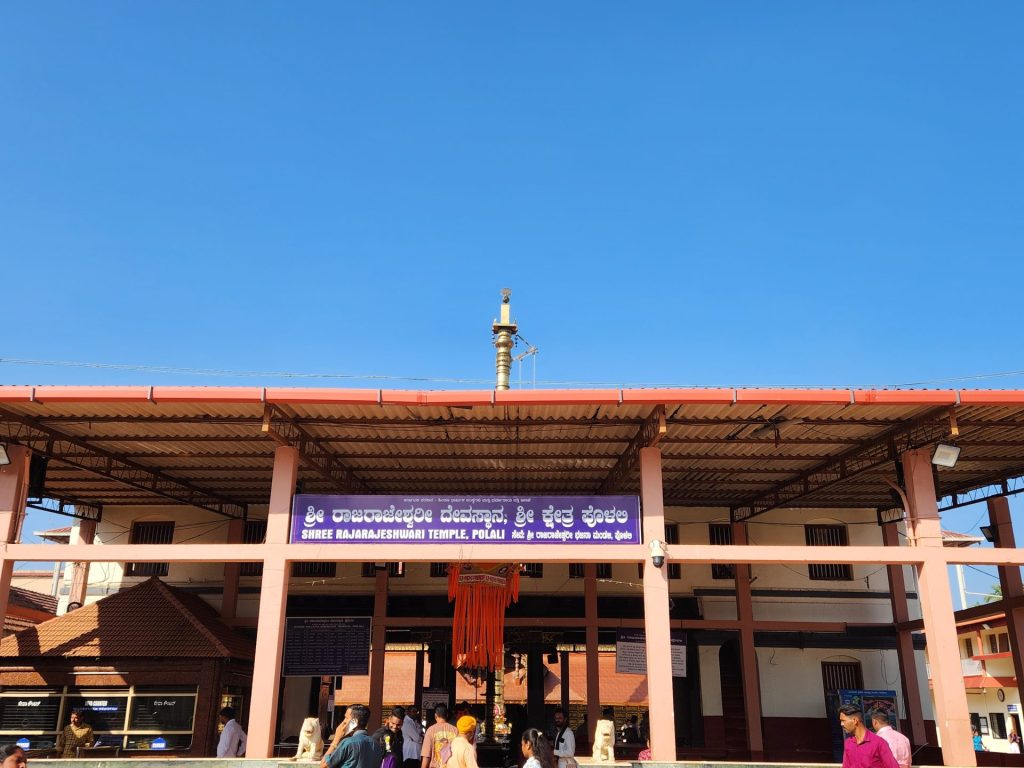
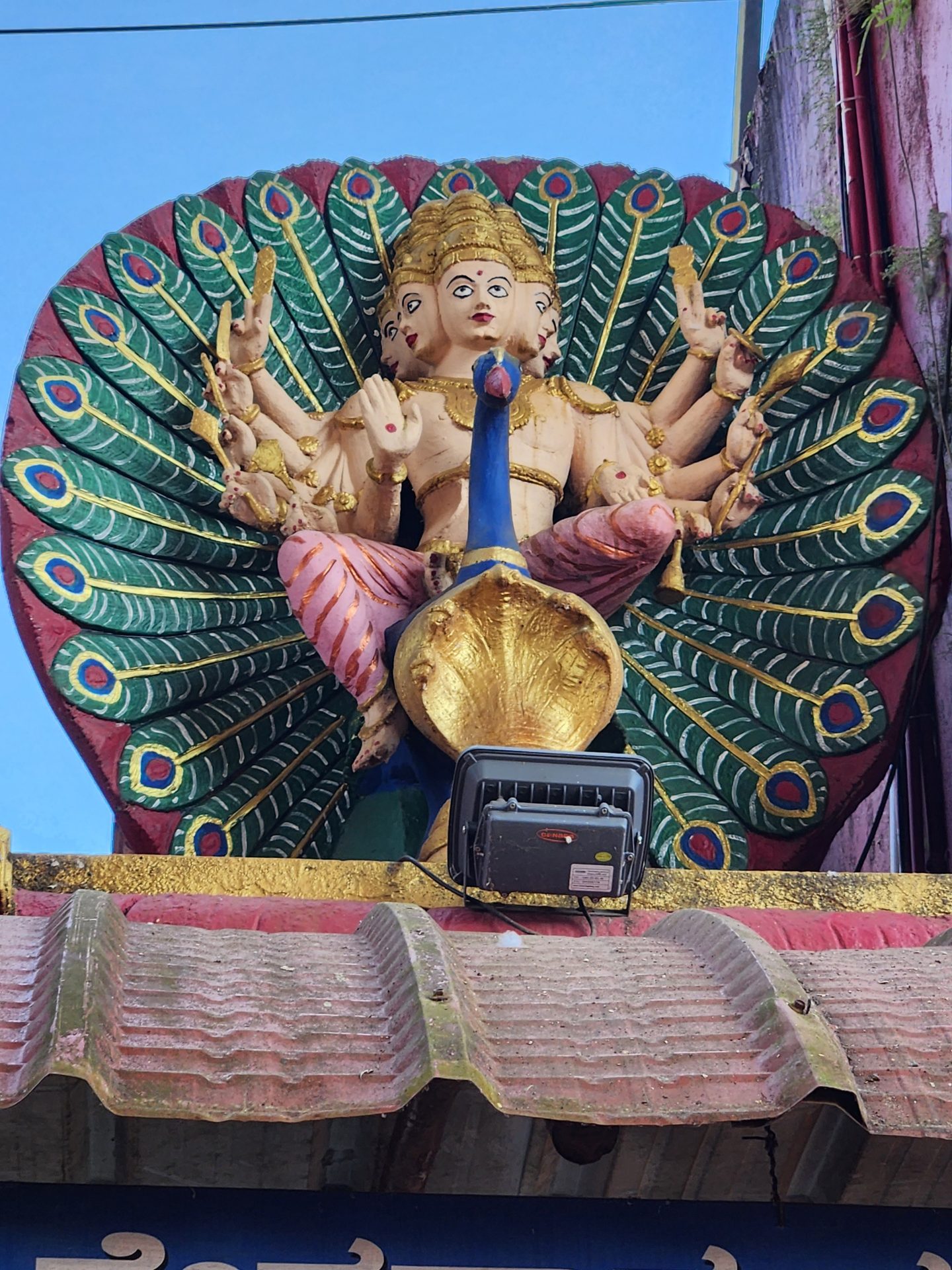
The Polali Raja Rajeshwari Temple
A 18 km drive through not so good roads and narrow stretches at certain points brought us to Polali by around 10.00 AM. The primary deity of this temple is Shri Rajarajeshwari.
Located on the banks of the river Phalguni, the temple is surrounded by lush green paddy fields.
The temple is believed to have been built in the 8th century AD by King Suratha and got further developed by many dynasties which ruled over the region.
The Goddess is also known as Tirupurasundari and the idol is completely moulded from clay with lot of medicinal properties. Its said that the king gave his crown to adorn the goddess.
Kateel was a further 22 Kms from Polali and it took us around 45 minutes to reach the Durga Parameshwari temple. Tulunadu as also what Mangalore is known as is renowned for its 7 Durga Goddesses or the Sapta Durgas.
The Durga Paramweswari can be found at Kateel, Bappanadu, Mundkut, Kunjarugiri and Chitrapura while the Raja Rajeswari temple is at Polali and the Sasihitlu Bhagavati at Mundkur.
The Kateel Durga Parameshwari Temple
Located on an islet on the banks of the river Nandini, this temple is regarded as powerful Shakthi Peetha.
Dedicated to Goddess Shakti, legend has it that the Goddess appeared in the form of a bee to kill the demon Arunasura, making it a sacred spot. Ornate Pillars and beautiful domes add to the beauty of the temple complex which also houses shrines for Lord Ganapathi, Goddess Chamundi and Lord Brahma, enhancing the sacred energy. While we reached the temple at around 10.45 AM, it took us almost an hour and fifteen minutes to complete the darshan.
The 1000 Pillar Jain Basadi Temple
We moved onto Moodbidri town located around 16 kms away and reached at around 12.30 PM.
The town of Moodbidri has 18 lakes, 18 Jain Basadis, 18 temples and 18 roads connecting the various villages in Moodbidri. This town emerged as a centre of Jain religion, culture, art and architecture during the 14th to 16th centuries.
Our first stop was at the 1000 Pillar Jain Basadi temple. Also known as the Tribhuvana Tilaka Chudamani Basadi, this is a majestic and highly significant temple.
This 15th century structure, revered to as the Jain Kashi of the South has 1000 exquisitely carved Pillars, none of which are identical to each other.
The temple took 31 years to complete and is dedicated to the 8th Jain Thirthankara, Chandraprabha. The idol is 8 feet tall and is made out of bronze. There is an 45 feet tall ornate Monolithic Flag Post in front of the main entrance.
The Chaturmukha Jaina Basadi
We moved on next to Karkala 18 kms away and reached there by around 13.30 hours The Anekere Chaturmukha Basadi located in the middle of a lake was closed since it was lunch time. Nobody was around but the timings on the board indicated 15.30 hours.
We passed by the Chaturmukha Jaina Basadi and to our surprise, we found a person standing right at the top of the steps. We decided to go ahead and check out the place and to our luck he happened to be a kind of caretaker who volunteered to show us around the temple.
There are 4 symmetrical faces with images of Tirthankara, Aranth, Mallinath and Munisuvratnath and the Basadi is made completely out of granite rocks. The temple faces the famous Karkala Bahubali statue which was installed in the year 1432 by Veera Pandya of the Santara dynasty, The outside of the temple has carvings of gods and goddesses from Hindu Mythology. During the Equinox day on March 21st, one of the sides amongst the 4 turns completely red when the sun rays fall on it.
We then headed for lunch to the outskirts after some search on the net and discovered that the Sagar Ratna where we had breakfast earlier on our way to Horanadu, was located very close by. A quick lunch ensured and we made our way back by around 3.30 PM to the Anekere Chaturmukha Basadi.
The Anekere Chaturmukha Basadi
The temple is located right in the middle of the Anekere lake and incorporates a dual level design, showcasing intricate workmanship and based on the Hoysala Ganga architecture. The Upper Level houses the idol of Parswanath Swami, the 23td Tirthankara while the lower level enshrines multiple revered deities including Adinath Swami and Mahavira Swami. The lake was historically used for bathing elephants.
The Karkala Gomateshwara Statue
We then moved onto the Karkala Gomateshwara statue located around 2 Kms from the lake. The car took us right to the top of the Gommata Betta hill where a towering 42 feet monolithic statue of the Jain deity Bahubali could be seen. Built in 1432 CE by King Veera Pandya, this is the 2nd tallest Bahubali statue in the state.
The statue has a serene smiling face with long arms and elongated ears. The Maha Masthakaabhisheka festival is held every 12 years when the statue of bathed with Saffron, Milk and Water. We left Karkala by around 4.30 in the evening and headed back for Mangalore.
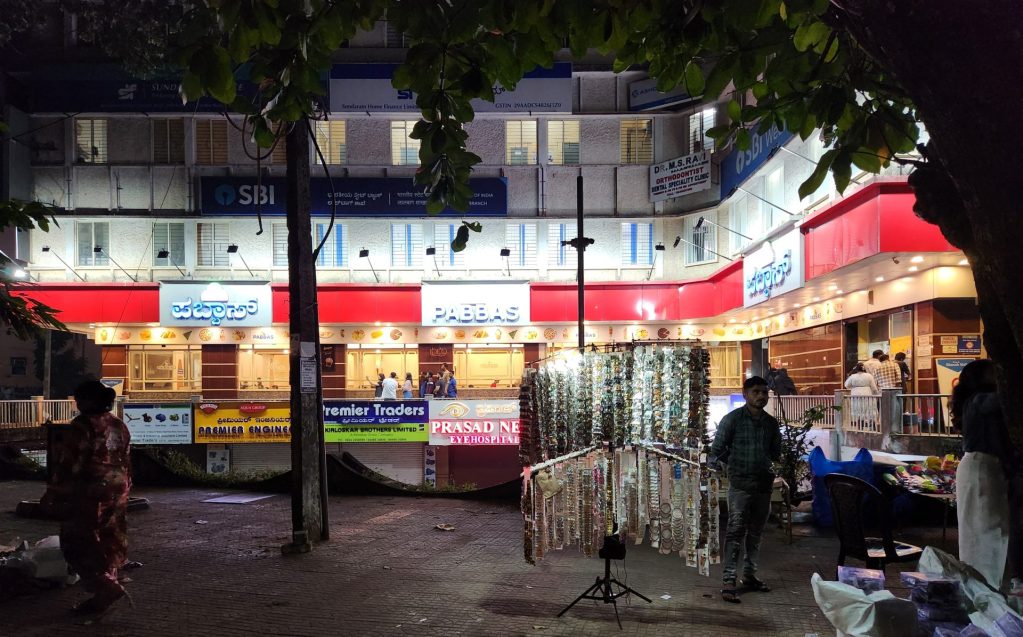
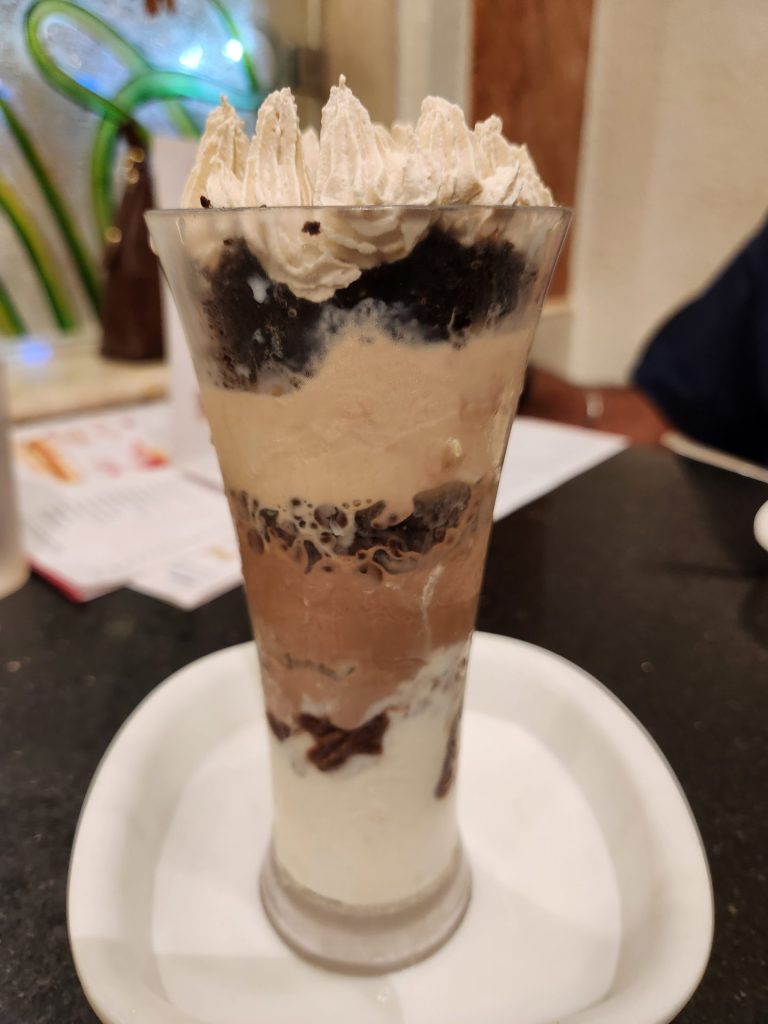
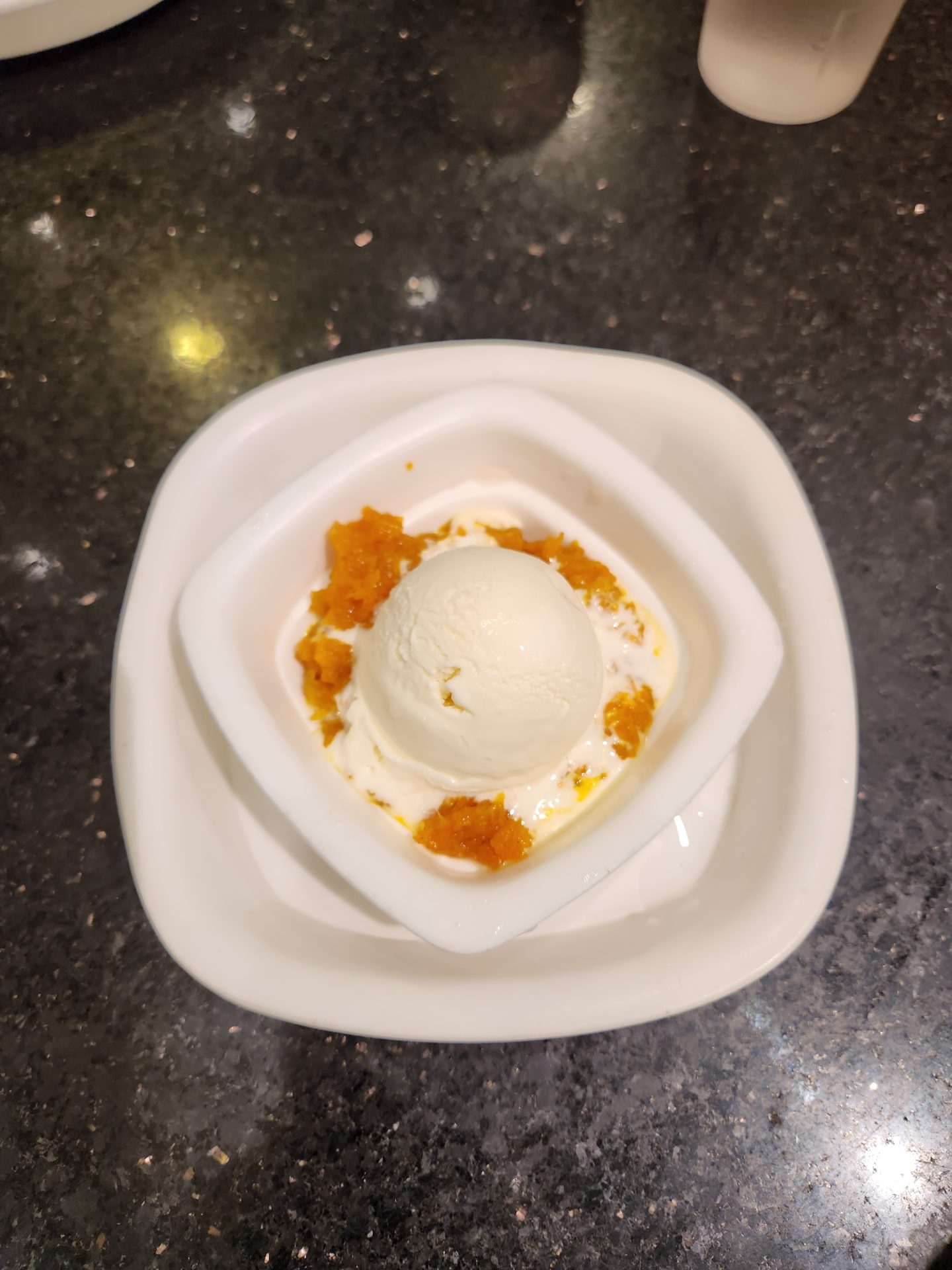
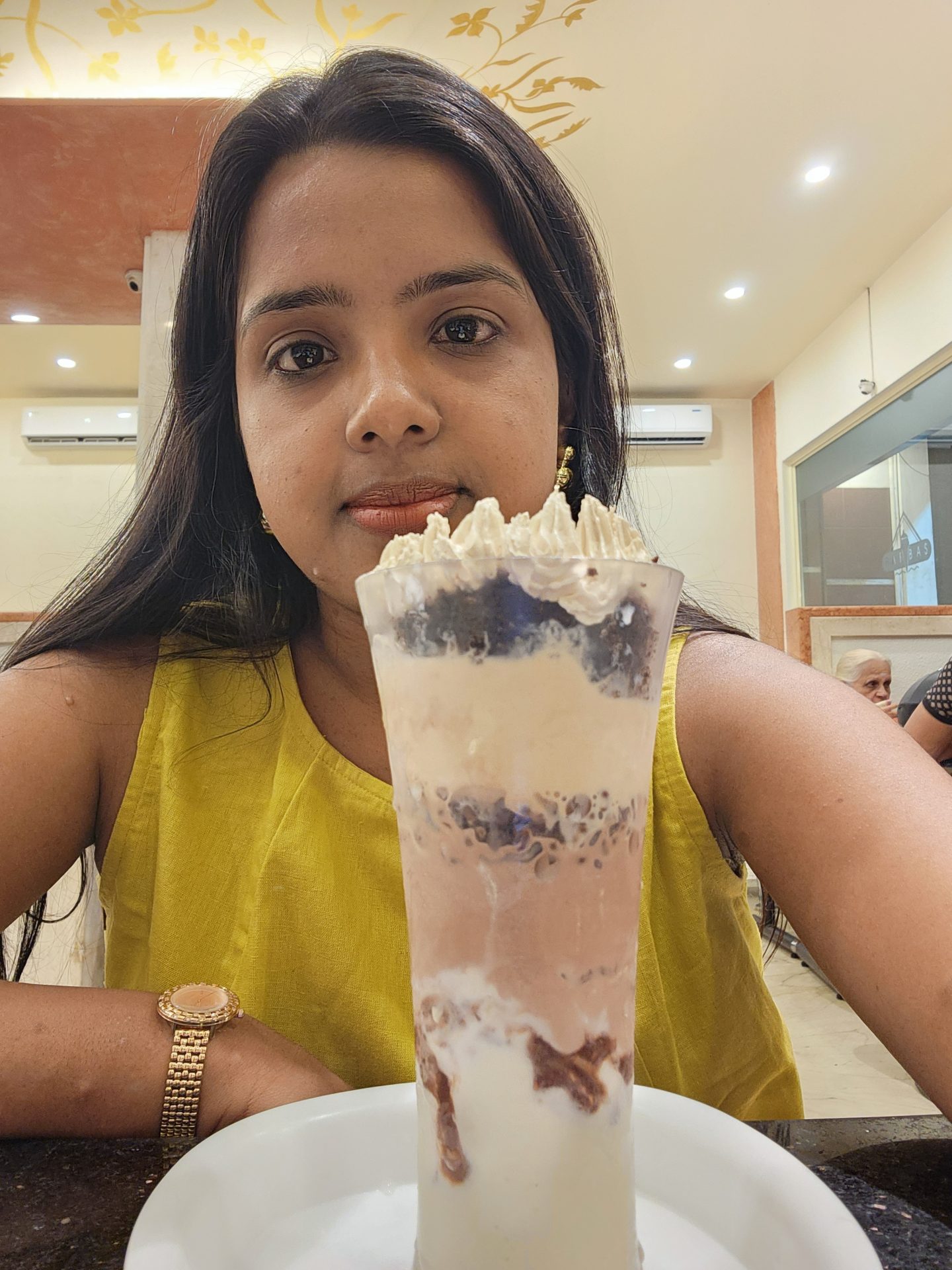
After reaching our hotel, we went to a nearby restaurant for some tea. The plan was to binge on Ice Creams @ Pabbas and we started 19.45 PM. A 15 minute ride brought us to Pabbas. The ice creams looked very tempting on the Menu Card and the next 45 minutes was spent diving into a wide assortment of ice creams.
This included the famed Gadbad ice cream and their cutlets. We reached our hotel back at around 9.30 PM, the stomachs absolutely full. We had nothing planned the next day which was to be our day of departure to Chennai except for some shopping around.
Pizzas @ Pabbas
Dec 13th 2025
We had finished our packing the previous night itself and after breakfast at the hotel, we checked out of the hotel around 11 AM and kept our luggage at the reception itself.
Some Random Sightings@Mangalore
The plan was to go around the city aimlessly as well as shop for some cashews and see the Central Markets.
At 11.00 AM, we headed for the Phalguni Cashew Centre, famed for its assortment of cashews and sweets made out of cashew.
We then left for Chutneys restaurant, located in Hotel Devi Comforts. Some great food followed and we were back at the hotel by around 2.30 PM
After spending an hour in the hotel lobby, we left for the Mangalore Central station, located around 200 to 300 metres from our hotel. We had packed some food from Chutneys since we were not sure on what would be available enroute the train journey.





































































































































































Wonderful glimpses and
Lovely detailed coverage. Looks like I went for a virtual trip !!Amazing pictures too.